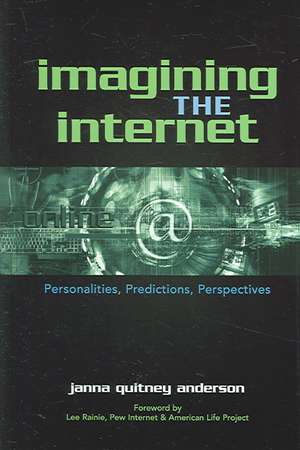
Imagining the Internet: Personalities, Predictions, Perspectives
Autor Janna Quitney Anderson Cuvânt înainte de Lee Rainieen Limba Engleză Hardback – 21 iul 2005
Visit www.elon.edu/predictions/ to view a comprehensive database that forms the investigative basis for this book.
Preț: 678.04 lei
Preț vechi: 1004.75 lei
-33%
Puncte Express: 1017
Carte tipărită la comandă
Livrare economică 27 noiembrie-11 decembrie
Livrare prin curier în România Termenul estimat este afișat lângă disponibilitate.
Transport gratuit pentru acest produs Plată online sau ramburs, în funcție de opțiunile comenzii.
Retur gratuit în 14 zile Comandă securizată și suport în română.
Specificații
ISBN-13: 9780742539365
ISBN-10: 0742539369
Pagini: 307
Dimensiuni: 160 x 235 x 28 mm
Greutate: 0.53 kg
Editura: Bloomsbury Publishing
Colecția Rowman & Littlefield
Locul publicării:New York, United States
ISBN-10: 0742539369
Pagini: 307
Dimensiuni: 160 x 235 x 28 mm
Greutate: 0.53 kg
Editura: Bloomsbury Publishing
Colecția Rowman & Littlefield
Locul publicării:New York, United States
Cuprins
Chapter 1 Introduction
Chapter 2 1 The Internet at the Forefront
Chapter 3 2 From Bonfires and Bongos to the Web
Chapter 4 3 Web Gems
Chapter 5 4 The "Highway" Metaphor
Chapter 6 5 Knocking the Net
Chapter 7 6 Saddam, O.J., and the Unabomber
Chapter 8 7 Nothing is Certain but Death and Taxes
Chapter 9 8 Aristotle, Jefferson, Marx, and McLuhan
Chapter 10 9 Supporters Crow about "500 Channels" and Everyone Warns about "Infoglut"
Chapter 11 10 Voices of the Net
Chapter 12 11 The Threat to Freedom; to the Earth
Chapter 13 12 The Future of Networks
Chapter 14 13 Nobody Knows You're a Dog
Chapter 15 14 Hmmm...Will it Happen?
Chapter 16 Appendix A: Wired Inspired
Chapter 17 Appendix B: Recording the Data
Chapter 18 Suggested Readings
Chapter 19 Bibliography
Chapter 2 1 The Internet at the Forefront
Chapter 3 2 From Bonfires and Bongos to the Web
Chapter 4 3 Web Gems
Chapter 5 4 The "Highway" Metaphor
Chapter 6 5 Knocking the Net
Chapter 7 6 Saddam, O.J., and the Unabomber
Chapter 8 7 Nothing is Certain but Death and Taxes
Chapter 9 8 Aristotle, Jefferson, Marx, and McLuhan
Chapter 10 9 Supporters Crow about "500 Channels" and Everyone Warns about "Infoglut"
Chapter 11 10 Voices of the Net
Chapter 12 11 The Threat to Freedom; to the Earth
Chapter 13 12 The Future of Networks
Chapter 14 13 Nobody Knows You're a Dog
Chapter 15 14 Hmmm...Will it Happen?
Chapter 16 Appendix A: Wired Inspired
Chapter 17 Appendix B: Recording the Data
Chapter 18 Suggested Readings
Chapter 19 Bibliography
Recenzii
Janna Anderson offers a great perspective on the history and future of the Internet based on Elon University/Pew Internet & American Life Project's extensive prediction collection. Good books come from thorough research. Starting with the earliest communications systems, such as the telegraph, is a useful bonus. Being a part of and having the last word in this fine past-and-future Internet chronicle is a real honor....
Janna Anderson illuminates with great clarity the history, dreams, and challenges of the Internet, which allow the reader to see glimpses of the future. A wonderful and important contribution.
There are many books on the Internet and cyberculture-part hype, part gloss, sometimes solid technology criticism. Anderson's book is valuable because it helps sort out differing viewpoints and puts them in a historical context, recreating many of the ups and downs of the 1990s, before things got really crazy. She has an amazing database of predictions, collected over time, and selects from it well. This book is never dense reading, but it is packed with interesting facts and milestones to jar my memory, to help me recreate what that time was like, because the subtle changes are what have worked us over so thoroughly. My favorite part in these excursions into the words of technology prophets and critics is picking out the threads that had an influence-that helped shape the larger visions of what this massive commons has become.
Anderson provides a variety of perspectives on contested issues such as privacy on the Internet, personal identity online, and 'information overload.' Anderson's knowledge is encyclopedic, and her accessible, jargon-free style will engage professors and researchers without alienating undergraduates. Highly recommended.
[Imagining the Internet] looks at the future through an analysis of the past. It is somewhat difficult after becoming immersed in these insights to remember that Internet communication began with the utmost diffidence. Indeed the first events involved a computer crash and unmemorable twaddle. . . . We hope that this material will be useful to scholars who wish to assess the distance we have come; journalists who are trying to figure out where we are now; government, industry, and nonprofit officials who want to build the Internet of the future; and people of all walks of life who must learn to recognize the coming complexities of their networked world.
Janna Anderson illuminates with great clarity the history, dreams, and challenges of the Internet, which allow the reader to see glimpses of the future. A wonderful and important contribution.
There are many books on the Internet and cyberculture-part hype, part gloss, sometimes solid technology criticism. Anderson's book is valuable because it helps sort out differing viewpoints and puts them in a historical context, recreating many of the ups and downs of the 1990s, before things got really crazy. She has an amazing database of predictions, collected over time, and selects from it well. This book is never dense reading, but it is packed with interesting facts and milestones to jar my memory, to help me recreate what that time was like, because the subtle changes are what have worked us over so thoroughly. My favorite part in these excursions into the words of technology prophets and critics is picking out the threads that had an influence-that helped shape the larger visions of what this massive commons has become.
Anderson provides a variety of perspectives on contested issues such as privacy on the Internet, personal identity online, and 'information overload.' Anderson's knowledge is encyclopedic, and her accessible, jargon-free style will engage professors and researchers without alienating undergraduates. Highly recommended.
[Imagining the Internet] looks at the future through an analysis of the past. It is somewhat difficult after becoming immersed in these insights to remember that Internet communication began with the utmost diffidence. Indeed the first events involved a computer crash and unmemorable twaddle. . . . We hope that this material will be useful to scholars who wish to assess the distance we have come; journalists who are trying to figure out where we are now; government, industry, and nonprofit officials who want to build the Internet of the future; and people of all walks of life who must learn to recognize the coming complexities of their networked world.