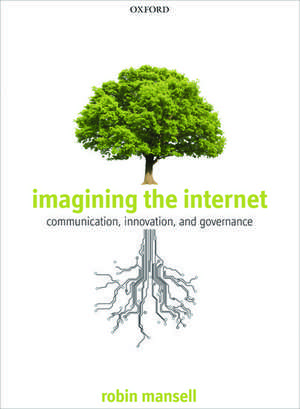
Imagining the Internet: Communication, Innovation, and Governance
Autor Robin Mansellen Limba Engleză Hardback – 12 iul 2012
Preț: 784.74 lei
Preț vechi: 1019.91 lei
-23%
Puncte Express: 1177
Carte tipărită la comandă
Livrare economică 10-16 decembrie
Livrare prin curier în România Termenul estimat este afișat lângă disponibilitate.
Transport gratuit pentru acest produs Plată online sau ramburs, în funcție de opțiunile comenzii.
Retur gratuit în 14 zile Comandă securizată și suport în română.
Specificații
ISBN-13: 9780199697045
ISBN-10: 0199697043
Pagini: 310
Ilustrații: Figures and tables
Dimensiuni: 163 x 241 x 24 mm
Greutate: 0.64 kg
Ediția:New.
Editura: OUP OXFORD
Colecția OUP Oxford
Locul publicării:Oxford, United Kingdom
ISBN-10: 0199697043
Pagini: 310
Ilustrații: Figures and tables
Dimensiuni: 163 x 241 x 24 mm
Greutate: 0.64 kg
Ediția:New.
Editura: OUP OXFORD
Colecția OUP Oxford
Locul publicării:Oxford, United Kingdom
V-ar putea interesa
-
 The Net DelusionEvgeny MorozovPreț: 136.00 lei
 -
 The Infinite AlphabetCésar A. HidalgoPreț: 191.23 lei
 -
 Declaring Independence in CyberspaceMilton L. Mueller-20%Preț: 307.09 lei383.86 lei
 -
 The Master SwitchTim WuPreț: 137.44 lei
 -
 Encyclopedia of New MediaSteve Jones-9%Preț: 1028.24 lei1129.94 lei
 -
 -26%Preț: 68.27 lei92.57 lei
 -
 Brockman (Ed.), J: How is the Internet Changing the Way YouJohn Brockman (Ed.)-17%Preț: 88.63 lei106.95 lei
 -
 AI First, Human AlwaysSandy CarterPreț: 132.84 lei
 -
 Silicon EmpiresNick SrnicekPreț: 108.04 lei
 -
 Digital DegrowthNeil SelwynPreț: 79.12 lei
 -
 The Dark Forest Theory of the InternetBogna KoniorPreț: 86.72 lei
 -
 -25%Preț: 53.65 lei71.93 lei
 -
 Internet Policies & Issues: Volume 8B G Kutais-35%Preț: 1269.46 lei1964.74 lei
 -
 International Communication: Continuity and ChangeDaya Kishan Thussu-24%Preț: 191.87 lei251.68 lei
 -
 MiddlelandRory StewartPreț: 159.93 lei
 -
 The Internet ConCory DoctorowPreț: 84.03 lei
 -
 Cybernetic Circulation ComplexNick Dyer-WithefordPreț: 129.05 lei
 -
 The Information AnimalAlicia WanlessPreț: 242.32 lei
 -
 EnshittificationCory DoctorowPreț: 170.65 lei
Recenzii
Imagining the Internet is a thorough and documented analysis of the political conflicts and policy debates surrounding the design and governance of the communication networks of our lives. Robin Mansell is an authority in the field of communication technology studies and this book brings together a coherent argument of her seminal contributions to the understanding of the Internet. Mandatory reading for communication, business strategists, and policy-making scholars alike.
Imagining the Internet provides perceptive, technologically, and institutionally savvy perspectives on current socially shared conceptualizations of the evolving Internet and its implications for the lives of individuals, the fortunes of business companies, and the future of societies. Mansell's exposure and analysis of the contending particular interests that have embraced, and shaped alternative visions of the Web and the Information Society's futures makes this book "a must read" for students of contemporary social communications and thoughtful policy-makers in the public and private sectors alike.
Robin Mansell's Imagining the Internet comes at exactly the right moment. The world is being transformed by digital communication yet for many of us, it is difficult to understand what exactly is happening and why. Imagining the Internet cuts through the hot air, providing a valuable perspective as well as a sense of the great policy issues that will define the Internet going forward.
Imaging the Internet arrives at a critical moment in Internet timejust when breath-taking national policy initiatives are being introduced in ways that could reshape freedom of expression, privacy, and other core communication values that underpin the vitality of network societies around the world. Robin Mansell brings her critical insights on the social and economic roles of media, information, and communication technologies to bear on major issues for policy and practice. It is must reading for students, communication professionals, and policy-makers who will value her original synthesis of a wide range of multi-disciplinary research. The book effectively challenges and reconciles conflicting viewpoints in ways that can guide innovation in technology, governance, and policy for a good society in the coming Internet age.
A perfect book
Imagining the Internet provides perceptive, technologically, and institutionally savvy perspectives on current socially shared conceptualizations of the evolving Internet and its implications for the lives of individuals, the fortunes of business companies, and the future of societies. Mansell's exposure and analysis of the contending particular interests that have embraced, and shaped alternative visions of the Web and the Information Society's futures makes this book "a must read" for students of contemporary social communications and thoughtful policy-makers in the public and private sectors alike.
Robin Mansell's Imagining the Internet comes at exactly the right moment. The world is being transformed by digital communication yet for many of us, it is difficult to understand what exactly is happening and why. Imagining the Internet cuts through the hot air, providing a valuable perspective as well as a sense of the great policy issues that will define the Internet going forward.
Imaging the Internet arrives at a critical moment in Internet timejust when breath-taking national policy initiatives are being introduced in ways that could reshape freedom of expression, privacy, and other core communication values that underpin the vitality of network societies around the world. Robin Mansell brings her critical insights on the social and economic roles of media, information, and communication technologies to bear on major issues for policy and practice. It is must reading for students, communication professionals, and policy-makers who will value her original synthesis of a wide range of multi-disciplinary research. The book effectively challenges and reconciles conflicting viewpoints in ways that can guide innovation in technology, governance, and policy for a good society in the coming Internet age.
A perfect book
Notă biografică
Robin Mansell is Professor of New Media and the Internet in the Department of Media and Communications, London School of Economics and Political Science. Her work focuses on the social, economic, and political issues arising from new information and communication technologies, the integration of new media into society, and sources of governance effectiveness and failure. She was Head of the Media and Communications Department at the London School of Economics (2006-2009) and President of the International Association for Media and Communication Research (2004-2008).