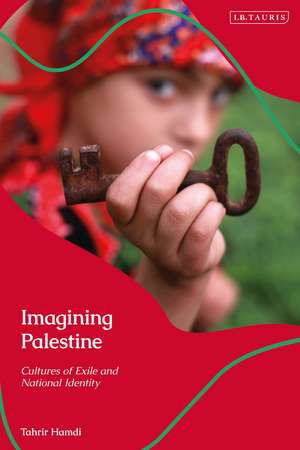
Imagining Palestine: Cultures of Exile and National Identity
Autor Tahrir Hamdien Limba Engleză Paperback – 27 iun 2024
All national identities are somewhat fluid, held together by collective beliefs and practices as much as official territory and borders. In the context of the Palestinians, whose national status in so many instances remains unresolved, the articulation and 'imagination' of national identity is particularly urgent. This book explores the ways that Palestinian intellectuals, artists, activists and ordinary citizens 'imagine' their homeland, examining the works of key Palestinian and other thinkers and writers such as Edward Said, Ghassan Kanafani, Naji Al Ali, Mahmoud Darwish, Mourid Barghouti, Radwa Ashour, Suheir Hammad, and Susan Abulhawa. Deploying decolonial and resistance concepts, such as Palestinian sumud, Tahrir Hamdi argues that the imaginative construction of Palestine is a key element in the Palestinians' ongoing struggle. An interdisciplinary work drawing upon critical theory, postcolonial and decolonial studies and literary analysis, this book will be of interest to students and scholars of Palestine and Middle East studies and Arabic literature.
Preț: 212.71 lei
Preț vechi: 293.63 lei
-28%
Puncte Express: 319
Carte tipărită la comandă
Livrare economică 01-15 decembrie
Livrare prin curier în România Termenul estimat este afișat lângă disponibilitate.
Transport gratuit de la 400.00 lei Plată online sau ramburs, în funcție de opțiunile comenzii.
Retur gratuit în 14 zile Comandă securizată și suport în română.
Specificații
ISBN-13: 9780755649419
ISBN-10: 0755649419
Pagini: 248
Dimensiuni: 153 x 232 x 18 mm
Greutate: 0.38 kg
Editura: Bloomsbury Publishing
Colecția I.B.Tauris
Locul publicării:London, United Kingdom
ISBN-10: 0755649419
Pagini: 248
Dimensiuni: 153 x 232 x 18 mm
Greutate: 0.38 kg
Editura: Bloomsbury Publishing
Colecția I.B.Tauris
Locul publicării:London, United Kingdom
V-ar putea interesa
-
 Environmental Management In Tropical AgricultureRobert Goodland-18%Preț: 1112.48 lei1356.68 lei
 -
 -18%Preț: 1121.09 lei1367.19 lei
 -
 IcelandMarcel Krueger-41%Preț: 101.18 lei172.57 lei
 -
 Preț: 72.65 lei
 -
 Deux Bretons. Tome 6Xavier De MontépinPreț: 177.30 lei
 -
 Une femme d'argentHector MalotPreț: 184.83 lei
 -
 Oeuvres de Chateaubriand. PolémiqueFrançois-René De ChateaubriandPreț: 161.69 lei
 -
 Oeuvres Complètes de M. A. de Lamartine. Tome 3 JocelynAlphonse De LamartinePreț: 223.41 lei
 -
 Oeuvres Complètes de M. A. de Lamartine. Tome 4 La Chute d'Un AngeAlphonse De LamartinePreț: 224.18 lei
 -
 Les Nuits italiennes, contes nocturnes (Éd.1853)Joseph MéryPreț: 185.51 lei
 -
 Oeuvres Illustrées. Le Trou de l'EnferAlexandre DumasPreț: 116.07 lei
 -
 Romans Populaires Illustrés. Le Dernier Des MohicansJames Fenimore CooperPreț: 90.51 lei
 -
 Oeuvres. Paula MontiEugène SuePreț: 177.39 lei
 -
 Oeuvres choisies de Molière, nouvelle édition précédée d'une noticeJean-Baptiste Molière (Poquelin Dit)Preț: 169.26 lei
 -
 Preț: 230.72 lei
 -
 Preț: 231.07 lei
 -
 Oeuvres Illustrées. Les Mille Et Un Fantômes Pascal BrunoAlexandre DumasPreț: 115.91 lei
 -
 Preț: 177.56 lei
 -
 Paul Jones: Drame En 5 ActesAlexandre DumasPreț: 79.38 lei
Cuprins
Introduction
List of Figures
1. The Restless Spirit: Palestine Theorized
2. Exile is the World Inside: the Poetry of Resistance and Solidarity
3. Writing Self, Writing Nation in the Memoir and the Novel: Palestine Narrated
4. Writings on the Wall
Conclusion. Continuing the Conversation: Palestine, a Living Cause
List of Figures
1. The Restless Spirit: Palestine Theorized
2. Exile is the World Inside: the Poetry of Resistance and Solidarity
3. Writing Self, Writing Nation in the Memoir and the Novel: Palestine Narrated
4. Writings on the Wall
Conclusion. Continuing the Conversation: Palestine, a Living Cause
Recenzii
With elegant prose and insightful ideas, Tahrir Hamdi has written a theoretical work that will be of interest to students and scholars of Palestine and Middle East studies and Arabic literature. However, because she emphasizes that transformation of theory into action, her book belongs on the shelf of everyone who is participating in the solidarity movement, partly because she thoroughly explains what it means to act in solidarity but also because her prose counters defeatist attitudes with a blueprint for victory.
What is so brilliant about this book is that it links the human approach by so many of the Palestinians discussed here to the same paradoxical epistemo-logical and moral questions: navigating between their universal values, unconditional commitment to the liberation of Palestine, and their particular mode of expression. Such navigation is at the heart of the "Theory of Palestine."
This book could only be written by Tahrir Hamdi, an esteemed literary scholar from a family rooted in Palestinian resistance politics. Hamdi here models Said's 'intransigent' intellectual, demanding irresistibly that postcolonial studies reclaim its radical roots and, in accounting for Palestine, realign with decolonial politics.
Tahrir Hamdi's perspicacious interrogation of works of major Palestinian literary figures and international solidarity poets, concretizes ideas of RETURN, as the Palestinian imaginary. RETURN presupposes the dismantling of Zionist institutions in the process of liberation to build a democratic Palestinian state.
What is so brilliant about this book is that it links the human approach by so many of the Palestinians discussed here to the same paradoxical epistemo-logical and moral questions: navigating between their universal values, unconditional commitment to the liberation of Palestine, and their particular mode of expression. Such navigation is at the heart of the "Theory of Palestine."
This book could only be written by Tahrir Hamdi, an esteemed literary scholar from a family rooted in Palestinian resistance politics. Hamdi here models Said's 'intransigent' intellectual, demanding irresistibly that postcolonial studies reclaim its radical roots and, in accounting for Palestine, realign with decolonial politics.
Tahrir Hamdi's perspicacious interrogation of works of major Palestinian literary figures and international solidarity poets, concretizes ideas of RETURN, as the Palestinian imaginary. RETURN presupposes the dismantling of Zionist institutions in the process of liberation to build a democratic Palestinian state.