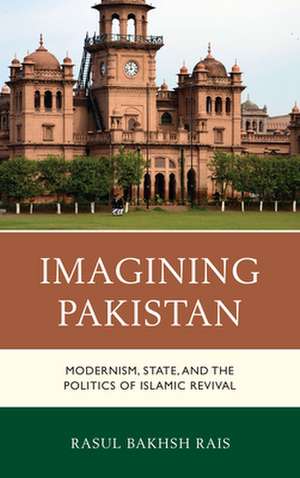
Imagining Pakistan: Modernism, State, and the Politics of Islamic Revival
Autor Rasul Bakhsh Raisen Limba Engleză Paperback – 13 sep 2019
Preț: 285.06 lei
Preț vechi: 388.40 lei
-27%
Puncte Express: 428
Carte tipărită la comandă
Livrare economică 18 noiembrie-02 decembrie
Livrare prin curier în România Termenul estimat este afișat lângă disponibilitate.
Transport gratuit de la 400.00 lei Plată online sau ramburs, în funcție de opțiunile comenzii.
Retur gratuit în 14 zile Comandă securizată și suport în română.
Specificații
ISBN-13: 9781498553971
ISBN-10: 1498553974
Pagini: 234
Dimensiuni: 150 x 221 x 17 mm
Greutate: 0.35 kg
Editura: Bloomsbury Publishing
Colecția Lexington Books
Locul publicării:New York, United States
ISBN-10: 1498553974
Pagini: 234
Dimensiuni: 150 x 221 x 17 mm
Greutate: 0.35 kg
Editura: Bloomsbury Publishing
Colecția Lexington Books
Locul publicării:New York, United States
Cuprins
Chapter 1: Introduction
Chapter 2: Islam and the State
Chapter 3: Modernism and Imagining of Pakistan
Chapter 4: Erosion of Modernist Tradition
Chapter 5: State in Decline
Chapter 6: The Politics of Islamic Revival
Chapter 7: The Struggle Within
Chapter 8: Conclusion: Reviving the State and Society
Chapter 2: Islam and the State
Chapter 3: Modernism and Imagining of Pakistan
Chapter 4: Erosion of Modernist Tradition
Chapter 5: State in Decline
Chapter 6: The Politics of Islamic Revival
Chapter 7: The Struggle Within
Chapter 8: Conclusion: Reviving the State and Society
Recenzii
Rais (Lahore Univ. of Management Sciences, Pakistan) provides expert insight into the current problems and challenges facing Pakistan, and how to address them. He argues that long periods of military rule, dynastic political parties, and extremist Islamist groups have been responsible for the country's deviation from its founding fathers' vision of a progressive, constitutional, pluralistic, and modern democracy, compatible with the values of Islam. Despite the weakness of state institutions, poor governance, political violence, corruption, and ethnic and religious polarization, the author believes there is hope for a better future. However, nothing short of a comprehensive national reform agenda is needed to bring about change. The strength of the work is reflected in the author's highlighting of the struggle between the forces of modernism, represented by a growing middle-class, robust civil society, and independent print and broadcast media, and the forces of traditionalism, represented by feudal oligarchism, praetorianism, and religious extremism. The results of this struggle will ultimately determine whether Pakistan will return to the values cherished by the country's founders. Summing Up: Recommended. Upper-division undergraduates through faculty.
Here, at last, is a solidly researched study about Pakistan that does not blame its Indian neighbor for the country's ills, that does not consider the Islamic faith of its people an implacable obstacle to modernity, and that finds plentiful signs that the country's democratic institutions, in spite of the battering they have taken from the country's military leaders, have ample capacity to revive the liberal and pluralist ideals of Pakistan's founding fathers. Refreshingly and knowledgeably optimistic about a nation that has for too long been a poster child for political dysfunctionality, this is an important book about an important country that will soon rank as the most populous Muslim state on the planet.
An important contribution by a seasoned scholar of Pakistan, this well-written and accessible study will invigorate discussions about the competing visions of the country as an apparently modern, democratic state conceived by its founders and as a conservative, illiberal one preferred by radical Islamists. It should be of interest to anyone who cares about the future of Pakistan, but also to those who are interested in how contestation over national identity shapes the struggle for pluralism and democracy in a state historically dominated by a praetorian military.
For a careful diagnosis of what has gone wrong with Pakistan, this is the book to read. With clarity and insight, Rasul Bakhsh Rais reveals how its ills can be largely traced to the state's having strayed far from realizing its founding democratic ideals. Yet he also offers a hopeful prognosis in envisioning how the country could reclaim its liberal, progressive inheritance. Similarly, while describing how radical Islamic elements have seriously challenged Pakistan's modernization and Western political ideas of constitutionalism, Rais finds hope that through domestic reform and courageous and wise national leadership, a more pluralistic and tolerant Islam in a healthier Pakistan can emerge.
This seminal work, written by one of Pakistan's leading academics, combines the essence of political history and political science to examine the Pakistani state from independence to the present day.
Here, at last, is a solidly researched study about Pakistan that does not blame its Indian neighbor for the country's ills, that does not consider the Islamic faith of its people an implacable obstacle to modernity, and that finds plentiful signs that the country's democratic institutions, in spite of the battering they have taken from the country's military leaders, have ample capacity to revive the liberal and pluralist ideals of Pakistan's founding fathers. Refreshingly and knowledgeably optimistic about a nation that has for too long been a poster child for political dysfunctionality, this is an important book about an important country that will soon rank as the most populous Muslim state on the planet.
An important contribution by a seasoned scholar of Pakistan, this well-written and accessible study will invigorate discussions about the competing visions of the country as an apparently modern, democratic state conceived by its founders and as a conservative, illiberal one preferred by radical Islamists. It should be of interest to anyone who cares about the future of Pakistan, but also to those who are interested in how contestation over national identity shapes the struggle for pluralism and democracy in a state historically dominated by a praetorian military.
For a careful diagnosis of what has gone wrong with Pakistan, this is the book to read. With clarity and insight, Rasul Bakhsh Rais reveals how its ills can be largely traced to the state's having strayed far from realizing its founding democratic ideals. Yet he also offers a hopeful prognosis in envisioning how the country could reclaim its liberal, progressive inheritance. Similarly, while describing how radical Islamic elements have seriously challenged Pakistan's modernization and Western political ideas of constitutionalism, Rais finds hope that through domestic reform and courageous and wise national leadership, a more pluralistic and tolerant Islam in a healthier Pakistan can emerge.
This seminal work, written by one of Pakistan's leading academics, combines the essence of political history and political science to examine the Pakistani state from independence to the present day.