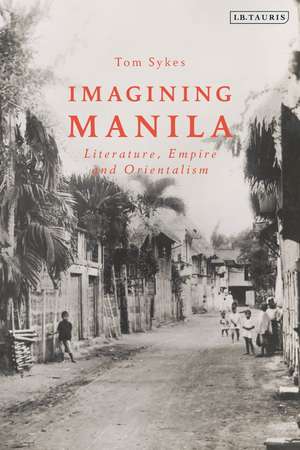
Imagining Manila: Literature, Empire and Orientalism
Autor Tom Sykesen Limba Engleză Paperback – 20 oct 2022
This study uncovers to what extent Western literary tropes and representational models have informed understandings of the Philippines, in the West and elsewhere, and the types of counter-narrative which have emerged in the Philippines in response to them.
Preț: 217.15 lei
Preț vechi: 292.72 lei
-26%
Puncte Express: 326
Carte tipărită la comandă
Livrare economică 02-16 decembrie
Livrare prin curier în România Termenul estimat este afișat lângă disponibilitate.
Transport gratuit de la 400.00 lei Plată online sau ramburs, în funcție de opțiunile comenzii.
Retur gratuit în 14 zile Comandă securizată și suport în română.
Specificații
ISBN-13: 9780755640393
ISBN-10: 075564039X
Pagini: 216
Dimensiuni: 152 x 232 x 16 mm
Greutate: 0.34 kg
Editura: Bloomsbury Publishing
Colecția Bloomsbury Academic
Locul publicării:London, United Kingdom
ISBN-10: 075564039X
Pagini: 216
Dimensiuni: 152 x 232 x 16 mm
Greutate: 0.34 kg
Editura: Bloomsbury Publishing
Colecția Bloomsbury Academic
Locul publicării:London, United Kingdom
Cuprins
Introduction: Manilaism as an Orientalism
Chapter 1. 'A Seething Cauldron of Evil': Hispanophobia, Third World Blues and Manila-as-Hell
Chapter 2. 'Known to All Students of History': Adventure, Imperial Mythology and Orientalist Rhetoric in Manilaism of the US Conquest of the Philippines
Chapter 3. 'The Pious New Name of the Musket': Language, Gender, Race and Benevolent Assimilation
Chapter 4. In Our Image but Not Quite: Desire, Capital and Flawed Simulacra in Twentieth Century Manilaism
Chapter 5. Money-Getting, Job-Thieving and Militarisation: Manilaist Constructions of Chinese-Filipinos from Daniel Defoe to Jonathan Miller
Chapter 6. Call of Duterte: Cacique Despotism and Western (Neo)liberal Crisis
Chapter 7. Towards an Anti-Manilaism
Conclusion: Liberal Orientalism versus Genuine Humanism
Notes
Bibliography
Chapter 1. 'A Seething Cauldron of Evil': Hispanophobia, Third World Blues and Manila-as-Hell
Chapter 2. 'Known to All Students of History': Adventure, Imperial Mythology and Orientalist Rhetoric in Manilaism of the US Conquest of the Philippines
Chapter 3. 'The Pious New Name of the Musket': Language, Gender, Race and Benevolent Assimilation
Chapter 4. In Our Image but Not Quite: Desire, Capital and Flawed Simulacra in Twentieth Century Manilaism
Chapter 5. Money-Getting, Job-Thieving and Militarisation: Manilaist Constructions of Chinese-Filipinos from Daniel Defoe to Jonathan Miller
Chapter 6. Call of Duterte: Cacique Despotism and Western (Neo)liberal Crisis
Chapter 7. Towards an Anti-Manilaism
Conclusion: Liberal Orientalism versus Genuine Humanism
Notes
Bibliography
Recenzii
Imagining Manila has the merit of shedding light on a myriad of texts from the Anglosphere, some of them relatively unknown ... The variety of sources and references quoted is such that it makes it a very engaging reading. Intellectually stimulating, this book will be of utmost interest for scholars researching travel literature in South East Asia and postcolonial studies.
Tom Sykes demonstrates how Manila functions as the metonym for the Philippine meta-archipelago, often with breath-taking reductiveness and strikingly telling material effects. Imagining Manila has much to teach us on the matter of representations, and why representations matter.
Sykes provides a powerful antidote to the orientalist worlding of Manila in Anglo-American literature. Rigorous, engaged and insightful, his postcolonial critique of 'Manilaism' exposes the poverty and hypocrisy of this discursive paradigm and presents cogent analyses of anti-Manilaist writing, thereby offering a radically different imagining of Manila.
Tom [Sykes] weaves a unique and nuanced picture of Manila and the layers of history that make it distinct. He shows us sides to the city that even Filipinos (and I am one) may never have noticed before . For those in the West, Sykes offers an excellent primer on contemporary Filipino history, and unique insights into one of the least discussed aspects of American empire. For those coming from the East, and for Filipinos in particular, it reminds us to view the modern Filipino experience through the lens of history and to recognise within it the patterns that our post-colonial hangover has left behind . In the times that we live in, this is most welcome.
Presents a framework for understanding how representations shape not only public perceptions but also the real-world development of urban spaces. By analyzing the cultural and ideological forces at play in the representation of Manila, Imagining Manila ultimately contributes to a deeper understanding of the complexities of urban history in a colonial context.
Sykes's ability to unapologetically hold authors and creators, especially western contemporary ones, to account when discussing Manila, be it through the lens of sociology, culture, or politics is impressive ... He calls for readers to view all media in a more considered light ... In the times that we live in, any reminder of this is most welcome.
Tom Sykes demonstrates how Manila functions as the metonym for the Philippine meta-archipelago, often with breath-taking reductiveness and strikingly telling material effects. Imagining Manila has much to teach us on the matter of representations, and why representations matter.
Sykes provides a powerful antidote to the orientalist worlding of Manila in Anglo-American literature. Rigorous, engaged and insightful, his postcolonial critique of 'Manilaism' exposes the poverty and hypocrisy of this discursive paradigm and presents cogent analyses of anti-Manilaist writing, thereby offering a radically different imagining of Manila.
Tom [Sykes] weaves a unique and nuanced picture of Manila and the layers of history that make it distinct. He shows us sides to the city that even Filipinos (and I am one) may never have noticed before . For those in the West, Sykes offers an excellent primer on contemporary Filipino history, and unique insights into one of the least discussed aspects of American empire. For those coming from the East, and for Filipinos in particular, it reminds us to view the modern Filipino experience through the lens of history and to recognise within it the patterns that our post-colonial hangover has left behind . In the times that we live in, this is most welcome.
Presents a framework for understanding how representations shape not only public perceptions but also the real-world development of urban spaces. By analyzing the cultural and ideological forces at play in the representation of Manila, Imagining Manila ultimately contributes to a deeper understanding of the complexities of urban history in a colonial context.
Sykes's ability to unapologetically hold authors and creators, especially western contemporary ones, to account when discussing Manila, be it through the lens of sociology, culture, or politics is impressive ... He calls for readers to view all media in a more considered light ... In the times that we live in, any reminder of this is most welcome.