
Imaginative Science Education: The Central Role of Imagination in Science Education
Autor Yannis Hadzigeorgiouen Limba Engleză Paperback – 30 mai 2018
The approaches discussed in the book are storytelling, the experience of wonder, the development of ‘romantic understanding’, and creative science, including science through visual art, poetry and dramatization. However, given the perennial problem of how to engage students (of all ages) in science, the notion of ‘aesthetic experience’, and hence the possibility for students to have more holistic and fulfilling learning experiences through the aforementioned imaginative approaches, is also discussed.
Each chapter provides an in-depth discussion of the theoretical background of a specific imaginative approach (e.g., storytelling, ‘wonder-full’ science), reviews the existing empirical evidence regarding its role in the learning process, and points out its implications for pedagogy and instructional practices. Examples from physical science illustrating its implementation in the classroom are also discussed.
In distinguishing between ‘participation in a science activity’ and ‘engagement with science ideas per se’, the book emphasizes the central role of imaginative engagement with science content knowledge, and thus the potential of the recommended imaginative approaches to attract students to the world of science.
| Toate formatele și edițiile | Preț | Express |
|---|---|---|
| Paperback (1) | 616.28 lei 6-8 săpt. | |
| Springer International Publishing – 30 mai 2018 | 616.28 lei 6-8 săpt. | |
| Hardback (1) | 622.29 lei 6-8 săpt. | |
| Springer International Publishing – 6 iun 2016 | 622.29 lei 6-8 săpt. |
Preț: 616.28 lei
Preț vechi: 725.04 lei
-15%
Puncte Express: 924
Preț estimativ în valută:
108.96€ • 126.77$ • 94.27£
108.96€ • 126.77$ • 94.27£
Carte tipărită la comandă
Livrare economică 23 aprilie-07 mai
Specificații
ISBN-13: 9783319805900
ISBN-10: 3319805908
Pagini: 283
Ilustrații: XXII, 283 p. 1 illus.
Dimensiuni: 155 x 235 mm
Greutate: 0.44 kg
Ediția:Softcover reprint of the original 1st ed. 2016
Editura: Springer International Publishing
Colecția Springer
Locul publicării:Cham, Switzerland
ISBN-10: 3319805908
Pagini: 283
Ilustrații: XXII, 283 p. 1 illus.
Dimensiuni: 155 x 235 mm
Greutate: 0.44 kg
Ediția:Softcover reprint of the original 1st ed. 2016
Editura: Springer International Publishing
Colecția Springer
Locul publicării:Cham, Switzerland
V-ar putea interesa
-
 Preț: 206.96 lei
 -
 -42%Preț: 96.21 lei167.03 lei
 -
 Sentence Structure and Punctuation: Ages 9-10Christine Moorcroft-42%Preț: 96.07 lei166.78 lei
 -
 Renaissance in the Classroom: Arts Integration and Meaningful LearningGail E. Burnaford-15%Preț: 441.10 lei518.95 lei
 -
 -18%Preț: 182.95 lei223.08 lei
 -
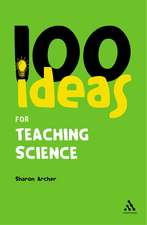 100 Ideas for Teaching ScienceSharon Archer-42%Preț: 71.65 lei124.15 lei
 -
 Teaching Number SenseDr Julia Anghileri-25%Preț: 229.48 lei305.69 lei
 -
 Getting the Buggers Into Languages 2nd EditionAmanda Barton-42%Preț: 96.36 lei166.02 lei
 -
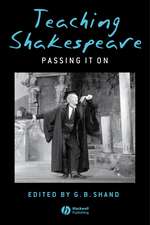 Teaching Shakespeare – Passing it OnGB ShandPreț: 397.55 lei
 -
 Writing Models Year 3Pie CorbettPreț: 263.80 lei
 -
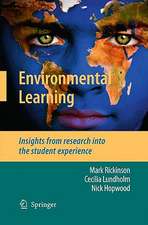 Environmental LearningMark Rickinson-15%Preț: 608.38 lei715.74 lei
 -
 -8%Preț: 566.46 lei615.72 lei
Cuprins
Acknowledgement.- Foreword by Robert Yager.- Introduction.- Imaginative Thinking in Science and Science Education.- Engagement and Aesthetic Experience in Science Education.- Teaching for Romantic Understanding.- Narrative Thinking and Storytelling in Science Education.- Creative Science Education.- Wonder-full” Science Education.- “Artistic” Science Education.- Appendices.
Notă biografică
Textul de pe ultima copertă
This book is about imaginative approaches to teaching and learning school science. Its central premise is that science learning should reflect the nature of science, and therefore be approached as an imaginative / creative activity. As such, the book can be seen as an original contribution of ideas relating to imagination and creativity in science education. The approaches discussed in the book are storytelling, the experience of wonder, the development of ‘romantic understanding’, and creative science, including science through visual art, poetry and dramatization. However, given the perennial problem of how to engage students (of all ages) in science, the notion of ‘aesthetic experience’, and hence the possibility for students to have more holistic and fulfilling learning experiences through the aforementioned imaginative approaches, is also discussed. Each chapter provides an in-depth discussion of the theoretical background of a specific imaginative approach (e.g., storytelling,‘wonder-full’ science), reviews the existing empirical evidence regarding its role in the learning process, and points out its implications for pedagogy and instructional practices. Examples from physical science illustrating its implementation in the classroom are also discussed. In distinguishing between ‘participation in a science activity’ and ‘engagement with science ideas per se’, the book emphasizes the central role of imaginative engagement with science content knowledge, and thus the potential of the recommended imaginative approaches to attract students to the world of science.
Caracteristici
Helps the reader understand the centrality of imagination in human thinking and learning Helps the reader understand both the theory behind the recommended approaches and the practical applications in the classroom Includes a wide variety of examples to be used in the classroom Addresses perhaps one of the most important educational problems, namely how to engage students in science Includes supplementary material: sn.pub/extras