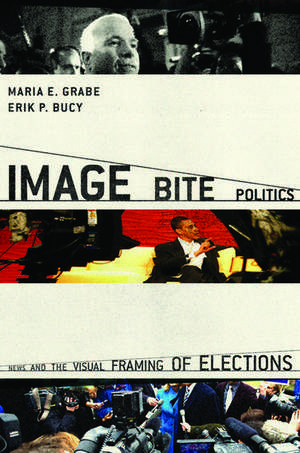
Image Bite Politics: News and the Visual Framing of Elections: Series in Political Psychology
Autor Maria Elizabeth Grabe, Erik Page Bucyen Limba Engleză Hardback – 19 mar 2009
În cadrul programelor de studiu dedicate comunicării politice și psihologiei sociale, Image Bite Politics ocupă un loc central prin mutarea accentului de la analiza discursului la cea a imaginii. Observăm o lucrare ce refuză simplificările, propunând prima evaluare sistematică a modului în care televiziunea cadrează vizual candidații la președinția SUA. Premisa autorilor este una riguroasă: impactul vizual al știrilor despre alegeri între 1992 și 2004 este corelat direct cu fluctuațiile opiniei publice, demonstrând că emoția procesată vizual precede adesea analiza cognitivă.
Remarcăm structura interdisciplinară a volumului, care integrează date din biologia comportamentală și neuroștiințe pentru a explica de ce alegătorii reacționează mai rapid la stimuli vizuali decât la argumente textuale. Maria Elizabeth Grabe și Erik Page Bucy prezintă concluzii contraintuitive, susținute de 64 de ilustrații și 24 de grafice. De exemplu, datele lor arată că „image bites” — acele cadre scurte cu lideri politici — au o influență mai mare asupra formării impresiilor decât celebrele „sound bites”, iar media rețelelor de știri a favorizat vizual candidații republicani, demontând mitul unei orientări liberale generalizate.
Acoperă aceeași arie ca Image and Emotion in Voter Decisions de Renita Coleman, dar cu o abordare mai orientată spre analiza sistematică a conținutului de știri pe termen lung și spre fundamentele biologice ale percepției. În timp ce alte lucrări din domeniu se concentrează pe noile tehnologii digitale, acest volum rămâne esențial pentru înțelegerea mecanismelor clasice ale televiziunii care încă fundamentează alfabetizarea vizuală a publicului contemporan.
Din seria Series in Political Psychology
- 31%
 Preț: 370.34 lei
 - 30%
 Preț: 434.08 lei
 - 31%
 Preț: 414.57 lei
 - 33%
 Preț: 538.16 lei
 - 22%
 Preț: 339.77 lei
 - 31%
 Preț: 439.60 lei
 - 34%
 Preț: 459.84 lei
 - 31%
 Preț: 416.94 lei
 - 34%
 Preț: 598.48 lei
 - 34%
 Preț: 1019.56 lei
 - 30%
 Preț: 379.64 lei
 - 7%
 Preț: 530.08 lei
 - 24%
 Preț: 270.78 lei
 - 34%
 Preț: 617.23 lei
 - 8%
 Preț: 559.75 lei
 - 30%
 Preț: 371.49 lei
 - 15%
 Preț: 322.18 lei
 - 22%
 Preț: 577.58 lei
 - 14%
 Preț: 516.75 lei
 - 11%
 Preț: 486.76 lei
 - nou
 Preț: 782.82 lei
 - nou
 Preț: 416.97 lei
Preț: 355.71 lei
Preț vechi: 458.05 lei
-22%
Carte tipărită la comandă
Livrare economică 11-17 iunie
Specificații
ISBN-10: 0195372077
Pagini: 344
Ilustrații: 64 halftones, 24 line drawings
Dimensiuni: 163 x 236 x 25 mm
Greutate: 0.59 kg
Editura: Oxford University Press
Colecția OUP USA
Seria Series in Political Psychology
Locul publicării:New York, United States
V-ar putea interesa
-
 Adaptive Thinking: Rationality in the Real WorldGerd Gigerenzer-11%Preț: 406.35 lei456.58 lei
 -
 A Life Worth Living: Contributions to positive psychologyMihaly Csikszentmihalyi-21%Preț: 520.72 lei660.78 lei
 -
 The Escape of the MindHoward Rachlin-14%Preț: 538.82 lei626.53 lei
 -
 Advances in Culture and PsychologyMichele J. Gelfand-19%Preț: 475.65 lei590.46 lei
 -
 The Philosophy of Creativity: New EssaysElliot Samuel Paul-14%Preț: 514.86 lei598.68 lei
 -
 Social Dilemmas: Understanding Human CooperationPaul Van Lange-17%Preț: 689.54 lei825.93 lei
 -
 The Political Psychology of Terrorism FearsSamuel Justin Sinclair-34%Preț: 593.01 lei902.95 lei
 -
 David and GoliathMalcolm GladwellPreț: 114.51 lei
 -
 BlindspotMahzarin R. BanajiPreț: 91.38 lei
 -
 Social Psychology For DummiesDaniel RichardsonPreț: 117.01 lei
 -
 The Tipping PointMalcolm GladwellPreț: 49.00 lei
De ce să citești această carte
Această carte este indispensabilă pentru studenții și cercetătorii în științe politice care doresc să înțeleagă mecanismele subtile de manipulare vizuală. Cititorul câștigă o perspectivă bazată pe date concrete despre cum imaginile TV influențează votul mai mult decât discursurile. Este un instrument critic pentru oricine dorește să decodeze strategiile de branding politic și să înțeleagă rolul neuroștiinței în procesul electoral modern.
Despre autor
Maria Elizabeth Grabe și Erik Page Bucy sunt cercetători de prestigiu în domeniul comunicării și psihologiei politice. Contribuția lor în Series in Political Psychology a Oxford University Press reflectă o expertiză vastă în analiza media. Maria Elizabeth Grabe este recunoscută pentru studiile sale asupra modului în care formatele de știri afectează informarea cetățenilor, în timp ce Erik Page Bucy s-a specializat în analiza comportamentului non-verbal al liderilor politici și în impactul noilor tehnologii asupra participării democratice, ambii fiind pionieri în utilizarea metodelor interdisciplinare pentru a studia comunicarea vizuală.
Descriere
Recenzii
Scholars and pundits have long acknowledged (and often lamented) the role of image in politics. Yet, systematic studies of image have been rare. This book not only fills that gap, but it also does so with unparalleled substantive and methodological rigor. It is sure to serve as a launching point for an entire field of study on image and politics.
Grabe and Bucy show how visual images convey information and demonstrate the impact images in news coverage inform and move the electorate. Image Bite Politics is thoughtful, carefully wrought, impressive and path breaking.
This volume presents an unusually detailed, extensively referenced and thoroughly researched argument for taking the visuals of television news seriously as a source of political information. Cogently and clearly written, it includes a broad sweep of the history of the development of the human eye and the brain in processing visual and verbal information as well as extensive data from four consecutive presidential elections. As such, it breaks with the tradition in most election studies of privileging the word over the image and takes the visual dimension of television more seriously than most scholars of politics have thus far. For those interested in the role of television and visual images in elections and political communication, this is an essential work.
Grabe and Bucy introduce contemporary neuroscience to the analysis of voters' perception and responses to the televised coverage of politics. Because emotional responses are more rapid than cognitive analysis and judgment, this approach shows why theories based on print communication or "rational choice" often fail to describe political life. It's past time that a scientific understanding of non-verbal cues and visual framing are integrated to a comprehensive assessment of television news, campaigns, and the emotional dimension of politics. The result is a book that should become a classic that is required reading throughout the political science discipline (and not just in studies of the role of media in American politics).