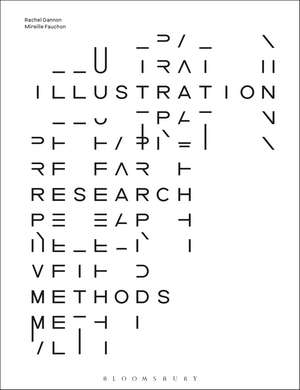
Illustration Research Methods
Autor Rachel Gannon, Mireille Fauchonen Limba Engleză Paperback – 28 ian 2021
For years illustration has lacked a strong critical history in which to frame it, with academics and media alike assessing it as part of design rather than a discipline in its own right. Illustration Research Methods addresses this void and adds to a fast-emerging discipline, establishing a lexicon that is specific to discussing contemporary illustration practice and research.
The chapters are broken down into the various roles that exist within the industry and which illustration research can draw from, such as 'Reporting' and 'Education'. In doing so, users are able to explore a diverse range of disciplines that are rich in critical theory and can map these existing research methodologies to their own study and practice.
Supported by a wealth of case studies from international educators, student projects sit alongside those of world-renowned illustrators. Thus allowing users the opportunity to put what they have learnt into context and offering insight into the thinking and techniques behind some of illustrations' greats.
Preț: 197.09 lei
Preț vechi: 240.04 lei
-18%
Puncte Express: 296
Carte disponibilă
Livrare economică 09-23 noiembrie
Livrare express 24-30 octombrie pentru 84.91 lei
Livrare prin curier în România Termenul estimat este afișat lângă disponibilitate.
Transport gratuit de la 400.00 lei Plată online sau ramburs, în funcție de opțiunile comenzii.
Retur gratuit în 14 zile Comandă securizată și suport în română.
Specificații
ISBN-13: 9781350051430
ISBN-10: 1350051438
Pagini: 224
Ilustrații: 200 colour illus
Dimensiuni: 188 x 246 x 16 mm
Greutate: 0.64 kg
Editura: Bloomsbury Publishing
Colecția Bloomsbury Visual Arts
Locul publicării:London, United Kingdom
ISBN-10: 1350051438
Pagini: 224
Ilustrații: 200 colour illus
Dimensiuni: 188 x 246 x 16 mm
Greutate: 0.64 kg
Editura: Bloomsbury Publishing
Colecția Bloomsbury Visual Arts
Locul publicării:London, United Kingdom
V-ar putea interesa
-
 Sketching User Experiences: The WorkbookSaul Greenberg-17%Preț: 123.24 lei149.00 lei
 -
 A Beautiful WorldJames NorburyPreț: 140.46 lei
 -
 Drawing for IllustrationMartin Salisbury-15%Preț: 204.07 lei240.19 lei
 -
 -15%Preț: 446.38 lei525.15 lei
 -
 -8%Preț: 227.63 lei247.89 lei
 -
 -17%Preț: 213.91 lei258.82 lei
 -
 Visual ResearchRussell Bestley-13%Preț: 267.19 lei308.68 lei
 -
 -44%Preț: 410.36 lei735.77 lei
 -
 IllustrationAlan Male-23%Preț: 222.46 lei287.38 lei
 -
 Illustration and HeritageRachel Emily Taylor-14%Preț: 164.46 lei190.22 lei
 -
 Illustration, Narrative and The Suffragette: An Illustrative EnquiryMireille Fauchon-18%Preț: 167.25 lei205.06 lei
 -
 Handbook of Arts-Based Research, Second EditionPatricia Leavy-15%Preț: 668.84 lei786.87 lei
 -
 Reportage Illustration: Visual JournalismReportage Drawing Gary Embury-18%Preț: 217.37 lei265.18 lei
 -
 The Fundamentals of IllustrationProfessor Lawrence ZeegenPreț: 216.15 lei
 -
 Visual Methods for Digital Research - An IntroductionGabriele ColomboPreț: 139.67 lei
 -
 The Illustration Idea Book: Inspiration from 50 MastersGail Anderson-26%Preț: 80.53 lei108.44 lei
 -
 How Do Social Research With...Rebecca ColemanPreț: 204.47 lei
 -
 -21%Preț: 237.93 lei301.04 lei
 -
 -18%Preț: 356.71 lei434.22 lei
Cuprins
Introduction
1. Illustration research
Definitions
Illustration as process
Identity
Language and terminology
The principles of illustration practice
Shifting roles - an expanded practice
Can illustration ever be authorless?
A social practice
Research into, through and for illustration - a framework for categorising methods
Rigour in illustration
Originality in illustration
2. Authorship
Tell me a story
Narrative components
Narrative inquiries - different ways of thinking of narrative research
The autoethnographic illustrator
Adaption and interpretation
Picture visual research
Illustrative writing
3. Reporting
Illustrator as reporter
This is research
How to
Drawing from life
Sketchbooks
Listening
Observation
A multisensory lifeworld
Walking
Me you and everyone else
Is this real
Reporting the news
4. Crafting
Illustration and craft, a happy marriage?
'I already know what I'm going to do'
The meaning in the mark
Tools of the trade
The meaning of material
The stuff of life
Illustration as object, 3d, physical and virtual form
The illustrated object or the object illustration?
Collected
Fabricated
Immaterial technologies
5. Activism
Am I political?
Power play
An informed practice
The visual identity of protest
Detournement
The illustrators joke
Who do you think I am?
The meme
Future visions
Illustration as event
Models of behaviour
'How can I help you?'
6. Education
What is your philosophy?
What is an education space?
Signature pedagogies
Shop talk
Learning through illustration
Residency as method
Documents of experience
Illustration-based research
Data visualisation
The language of reliability
Interactive illustration
7. Illustration futures
Appendix
Proposals
Working with others
Interviews
Reflective practice
Positioning
Who benefits?
Legacy
Informed consent
Illustration research
1. Illustration research
Definitions
Illustration as process
Identity
Language and terminology
The principles of illustration practice
Shifting roles - an expanded practice
Can illustration ever be authorless?
A social practice
Research into, through and for illustration - a framework for categorising methods
Rigour in illustration
Originality in illustration
2. Authorship
Tell me a story
Narrative components
Narrative inquiries - different ways of thinking of narrative research
The autoethnographic illustrator
Adaption and interpretation
Picture visual research
Illustrative writing
3. Reporting
Illustrator as reporter
This is research
How to
Drawing from life
Sketchbooks
Listening
Observation
A multisensory lifeworld
Walking
Me you and everyone else
Is this real
Reporting the news
4. Crafting
Illustration and craft, a happy marriage?
'I already know what I'm going to do'
The meaning in the mark
Tools of the trade
The meaning of material
The stuff of life
Illustration as object, 3d, physical and virtual form
The illustrated object or the object illustration?
Collected
Fabricated
Immaterial technologies
5. Activism
Am I political?
Power play
An informed practice
The visual identity of protest
Detournement
The illustrators joke
Who do you think I am?
The meme
Future visions
Illustration as event
Models of behaviour
'How can I help you?'
6. Education
What is your philosophy?
What is an education space?
Signature pedagogies
Shop talk
Learning through illustration
Residency as method
Documents of experience
Illustration-based research
Data visualisation
The language of reliability
Interactive illustration
7. Illustration futures
Appendix
Proposals
Working with others
Interviews
Reflective practice
Positioning
Who benefits?
Legacy
Informed consent
Illustration research
Recenzii
A treasure chest of ideas, insights, new terminology and eye-opening case studies ... It will make a vital contribution to the discipline's discourse.
I've been waiting for a book that illustrates how valuable illustration is to art, culture, politics, science - well, society as a whole ... An essential volume.
I've been waiting for a book that illustrates how valuable illustration is to art, culture, politics, science - well, society as a whole ... An essential volume.