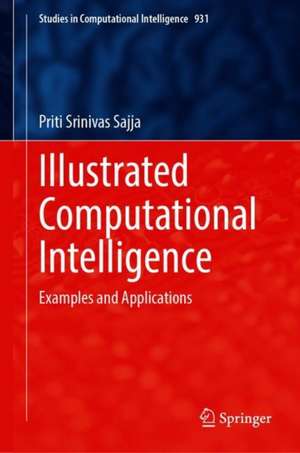
Illustrated Computational Intelligence
Autor Priti Srinivas Sajjaen Limba Engleză Hardback – 17 noi 2020
Preț: 967.23 lei
Preț vechi: 1209.05 lei
-20%
Puncte Express: 1451
Carte tipărită la comandă
Livrare economică 02-16 decembrie
Livrare prin curier în România Termenul estimat este afișat lângă disponibilitate.
Transport gratuit pentru acest produs Plată online sau ramburs, în funcție de opțiunile comenzii.
Retur gratuit în 14 zile Comandă securizată și suport în română.
Specificații
ISBN-13: 9789811595882
ISBN-10: 9811595887
Pagini: 244
Ilustrații: XV, 225 p. 157 illus., 155 illus. in color.
Dimensiuni: 160 x 241 x 19 mm
Greutate: 0.48 kg
Ediția:1st ed. 2021
Editura: Springer
Locul publicării:Singapore, Singapore
ISBN-10: 9811595887
Pagini: 244
Ilustrații: XV, 225 p. 157 illus., 155 illus. in color.
Dimensiuni: 160 x 241 x 19 mm
Greutate: 0.48 kg
Ediția:1st ed. 2021
Editura: Springer
Locul publicării:Singapore, Singapore
Cuprins
Introduction to Traditional AI.- Soft Computing Fundamentals.- Examples Based on Fuzzy Logic Systems.- Examples Based on Artificial Neural Network.- Examples Based on Genetic Algorithms.- Examples Based on Hybrid Intelligent Systems.
Notă biografică
Rajendra Akerkar is a professor of information technology at Western Norway Research Institute, Norway. He has 23 years of research and teaching experience in artificial intelligent systems, semantic technologies and big data science. His recent research focuses on real world use of big data, and social media analysis in a wide set of semantic dimensions. He has held senior positions in the key academic conference committees, journal boards and review committees in those fields and he has supervised Ph.D. and research M.Sc. projects in intelligent systems, web intelligence and data science. He has managed 12 international ICT initiatives, and data-intensive research & development projects for more than 17 years.
Dr Priti Srinivas Sajja (b.1970) joined the faculty of the Department of Computer Science, Sardar Patel University, India in 1994 and is presently working as a Professor. She received her M.S. (1993) and Ph.D (2000) in Computer Science from the Sardar Patel University. Her research interests include knowledge-based systems, soft computing, multi-agent systems, and software engineering. She has 152 publications in books, book chapters, journals, and in the proceedings of national and international conferences out of which five publications have won best research paper awards. She is co-author of 'Knowledge-Based Systems' and 'Intelligent Technologies for Web Applications' published in the USA. She is supervising work of a few doctoral research scholars while six candidates have completed their Ph.D research under her guidance. She was Principal Investigator of a major research project funded by UGC, India. She is serving as a member on the editorial board of many international science journals and served as a program committee member for various international conferences.
Textul de pe ultima copertă
This book presents a summary of artificial intelligence and machine learning techniques in its first two chapters. The remaining chapters of the book provide everything one must know about the basic artificial intelligence to modern machine intelligence techniques including the hybrid computational intelligence technique, using the concepts of several real-life solved examples, design of projects and research ideas. The solved examples with more than 200 illustrations presented in the book are a great help to instructors, students, non–AI professionals, and researchers. Each example is discussed in detail with encoding, normalization, architecture, detailed design, process flow, and sample input/output. Summary of the fundamental concepts with solved examples is a unique combination and highlight of this book.
Caracteristici
Highlights the connection between artificial and machine intelligence techniques including hybrid soft computing techniques Discusses the utilization of several soft computing techniques in real-life scenarios Is a valuable resource for instructors, students, non–AI professionals, and researchers