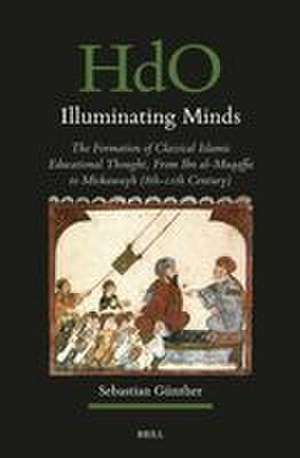
Illuminating Minds: The Formation of Classical Islamic Educational Thought, From Ibn al-Muqaffa to Miskawayh (8th-11th Century): Handbook of Oriental Studies. Section 1 The Near and Middle East, cartea 205
Sebastian Güntheren Limba Engleză Hardback – 17 dec 2026
By presenting ten major Muslim thinkers as pioneers of distinct yet interconnected educational visions, the study reveals a coherent movement toward ethics as the horizon of learning in classical Islam.
Din seria Handbook of Oriental Studies. Section 1 The Near and Middle East
- 18%
 Preț: 1111.38 lei
 - 18%
 Preț: 1291.09 lei
 - 18%
 Preț: 1207.70 lei
 - 18%
 Preț: 925.06 lei
 - 18%
 Preț: 1118.66 lei
 - 18%
 Preț: 1121.94 lei
 - 18%
 Preț: 1118.79 lei
 - 18%
 Preț: 779.52 lei
 - 18%
 Preț: 995.07 lei
 - 18%
 Preț: 1269.35 lei
 - 15%
 Preț: 588.21 lei
 - 18%
 Preț: 1418.57 lei
 - 18%
 Preț: 907.10 lei
 - 18%
 Preț: 842.19 lei
 - 18%
 Preț: 1119.65 lei
 - 18%
 Preț: 1429.25 lei
 - 18%
 Preț: 1040.33 lei
 - 18%
 Preț: 1435.74 lei
 - 18%
 Preț: 1087.11 lei
 - 18%
 Preț: 629.90 lei
 - 18%
 Preț: 1038.01 lei
 - 18%
 Preț: 895.39 lei
 - 18%
 Preț: 735.49 lei
 - 18%
 Preț: 846.16 lei
 - 18%
 Preț: 680.57 lei
 - nou
 Preț: 2693.32 lei
 - nou
 Preț: 860.03 lei
 - 18%
 Preț: 2715.45 lei
 - 18%
 Preț: 1798.94 lei
 - 18%
 Preț: 2812.74 lei
 - nou
 Preț: 962.38 lei
 - nou
 Preț: 895.33 lei
 - nou
 Preț: 683.95 lei
 - 18%
 Preț: 2423.17 lei
 - 18%
 Preț: 2555.21 lei
 - 18%
 Preț: 2851.68 lei
Preț: 826.97 lei
Preț vechi: 1008.50 lei
-18% Precomandă
Puncte Express: 1240
Carte nepublicată încă
Livrare prin curier în România Precomanda se expediază când titlul devine disponibil.
Transport gratuit pentru acest produs Plată online sau ramburs, în funcție de opțiunile comenzii.
Retur gratuit în 14 zile Comandă securizată și suport în română.
Doresc să fiu notificat când acest titlu va fi disponibil:
Se trimite...
Specificații
ISBN-13: 9789004755390
ISBN-10: 900475539X
Dimensiuni: 155 x 235 mm
Greutate: 0 kg
Editura: Brill
Colecția Brill
Seria Handbook of Oriental Studies. Section 1 The Near and Middle East
ISBN-10: 900475539X
Dimensiuni: 155 x 235 mm
Greutate: 0 kg
Editura: Brill
Colecția Brill
Seria Handbook of Oriental Studies. Section 1 The Near and Middle East
Notă biografică
Sebastian Günther, Ph.D. (1989, University of Halle-Wittenberg), is Professor and Chair of Arabic and Islamic Studies at the University of Göttingen, and an International Honorary Member of the American Academy of Arts and Sciences. He has numerous publications on Islamic intellectual history, including Knowledge and Education in Classical Islam (ed., Brill 2020).
Cuprins
Acknowledgment
Introduction: Classical Islamic Pedagogy—An Outdated Legacy or Enduring Wisdom?
1 Scope and Aims of the Book
2 Recent Scholarship on Islamic Education
3 Intellectual Currents in Classical Islamic Learning
4 Methodological Reflections and Future Pathways
5 Epistemological and Conceptual Challenges
6 Analytical Approaches
7 Navigating the Pedagogical Archive
8 Tradition and Reform in Islamic Education
9 Broadening the Scope of Inquiry
10 Key Figures and Ideas: A Thematic Synopsis
11 Toward a History of Classical Islamic Pedagogy: Reflections and Prospects
12 Bibliography
1 Leadership Education in Literary Garb
Ibn al-Muqaffaʿ (ca. 720–ca. 756)
1 Life, Education, and Scholarship
2The Principal Guide to Rules of Conduct
3 Conclusions
4 Appendix: Leadership Terms in Context
5 Bibliography
6 Further Reading
2 Scripture as the Focus of Religious Schooling
Ibn Saḥnūn (817–870)
1 Life, Education, and Scholarship
2The Book of Rules of Conduct for Teachers
3 Conclusions
4 Bibliography
5 Further Reading
3 Reading, Reasoning, and the Poetics of Teaching
al-Jāḥiẓ (776–869)
1 Life, Education, and Scholarship
2The Book of Teachers
3The Book of Animals
4The Book of Elucidation and Exposition
5 “Foolish Schoolteachers” as a Literary Topic
6 Conclusions
7 Bibliography
8 Further Reading
4 Writerly Culture and Humanistic Education
Ibn Qutayba (828–889)
1 Life, Education, and Scholarship
2The Scribe’s Manual of Proper Conduct
3The Book of Knowledge
4Poetry and the Poets
5The Excellence of the Arabs
6The Choicest Narratives
7 Conclusions
8 Bibliography
9 Further Reading
5 Intuitive Knowledge and a Mystic’s Pedagogy
al-Ḥakīm al-Tirmidhī (ca. 830–ca. 910)
1 Life, Education, and Scholarship
2 The Broader Context of Mysticism
3The Taming of the Soul
4The Edification of the Soul
5The Sagacious and the Deluded
6 Conclusions
7 Bibliography
8 Further Reading
6 The Philosopher’s Curriculum and Human Fulfillment
al-Fārābī (ca. 870–ca. 950)
1 Life, Education, and Scholarship
2The Enumeration of the Sciences
3Selected Aphorisms
4The Philosophy of Plato
5The Book of Letters
6The Exhortation to the Path of Happiness
7The Utterances Used in Logic
8The Book of Demonstration
9The Book of Dialectic
10 Educational Perspectives in Further Works
11 Conclusions
12 Bibliography
13 Further Reading
7 Spiritual Pedagogy and Enlightenment
Ibn Manṣūr al-Yaman (ca. 883–ca. 958)
1 Life, Education, and Scholarship
2The Master and the Disciple
3 Conclusions
4 Bibliography
5 Further Reading
8 Encyclopaedic Learnedness and Human Wisdom
The Brethren of Purity (Tenth Century)
1 The Authors and Their Epistles
2 Epistle 7: On the Scientific Arts
3 Epistle 8: On the Practical Arts
4 Epistle 10: An Introduction to Logic
5 Epistle 42: On Opinions and Religions
6 Epistle 22: On the Categories of Living Beings
7 Conclusions
8 Bibliography
9 Further Reading
9 Prophetic Traditions as a Basis of Learning
Ibn al-Sunnī (ca. 893–974)
1 Life, Education, and Scholarship
2The Training of Students
3 Conclusions
4 Bibliography
5 Further Reading
10 Ethics as Educational Discourse
Miskawayh (ca. 932–1030)
1 Life, Education, and Scholarship
2The Refinement of Character Traits
3Random Questions and Exhaustive Responses
4The Rules of Conduct [and the Wisdom] of the Arabs and the Persians
5 Educational Perspectives in Further Works
6 Conclusions
7 Bibliography
8 Further Reading
Bibliographical Appendix: A Systematic Guide to Classical Islamic Education
Index
Introduction: Classical Islamic Pedagogy—An Outdated Legacy or Enduring Wisdom?
1 Scope and Aims of the Book
2 Recent Scholarship on Islamic Education
3 Intellectual Currents in Classical Islamic Learning
4 Methodological Reflections and Future Pathways
5 Epistemological and Conceptual Challenges
6 Analytical Approaches
7 Navigating the Pedagogical Archive
8 Tradition and Reform in Islamic Education
9 Broadening the Scope of Inquiry
10 Key Figures and Ideas: A Thematic Synopsis
11 Toward a History of Classical Islamic Pedagogy: Reflections and Prospects
12 Bibliography
1 Leadership Education in Literary Garb
Ibn al-Muqaffaʿ (ca. 720–ca. 756)
1 Life, Education, and Scholarship
2The Principal Guide to Rules of Conduct
3 Conclusions
4 Appendix: Leadership Terms in Context
5 Bibliography
6 Further Reading
2 Scripture as the Focus of Religious Schooling
Ibn Saḥnūn (817–870)
1 Life, Education, and Scholarship
2The Book of Rules of Conduct for Teachers
3 Conclusions
4 Bibliography
5 Further Reading
3 Reading, Reasoning, and the Poetics of Teaching
al-Jāḥiẓ (776–869)
1 Life, Education, and Scholarship
2The Book of Teachers
3The Book of Animals
4The Book of Elucidation and Exposition
5 “Foolish Schoolteachers” as a Literary Topic
6 Conclusions
7 Bibliography
8 Further Reading
4 Writerly Culture and Humanistic Education
Ibn Qutayba (828–889)
1 Life, Education, and Scholarship
2The Scribe’s Manual of Proper Conduct
3The Book of Knowledge
4Poetry and the Poets
5The Excellence of the Arabs
6The Choicest Narratives
7 Conclusions
8 Bibliography
9 Further Reading
5 Intuitive Knowledge and a Mystic’s Pedagogy
al-Ḥakīm al-Tirmidhī (ca. 830–ca. 910)
1 Life, Education, and Scholarship
2 The Broader Context of Mysticism
3The Taming of the Soul
4The Edification of the Soul
5The Sagacious and the Deluded
6 Conclusions
7 Bibliography
8 Further Reading
6 The Philosopher’s Curriculum and Human Fulfillment
al-Fārābī (ca. 870–ca. 950)
1 Life, Education, and Scholarship
2The Enumeration of the Sciences
3Selected Aphorisms
4The Philosophy of Plato
5The Book of Letters
6The Exhortation to the Path of Happiness
7The Utterances Used in Logic
8The Book of Demonstration
9The Book of Dialectic
10 Educational Perspectives in Further Works
11 Conclusions
12 Bibliography
13 Further Reading
7 Spiritual Pedagogy and Enlightenment
Ibn Manṣūr al-Yaman (ca. 883–ca. 958)
1 Life, Education, and Scholarship
2The Master and the Disciple
3 Conclusions
4 Bibliography
5 Further Reading
8 Encyclopaedic Learnedness and Human Wisdom
The Brethren of Purity (Tenth Century)
1 The Authors and Their Epistles
2 Epistle 7: On the Scientific Arts
3 Epistle 8: On the Practical Arts
4 Epistle 10: An Introduction to Logic
5 Epistle 42: On Opinions and Religions
6 Epistle 22: On the Categories of Living Beings
7 Conclusions
8 Bibliography
9 Further Reading
9 Prophetic Traditions as a Basis of Learning
Ibn al-Sunnī (ca. 893–974)
1 Life, Education, and Scholarship
2The Training of Students
3 Conclusions
4 Bibliography
5 Further Reading
10 Ethics as Educational Discourse
Miskawayh (ca. 932–1030)
1 Life, Education, and Scholarship
2The Refinement of Character Traits
3Random Questions and Exhaustive Responses
4The Rules of Conduct [and the Wisdom] of the Arabs and the Persians
5 Educational Perspectives in Further Works
6 Conclusions
7 Bibliography
8 Further Reading
Bibliographical Appendix: A Systematic Guide to Classical Islamic Education
Index