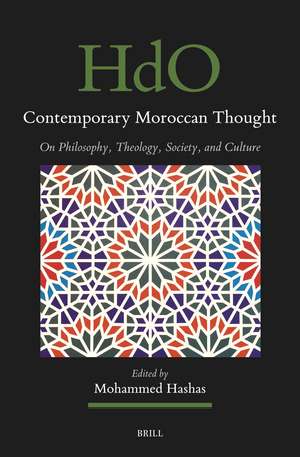
Contemporary Moroccan Thought: On Philosophy, Theology, Society, and Culture: Handbook of Oriental Studies. Section 1 The Near and Middle East, cartea 186
Mohammed Hashasen Limba Engleză Hardback – 14 noi 2024
Publicat sub egida prestigioasei edituri Brill, acest volum reprezintă un companion academic monumental, structurat pentru a oferi o cartografiere exhaustivă a peisajului intelectual din Marocul post-1950. Contemporary Moroccan Thought propune conceptul de „Școala de la Rabat” ca centru de greutate pentru o renaștere viguroasă a gândirii arabe moderne, situată geografic la marginea lumii islamice clasice, dar centrală prin rigoarea critică. Găsim în cele peste 800 de pagini o analiză detaliată a modului în care intelectualii marocani au negociat tensiunea dintre tradiție și modernitatea occidentală.
Structura volumului este riguros organizată, debutând cu o introducere programatică semnată de Mohammed Hashas, urmată de secțiuni dedicate proiectelor filozofice majore. Analizele se concentrează pe figuri precum Mohamed Aziz Lahbabi și personalismul său realist sau pe critica universalistă a lui Abdallah Laroui. Această lucrare servește ca o alternativă extinsă la titluri precum Islam, State, and Modernity de Zaid Eyadat pentru cursurile de filozofie islamică contemporană, cu avantajul unei acoperiri mult mai vaste, care depășește monografia unui singur autor pentru a include perspective sociologice și teologice diverse. Față de Contemporary Arab Thought de Elizabeth Kassab, care oferă o privire regională, volumul de față permite o imersiune profundă în specificul maghrebian, evidențiind „gândirea nomadă” și traducerile epistemice ale unor autori precum Abdelkébir Khatibi. Tonul este unul academic precis, oferind cititorului instrumentele necesare pentru a înțelege cum etica și conștiința istorică au fost recalibrate într-un spațiu de confluență culturală.
Din seria Handbook of Oriental Studies. Section 1 The Near and Middle East
- 18%
 Preț: 1111.38 lei
 - 18%
 Preț: 1268.80 lei
 - 18%
 Preț: 1207.70 lei
 - 18%
 Preț: 908.81 lei
 - 18%
 Preț: 1118.66 lei
 - 18%
 Preț: 1121.94 lei
 - 18%
 Preț: 1118.79 lei
 - 18%
 Preț: 779.52 lei
 - 18%
 Preț: 995.07 lei
 - 18%
 Preț: 1269.35 lei
 - 15%
 Preț: 588.21 lei
 - 18%
 Preț: 1418.57 lei
 - 18%
 Preț: 907.10 lei
 - 18%
 Preț: 842.19 lei
 - 18%
 Preț: 1101.77 lei
 - 18%
 Preț: 1022.03 lei
 - 18%
 Preț: 1410.57 lei
 - 18%
 Preț: 1068.06 lei
 - 18%
 Preț: 621.17 lei
 - 18%
 Preț: 1036.34 lei
 - 18%
 Preț: 882.96 lei
 - 18%
 Preț: 723.40 lei
 - 18%
 Preț: 842.63 lei
 - 18%
 Preț: 679.52 lei
 - 18%
 Preț: 2715.45 lei
 - 18%
 Preț: 1798.94 lei
 - 18%
 Preț: 2812.74 lei
 - nou
 Preț: 945.51 lei
 - nou
 Preț: 826.97 lei
 - nou
 Preț: 879.63 lei
 - 18%
 Preț: 2423.17 lei
 - 18%
 Preț: 2555.21 lei
 - 18%
 Preț: 2851.68 lei
Preț: 1404.22 lei
Preț vechi: 1712.45 lei
-18%
Carte disponibilă
Livrare economică 30 octombrie-04 noiembrie
Specificații
ISBN-10: 9004519521
Pagini: 830
Dimensiuni: 155 x 235 x 50 mm
Greutate: 1.33 kg
Editura: Brill
Colecția Brill
Seria Handbook of Oriental Studies. Section 1 The Near and Middle East
De ce să citești această carte
Suntem de părere că acest volum este indispensabil pentru cercetătorii și studenții la studii orientale sau filozofie politică. Cititorul câștigă o înțelegere nuanțată a modului în care gândirea islamică s-a modernizat fără a-și pierde rădăcinile, explorând concepte de eliberare etică și universalism critic. Este o resursă de referință care sintetizează decenii de dezbateri intelectuale din Maghreb, greu accesibile anterior într-o formă atât de sistematizată.
Despre autor
Mohammed Hashas este un cercetător și editor recunoscut, specializat în gândirea islamică contemporană și filozofia politică din lumea arabă. Prin acest volum din seria Handbook of Oriental Studies. Section 1 The Near and Middle East, el reunește o comunitate impresionantă de peste 30 de contributori, de la Wael Hallaq la Fatima Sadiqi, pentru a documenta evoluția „Școlii de la Rabat”. Expertiza sa se concentrează pe intersecția dintre tradiția teologică și cerințele modernității, Hashas fiind o voce autoritară în explicarea dinamismului intelectual marocan pentru publicul academic internațional.
Notă biografică
Contributors
Deina Abdelkader, Nayla Abi Nader, Kholoud Al-Ajarma, Salah Basalamah, Mohamed Wajdi Ben Hammed, Sara Borrillo, Ibrahim Bouhaouliane, Tina Dransfeldt Christensen, Driss El Ghazouani, Brahim El Guabli, Abdennabi El Harri, Amin El-Yousfi, Francesca Forte, Fatma Gargouri, Wael Hallaq, Mohammed Hashas, Alma Rachel Heckman, Aziz Hlaoua, Abdellatif Kidai, Markus Kneer, Mohamed Lamallam, Khalid Lyamlahy, Juan A. Macías-Amoretti, Djelloul Magoura, Mohammed K. B. Rhazzali, Raja Rhouni, Nils Riecken, Fatima Sadiqi, Hamza Salih, Ari Schriber, Simone Sibilio, and Abdessalam Tawil.
Descriere
This volume sets a new standard in the study of Moroccan, North African, and Middle Eastern societies, and will undoubtedly remain an important scholarly reference for generations to come.
Contributors
Deina Abdelkader, Nayla Abi Nader, Kholoud Al-Ajarma, Salah Basalamah, Mohamed Wajdi Ben Hammed, Sara Borrillo, Ibrahim Bouhaouliane, Tina Dransfeldt Christensen, Driss El Ghazouani, Brahim El Guabli, Abdennabi El Harri, Amin El-Yousfi, Francesca Forte, Fatma Gargouri, Wael Hallaq, Mohammed Hashas, Alma Rachel Heckman, Aziz Hlaoua, Abdellatif Kidai, Markus Kneer, Mohamed Lamallam, Khalid Lyamlahy, Juan A. Macías-Amoretti, Djelloul Magoura, Mohammed K. B. Rhazzali, Raja Rhouni, Nils Riecken, Fatima Sadiqi, Hamza Salih, Ari Schriber, Simone Sibilio, and Abdessalam Tawil.
Recenzii
- Michaelle L. Browers, Wake Forest University, North Carolina, author of Democracy and Civil Society in Arab Political Thought.
This is an invaluable work that is appearing at the right time. Hashas’ long, learned introduction is especially useful as a guide to the volume as a whole. With his essay and the rest of the studies the work is almost encyclopaedic in its coverage and will be mined by advanced students and seasoned scholars from a wide range of humanities disciplines for many years for insights on the whole atmosphere of thought in the Maghrib, the approaches of specific Maghribi thinkers, and details of key moments in Moroccan intellectual history. A necessary work in the collection of any researcher into the intellectual history of the Maghribi and Islamic world.
- Shamil Jeppie, University of Cape Town, author of Language, Identity, Modernity: The Arabic Study Circle of Durban.
This is a valuable and much needed addition to the field of contemporary Arab intellectual history. Hashas has put together first-rate essays on major and diverse figures of contemporary Moroccan thought. Together, they invite the reader to explore the wide range of themes and disciplines that Moroccan thinkers have been delving into and also to critically assess the edge that they might represent in the larger regional context.
- Elizabeth Suzanne Kassab, Doha Institute for Graduate Studies, author of Contemporary Arab Thought: Cultural Critique in Comparative Perspective.
Cuprins
Acknowledgements
Notes on Transliteration and Style
Notes on Contributors
1 Rabat School of Thought: Tradition, Modernity, and Critique from the Edge
Mohammed Hashas
Part 1: Projects in Philosophy and Philosophical Thought
2 Mohamed Aziz Lahbabi’s ‘Realistic Personalism’: The Multidimensionality of the Human Person in a Muslim Context
Markus Kneer
3 Abdallah Laroui’s Situated Universalist Critique of Western Modernity
Nils Riecken
4 Mohammed Abed al-Jabri and the Question of Method in Reading the Tradition
Nayla Abi Nader
5 Ali Oumlil’s Reform Agenda: Historical Consciousness, Tradition, and Modernity
Abdessalam Tawil
6 Abderrahmane Taha’s Translation of Modernity into an Islamic Paradigm: Towards an Ethical Project of Liberation
Salah Basalamah
7 Abdelkébir Khatibi: Epistemic Translation as a Mode of Nomadic Thinking
Khalid Lyamlahy
8 Abdessalam Benabdelali’s Critical Thought: Towards a Philosophical Canon in Morocco
Juan A. Macías-Amoretti
9 Ibn Rushd in Contemporary Moroccan Thought
Abdennebi El Harri
10 Ibn Khaldūn in Contemporary Moroccan Thought
Francesca Forte
11 The Particular Versus the Universal in Contemporary Arabic Philosophy: Abderrahmane Taha and Nassif Nassar
Djelloul Magoura
Part 2: Projects in Theology, Theological Politics, and Sufism
12 Allal al-Fassi: Visions of Shariʿa in Post-Colonial Moroccan State Law
Ari Schriber
13 Mohamed Hassan al-Ouazzani and the Centrality of the Political: Liberalism Delayed
Hamza Salih
14 Abdessalam Yassine: On Sovereignty and the Just Ruler
Deina Abdelkader
15 Farid al-Ansari: From the Islamist Movement’s ‘Political Inflation’ to the Aesthetics of Qur’an
Amin El-Yousfi
16 Ahmed Al-Raissouni’s Minimalist Political Theory: Freedom at the Nexus of Human Fiṭra, Public Morality, and State Power
Mohamed Lamallam
17 Ahmed El Khamlichi’s Views for Islamic Juridical Renewal
Ibrahim Bouhaouliane
18 Fatema Mernissi, the Demon of Coloniality and Decolonial Exorcisms
Raja Rhouni
19 Asma Lamrabet’s Theology: Navigating Islam, Gender Equality and Decolonial Thought
Sara Borrillo
20 The Gender Debate in Contemporary Morocco and the Formation of the ‘Middle’
Fatima Sadiqi
21 The Būtshīshiyya Sufi Order: From Retreat to Engagement with the Political
Aziz Hlaoua
Part 3: Projects in the Social Sciences and Cultural Studies
22 Mahdi Elmandjra’s Futurology and Arab Issues
Fatma Gargouri Bahloul
23 Abdellah Hammoudi: For an Arab Anthropology
Kholoud Al-Ajarma
24 Sociology Studies in Morocco: Trajectories, Actors, and Challenges
Abdellatif Kidai, Driss El Ghazouani, and Mohammed Khalid Rhazzali
25 Mohammed Bennis’s Thought and Poetics: On Modernity, Writing, and Space
Simone Sibilio
26 Abdelfattah Kilito: On the Merits of Bilingualism and the Persistence of Colonial Linguistic Paradigms
Mohamed Wajdi Ben Hammed
27 Abdellatif Laâbi and the Decolonial Roar: “All Silence Is Death by Default”
Tina Dransfeldt Christensen
28 Dreams and Disillusion: Moroccan Jewish Leftists and the Struggle for Democracy
Alma Rachel Heckman
29 Discursive and Theoretical Practices in Moroccan Cultural Journals during the “Years of Lead” (1956–1999)
Brahim El Guabli
30 Afterword: Reforming Modernity in Contemporary Moroccan Philosophy – A Conversation
Wael Hallaq
Index