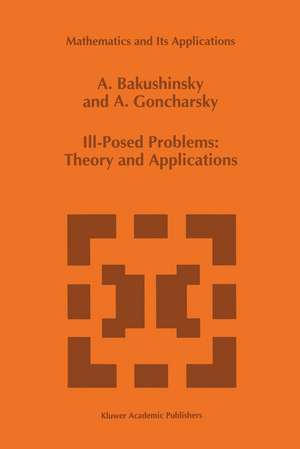
Ill-Posed Problems: Theory and Applications: Mathematics and Its Applications, cartea 301
Autor A. Bakushinsky, A. Goncharskyen Limba Engleză Hardback – 30 sep 1994
Din seria Mathematics and Its Applications
- 18%
 Preț: 1048.25 lei
 -
 Preț: 412.68 lei
 - 15%
 Preț: 672.96 lei
 - 15%
 Preț: 662.05 lei
 -
 Preț: 404.05 lei
 - 15%
 Preț: 668.15 lei
 - 15%
 Preț: 667.29 lei
 -
 Preț: 399.19 lei
 - 20%
 Preț: 615.89 lei
 -
 Preț: 405.32 lei
 -
 Preț: 404.56 lei
 - 18%
 Preț: 1037.84 lei
 - 15%
 Preț: 668.41 lei
 - 15%
 Preț: 676.76 lei
 - 15%
 Preț: 677.98 lei
 - 15%
 Preț: 624.77 lei
 - 15%
 Preț: 616.45 lei
 -
 Preț: 401.99 lei
 -
 Preț: 439.09 lei
 -
 Preț: 399.31 lei
 - 15%
 Preț: 670.10 lei
 - 15%
 Preț: 618.99 lei
 - 18%
 Preț: 975.31 lei
 - 20%
 Preț: 684.97 lei
 - 20%
 Preț: 662.39 lei
 -
 Preț: 411.74 lei
 -
 Preț: 400.98 lei
 -
 Preț: 436.79 lei
 -
 Preț: 368.23 lei
 - 15%
 Preț: 668.41 lei
 -
 Preț: 402.52 lei
 -
 Preț: 374.91 lei
 - 15%
 Preț: 679.50 lei
 - 15%
 Preț: 677.73 lei
 - 20%
 Preț: 645.35 lei
 -
 Preț: 414.61 lei
 -
 Preț: 399.93 lei
 - 18%
 Preț: 985.19 lei
 -
 Preț: 405.84 lei
 - 15%
 Preț: 676.33 lei
 - 15%
 Preț: 668.83 lei
 -
 Preț: 403.53 lei
 - 15%
 Preț: 669.80 lei
 - 15%
 Preț: 662.17 lei
Preț: 405.32 lei
Puncte Express: 608
Carte tipărită la comandă
Livrare economică 21 noiembrie-05 decembrie
Livrare prin curier în România Termenul estimat este afișat lângă disponibilitate.
Transport gratuit pentru acest produs Plată online sau ramburs, în funcție de opțiunile comenzii.
Retur gratuit în 14 zile Comandă securizată și suport în română.
Specificații
ISBN-13: 9780792330738
ISBN-10: 0792330730
Pagini: 272
Ilustrații: X, 258 p. 8 illus.
Dimensiuni: 160 x 241 x 20 mm
Greutate: 0.52 kg
Ediția:1994
Editura: Springer
Colecția Mathematics and its Applications
Seria Mathematics and Its Applications
Locul publicării:Dordrecht, Netherlands
ISBN-10: 0792330730
Pagini: 272
Ilustrații: X, 258 p. 8 illus.
Dimensiuni: 160 x 241 x 20 mm
Greutate: 0.52 kg
Ediția:1994
Editura: Springer
Colecția Mathematics and its Applications
Seria Mathematics and Its Applications
Locul publicării:Dordrecht, Netherlands
V-ar putea interesa
-
 Algorithmic Aspects of Flows in NetworksGünther Ruhe-20%Preț: 343.83 lei429.79 lei
 -
 Algorithms for Elliptic ProblemsMarián Vajteršic-20%Preț: 672.58 lei840.73 lei
 -
 Functional IntegralsA. D. Egorov-15%Preț: 676.90 lei796.35 lei
 -
 Numerical Methods for the Solution of Ill-Posed ProblemsA. N. TikhonovPreț: 413.14 lei
 -
 Vortex MethodsLung-An Ying-15%Preț: 664.02 lei781.21 lei
 -
 Preț: 382.64 lei
 -
 Regularization of Ill-Posed Problems by Iteration MethodsS. F. GilyazovPreț: 410.76 lei
 -
 Regularization of Inverse ProblemsHeinz Werner Engl-18%Preț: 1055.17 lei1286.79 lei
 -
 -9%Preț: 874.72 lei961.24 lei
 -
 Large Strain Finite Element MeMunjiza-27%Preț: 726.59 lei995.34 lei
 -
 -9%Preț: 857.85 lei942.69 lei
 -
 Iterative Methods for Approximate Solution of Inverse ProblemsA. B. BakushinskyPreț: 407.65 lei
 -
 Theory of Fuzzy ComputationApostolos SyropoulosPreț: 401.21 lei
 -
 Implicit Functions and Solution MappingsAsen L. Dontchev-15%Preț: 622.04 lei731.81 lei
 -
 Iterative Methods for Ill-Posed ProblemsAnatoly B. Bakushinsky-23%Preț: 1002.73 lei1302.24 lei
 -
 Mathematical Cardiac ElectrophysiologyPiero Colli Franzone-15%Preț: 676.20 lei795.53 lei
 -
 -20%Preț: 527.39 lei659.24 lei
 -
 -20%Preț: 519.81 lei649.76 lei
 -
 -29%Preț: 476.07 lei670.51 lei
 -
 -20%Preț: 510.36 lei637.95 lei
 -
 Numerical Techniques for Global Atmospheric ModelsPeter H. Lauritzen-15%Preț: 709.66 lei834.89 lei
 -
 The Concept of Stability in Numerical MathematicsWolfgang HackbuschPreț: 403.03 lei
 -
 Tensor Spaces and Numerical Tensor CalculusWolfgang Hackbusch-24%Preț: 759.08 lei998.80 lei
 -
 Some Basic Problems of the Mathematical Theory of ElasticityN. I. Muskhelishvili-18%Preț: 1285.60 lei1567.81 lei
 -
 Numerical Methods for the Solution of Ill-Posed ProblemsA. N. TikhonovPreț: 370.85 lei
 -
 ASYMPTOTIC METHODS FOR INTEGRALSTemme Nico M-18%Preț: 1297.75 lei1582.62 lei
 -
 Introduction to Computational Mathematics (2nd Edition)UK" University of Cambridge, UK <p> "University of Cambridge, UK" <p> "University of Cambridge, UK" University of Cambridge, UK <p> "University of Cambridge, UK" <p> "University of Cambridge, UK" University of Cambridge, UK) Yang, Xin-She (<p> "University of CambridgePreț: 459.63 lei
Public țintă
ResearchCuprins
Preface.- 1 General problems of regularizability.- 1.1 Definition of regularizing algorithm (RA).- 1.2 General theorems on regularizability and principles of constructing the regularizing algorithms.- 1.3 Estimates of approximation error in solving the ill-posed problems.- 1.4 Comparison of RA. The concept of optimal algorithm.- 2 Regularizing algorithms on compacta.- 2.1 The normal solvability of operator equations.- 2.2 Theorems on stability of the inverse mappings.- 2.3 Quasisolutions of the ill-posed problems.- 2.4 Properties of ?-quasisolutions on the sets with special structure.- 2.5 Numerical algorithms for approximate solving the ill-posed problem on the sets with special structure.- 3 Tikhonov’s scheme for constructing regularizing algorithms.- 3.1 RA in Tikhonov’s scheme with a priori choice of the regularization parameter.- 3.2 A choice of regularization parameter with the use of the generalized discrepancy.- 3.3 Application of Tikhonov’s scheme to Fredholm integral equations of the first kind.- 3.4 Tikonov’s scheme for nonlinear operator equations.- 3.5 Numerical implementation of Tikhonov’s scheme for solving operator equation.- 4 General technique for constructing linear RA for linear problems in Hilbert space.- 4.1 General scheme for constructing RA for linear problems with completely continuous operator.- 4.2 General case of constructing the approximating families and RA.- 4.3 Error estimates for solutions of the ill-posed problems. The optimal algorithms.- 4.4 Regularization in case of perturbed operator.- 4.5 Construction of linear approximating families and RA in Banach space.- 4.6 Stochastic errors. Approximation and regularization of the solution of linear problems in case of stochastic errors.- 5 Iterative algorithms for solvingnon-linear ill-posed problems with monotonic operators. Principle of iterative regularization.- 5.1 Variational inequalities as a way of formulating non-linear problems.- 5.2 Equivalent transforms of variational inequalities.- 5.3 Browder-Tikhonov approximation for the solutions of variational inequalities.- 5.4 Principle of iterative regularization.- 5.5 Iterative regularization based on the zero-order techniques.- 5.6 Iterative regularization based on the first-order technique (regularized Newton technique).- 5.7 RA for solving variational inequalities.- 5.8 Estimates of convergence rate of the iterative regularizing algorithms.- 6 Applications of the principle of iterative regularization.- 6.1 Algorithms for minimizing convex functionals. Solving the non-linear equations with monotonic operators.- 6.2 Algorithms for minimizing quadratic functionals. Non-linear procedures for solving linear problems.- 6.3 Iterative algorithms for solving general problems of mathematical programming.- 6.4 Algorithms to find the saddle points and equilibrium points in games.- 7 Iterative methods for solving non-linear ill-posed operator equations with non-monotonic operators.- 7.1 Iteratively regularized Gauss - Newton technique for operator equations.- 7.2 The other ways of constructing iterative algorithms for general ill-posed operator equations.- 8 Application of regularizing algorithms to solving practical problems.- 8.1 Inverse problems of image processing.- 8.2 Reconstructive computerized tomography.- 8.3 Computerized tomography of layered objects.- 8.4 Tomographic examination of objects with focused radiation.- 8.5 Seismic tomography in engineering geophysics.- 8.6 Inverse problems of acoustic sounding in wave approximation.- 8.7 Inverse problems of gravimetry.- 8.8 Problems oflinear programming.