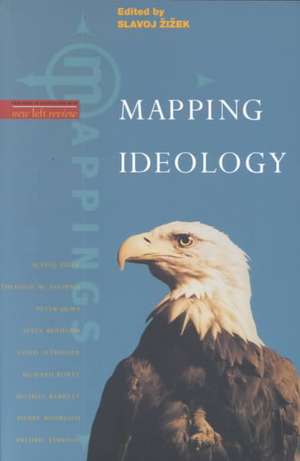
Ideology: Mappings S.
Autor Slavoj Zizeken Limba Engleză Paperback – 31 ian 1995
Această lucrare se prezintă sub forma unui companion teoretic esențial, un „reader” care reunește cele mai influente texte contemporane despre conceptul de ideologie. Într-o perioadă în care termenul risca să devină desuet, Slavoj Zizek coordonează o selecție riguroasă care demonstrează vitalitatea acestui domeniu în teoria culturală și practica politică. Volumul este structurat pentru a oferi o hartă conceptuală clară, pornind de la rădăcinile marxiste și trecând prin perspectivele Școlii de la Frankfurt, reprezentată aici prin Theodor Adorno, până la abordările post-structuraliste și psihanalitice.
Reținem că elementul distinctiv al ediției este eseul introductiv semnat de Slavoj Zizek, care nu doar sintetizează istoricul termenului, ci îl și recalibrează prin lentila lacaniană, temă centrală și în lucrarea sa de referință The Sublime Object of Ideology. Antologia facilitează un dialog critic între tradiții diverse: de la analiza aparatelor ideologice de stat ale lui Althusser, la pragmatismul lui Richard Rorty și teoriile lui Fredric Jameson despre capitalismul târziu. Comparabil cu On the Theory and History of Ideological Production de Malcolm K Read în ceea ce privește rigoarea analizei raporturilor sociale, volumul de față este însă mult mai cuprinzător, servind drept panoramă a întregului spectru de gândire politică și socială din secolul XX. Stilul textelor variază de la densitatea teoretică a lui Lacan la interviul clar și concis cu Pierre Bourdieu, oferind o experiență de lectură stratificată, adaptată nevoilor curriculare din științele politice și sociologie.
Preț: 247.77 lei
Carte indisponibilă temporar
Specificații
ISBN-10: 1859840558
Pagini: 341
Dimensiuni: 153 x 236 x 27 mm
Greutate: 0.52 kg
Editura: VERSO
Seriile Mappings S., Mapping (Paperback)
Locul publicării:United Kingdom
V-ar putea interesa
-
 Nato's Post-Cold War TrajectoryM. WebberPreț: 394.33 lei
 -
 Rationality and the Ideology of DisconnectionMichael TaylorPreț: 205.55 lei
 -
 Social Movements and American Political InstitutionsAnne N. Costain-21%Preț: 365.12 lei463.44 lei
 -
 Class, Crisis and the StateErik Olin WrightPreț: 146.96 lei
 -
 -8%Preț: 443.13 lei481.67 lei
 -
 The Future of Intelligence: Challenges in the 21st centuryIsabelle Duyvesteyn-15%Preț: 431.29 lei507.40 lei
 -
 Obama's WarsBob WoodwardPreț: 108.92 lei
 -
 Major, J: Communicating with IntelligenceJames S. Major-15%Preț: 505.52 lei594.73 lei
 -
 Liberty or Equality: The Challenge of Our TimesErik Ritter Von Kuehnelt-LeddihnPreț: 108.92 lei
 -
 Shattered HopesJosh RuebnerPreț: 239.99 lei
 -
 Frames of WarJudith ButlerPreț: 99.30 lei
 -
 Thomas Piketty's Capital in the Twenty-First CenturyStephan KaufmannPreț: 106.34 lei
 -
 Liebe Dein Symptom wie Dich selbst!Slavoj ZizekPreț: 104.80 lei
De ce să citești această carte
Recomandăm această antologie oricărui student sau cercetător în științe sociale care dorește să înțeleagă mecanismele invizibile ale puterii. Cititorul câștigă acces la o bibliotecă întreagă de texte fundamentale într-un singur volum, beneficiind de ghidajul critic al lui Žižek. Este un instrument indispensabil pentru a decoda discursurile politice actuale și pentru a înțelege cum ideologia modelează realitatea cotidiană, dincolo de simplele prejudecăți politice.
Despre autor
Slavoj Žižek (născut în 1949 la Ljubljana) este unul dintre cei mai proeminenți intelectuali publici ai contemporaneității. Filozof, teoretician cultural și critic de film, Žižek a revoluționat critica de ideologie prin fuziunea neortodoxă între idealismul german (Hegel), marxism și psihanaliza lacaniană. Cu un parcurs academic ce include doctorate la Ljubljana și Paris, el a devenit o figură centrală a stângii intelectuale. Opera sa vastă, care include titluri precum Enjoy Your Symptom! sau Surplus-Enjoyment, este marcată de un stil provocator, utilizând adesea referințe din cultura populară pentru a explica concepte filozofice abstracte.
Notă biografică
Theodor Adorno was director of the Institute for Social Research at the University of Frankfurt from 1956 until his death in 1969. His works include In Search of Wagner; Aesthetic Theory; Negative Dialectics; and (with Max Horkheimer) Dialectic of Enlightenment and Towards a New Manifesto.
Louis Althusser was born in Algeria in 1918 and died in France in 1990. He taught philosophy for many years at the Ecole Normale Superieur in Paris, and was a leading intellectual in the French Communist Party. His books include For Marx; Reading Capital (with Etienne Balibar); Essays in Ideology; Politics and History: Montesquieu, Rousseau, Marx; Machiavelli and Us; and The Spectre of Hegel.
Michèle Barrett is Professor of Modern Literary and Cultural Theory in the School of English and Drama, Queen Mary, University of London. She is the author, among other works, of Women’s Oppression Today, The Anti-Social Family, and Politics of Diversity (co-authored with Roberta Hamilton).
Pierre Bourdieu (1930–2002) was Professor of Sociology at the Collège de France and Director of Studies at the Ecole des Hautes Etudes en Sciences Sociales. He was the author of many books, most notably Distinction, The Rules of Art, The State Nobility, Homo Academicus, The Logic of Practice, and The Weight of the World.
Peter Dews is Professor of Philosophy at the University of Essex. He has published widely on contemporary French and German thought, and is the author of The Limits of Disenchantment.
Terry Eagleton is Professor of Cultural Theory and John Rylands Fellow, University of Manchester. His other books include Ideology; The Function of Criticism; Heathcliff and the Great Hunger; Against the Grain; Walter Benjamin; and Criticism and Ideology, all from Verso.
Fredric Jameson is Distinguished Professor of Comparative Literature at Duke University. The author of numerous books, he has over the last three decades developed a richly nuanced vision of Western culture’s relation to political economy. He was a recipient of the 2008 Holberg International Memorial Prize. He is the author of many books, including Postmodernism, Or, The Cultural Logic of Late Capitalism, The Cultural Turn, A Singular Modernity, The Modernist Papers, Archaeologies of the Future, Brecht and Method, Ideologies of Theory, Valences of the Dialectic, The Hegel Variations and Representing Capital.
The psychoanalyst Jacques Lacan (1901–1981) was one of the twentieth century’s most influential thinkers. His many published works include Ecrits and The Seminars.
Göran Therborn holds the Chair of Sociology at the University of Cambridge, and is editor and author of Inequalities of the World, Asia and Europe in Globalization, Between Sex and Power and From Marxism to Post Marxism?
Bryan S. Turner is professor of Sociology in the Department of Sociology at Cambridge University in England and a professorial fellow of Fitzwilliam College, Cambridge. His previous publications include The Body and Society (1984), Medical Power and Social Knowledge (1987) and Regulating Bodies (1992). He is the joint editor with Mike Featherstone of the journal Body & Society. He teaches medical sociology and the sociology of human rights at Cambridge. He is currently editing the Cambridge Dictionary of Sociology (with Craig Calhoun and Chris Rojek) and the International Handbook of Sociology. He is also doing research on rights, learning disabilities, and social inclusion.
Descriere scurtă
Mapping Ideology presents a comprehensive sampling of the most important contemporary writing on the subject. Slavoj Žižek’s introductory essay surveys the development of the concept from Marx to the present. Terry Eagleton, Peter Dews and Seyla Benhabib assess the decisive contributions of Lukács and the Frankfurt School. A different tradition is revealed in an essay by the French post-structuralist Michel Pêcheux, while the study of ideology is exemplified in classic texts by Theodor Adorno, Jacques Lacan and Louis Althusser. An intersection of Gramscian and Althusserian motifs appears in a now famous debate over “the dominant ideology thesis,” reprinted here. Pierre Bourdieu succinctly formulates his departure from this tradition in an interview with Eagleton. Further readings of the ideological are explored by Richard Rorty and Michèle Barrett. Finally Fredric Jameson supplies an authoritative statement of the nature and position of the ideological in late capitalist society. Mapping Ideology is an invaluable guide to what is now the most dynamic field of cultural theory.