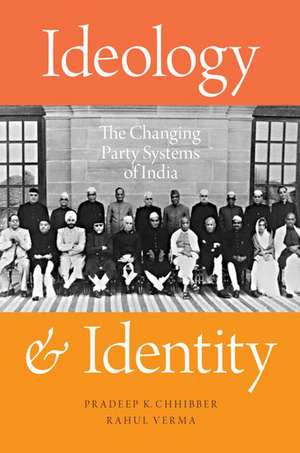
Ideology and Identity: The Changing Party Systems of India
Autor Pradeep K. Chhibber, Rahul Vermaen Limba Engleză Paperback – 8 noi 2018
Preț: 267.69 lei
Preț vechi: 324.13 lei
-17%
Puncte Express: 402
Carte tipărită la comandă
Livrare economică 19-25 noiembrie
Livrare prin curier în România Termenul estimat este afișat lângă disponibilitate.
Transport gratuit de la 400.00 lei Plată online sau ramburs, în funcție de opțiunile comenzii.
Retur gratuit în 14 zile Comandă securizată și suport în română.
Specificații
ISBN-13: 9780190623883
ISBN-10: 0190623888
Pagini: 336
Ilustrații: 50 illustrations
Dimensiuni: 231 x 155 x 20 mm
Greutate: 0.48 kg
Editura: Oxford University Press
Colecția OUP USA
Locul publicării:New York, United States
ISBN-10: 0190623888
Pagini: 336
Ilustrații: 50 illustrations
Dimensiuni: 231 x 155 x 20 mm
Greutate: 0.48 kg
Editura: Oxford University Press
Colecția OUP USA
Locul publicării:New York, United States
V-ar putea interesa
-
 -18%Preț: 271.61 lei331.77 lei
 -
 -19%Preț: 379.50 lei466.64 lei
 -
 -15%Preț: 67.27 lei78.70 lei
 -
 Religion's Sudden Decline: What's Causing it, and What Comes Next?Ronald F. Inglehart-17%Preț: 205.81 lei248.45 lei
 -
 Research Strategies in the Social Sciences: A Guide to New ApproachesElinor Scarbrough-33%Preț: 710.43 lei1053.97 lei
 -
 The National Co-ordination of EU Policy: The Domestic LevelHussein Kassim-33%Preț: 1216.03 lei1811.84 lei
 -
 -32%Preț: 706.74 lei1046.61 lei
 -
 Arguing Comparative PoliticsAlfred Stepan-25%Preț: 626.32 lei838.57 lei
 -
 Technopopulism: The New Logic of Democratic PoliticsChristopher J. Bickerton-22%Preț: 709.69 lei908.66 lei
 -
 Redistricting in Comparative PerspectiveLisa Handley-31%Preț: 696.82 lei1008.97 lei
 -
 Nations, States, and ViolenceDavid D. Laitin-29%Preț: 501.64 lei703.88 lei
 -
 -20%Preț: 281.07 lei353.02 lei
 -
 -21%Preț: 379.10 lei481.76 lei
 -
 -20%Preț: 381.81 lei478.14 lei
 -
 Corporatist Decline in Advanced CapitalismMark J. Gobeyn-30%Preț: 371.93 lei530.85 lei
 -
 Comparative Politics of Latin America: Democracy at Last?Daniel C. Hellinger-15%Preț: 604.95 lei711.71 lei
 -
 The Narrow CorridorDaron AcemogluPreț: 120.51 lei
 -
 Striking from the MarginsAziz Al-AzmehPreț: 229.98 lei
 -
 Religious Practice and Democracy in IndiaPradeep Chhibber-14%Preț: 771.83 lei897.48 lei
 -
 Neoliberal NationalismChristian JoppkePreț: 309.55 lei
 -
 Assault on DemocracyKurt WeylandPreț: 343.84 lei
 -
 -18%Preț: 1314.55 lei1603.11 lei
 -
 LobbyingWyn GrantPreț: 145.51 lei
 -
 Government by ReferendumMatt QvortrupPreț: 108.17 lei
 -
 Northern Ireland a Generation After Good FridayPeter ShirlowPreț: 273.52 lei
 -
 Putin's RussiaStephen K. WegrenPreț: 452.16 lei
Recenzii
This book will be useful to students and scholars interested in understanding the intellectual lineages of the issues that concern political parties in India today, and the Indian party system. It is well organized and the proofreading is good
Contrary to a dominant view of Indian voters as pawns traded by rapacious politicians, Chhibber and Verma permit India's citizens the capacity of reason and intellect. Ideology and Identity is a brave work of political theory bolstered by evidence from archives, opinion surveys, and government data that thrusts the study of Indian politics firmly into the 21st century.
This book's claim that in ethnically hierarchical and lower-income democracies like India, ideology should be viewed as a combination of what the state should do, both in society and economy, and how marginalized communities can be incorporated in the polity, is worthy of serious consideration. The arguments here will spawn many new thoughts, reflections and arguments.
This ambitious study makes a provocative argument about Indian politics. But, it also helps explain why elections in the developing world are often less chaotic, corrupt and clientelist than expected. By showing how late state formation leads to meaningful ideological cleavages, Chibber and Verma point to new ways to think about when and why elections show stable patterns in the developing world.
This book offers an alternative to the standard interpretation of Indian politics in terms of clientelism. It shows that ideology matters, even if it does not fit in the usual right vs left pattern. Besides the rise of Hindu nationalism, the rejection of state intervention in favor of positive discrimination or redistribution bear testimony of this ideological factor. This emphasis on the role of ideas (or prejudice!) refreshingly rehabilitates political culture as a key dimension of Indias public sphere.
Chhibber and Verma (both UC Berkeley) present an important case that Indian politics is and has always been quite ideological, despite standard views that it simply rewards various castes... This complex, quantified study invites comparisons with other multi-ethnic societies, and implicitly warns US Democrats against turning too much to "recognition" of marginal groups. The 2019 elections could show if the BJP's combination of Hinduism and markets holds together.
"Partisan politics is often said to have little to do with ideology in India. Pradeep Chhibber and Rahul Verma's impressive new book is intended to bury this perception, and in the process unpack the role of ideology in Indian politics. This makes it both a remarkable and an original addition to the rapidly accumulating scholarship on India, and as such, one that is required reading for all analysts of Indian politics."-Simon Chauchard, Perspective on Politics
Contrary to a dominant view of Indian voters as pawns traded by rapacious politicians, Chhibber and Verma permit India's citizens the capacity of reason and intellect. Ideology and Identity is a brave work of political theory bolstered by evidence from archives, opinion surveys, and government data that thrusts the study of Indian politics firmly into the 21st century.
This book's claim that in ethnically hierarchical and lower-income democracies like India, ideology should be viewed as a combination of what the state should do, both in society and economy, and how marginalized communities can be incorporated in the polity, is worthy of serious consideration. The arguments here will spawn many new thoughts, reflections and arguments.
This ambitious study makes a provocative argument about Indian politics. But, it also helps explain why elections in the developing world are often less chaotic, corrupt and clientelist than expected. By showing how late state formation leads to meaningful ideological cleavages, Chibber and Verma point to new ways to think about when and why elections show stable patterns in the developing world.
This book offers an alternative to the standard interpretation of Indian politics in terms of clientelism. It shows that ideology matters, even if it does not fit in the usual right vs left pattern. Besides the rise of Hindu nationalism, the rejection of state intervention in favor of positive discrimination or redistribution bear testimony of this ideological factor. This emphasis on the role of ideas (or prejudice!) refreshingly rehabilitates political culture as a key dimension of Indias public sphere.
Chhibber and Verma (both UC Berkeley) present an important case that Indian politics is and has always been quite ideological, despite standard views that it simply rewards various castes... This complex, quantified study invites comparisons with other multi-ethnic societies, and implicitly warns US Democrats against turning too much to "recognition" of marginal groups. The 2019 elections could show if the BJP's combination of Hinduism and markets holds together.
"Partisan politics is often said to have little to do with ideology in India. Pradeep Chhibber and Rahul Verma's impressive new book is intended to bury this perception, and in the process unpack the role of ideology in Indian politics. This makes it both a remarkable and an original addition to the rapidly accumulating scholarship on India, and as such, one that is required reading for all analysts of Indian politics."-Simon Chauchard, Perspective on Politics
Notă biografică
Pradeep K. Chhibber is Professor of Political Science and Indo-American Community Chair for India Studies at the University of California, Berkeley. He has published widely on the party politics of India, party systems, and religion and politics. Rahul Verma is a PhD candidate in Political Science at the University of California, Berkeley. His PhD dissertation focuses on the historical roots of elite persistence in contemporary Indian politics. His research interests include voting behavior, party politics and political violence. He also writes regular columns on Indian politics.
Cuprins
- Acknowledgements
- List of Tables and Graphs
- Introduction: Ideology in India's Electoral Politics
- Chapter 1. State Formation and Ideological Conflict in Multiethnic Countries
- Chapter 2. Ideology, Identity, and the 2014 National Elections
- Chapter 3. Intellectual Lineages of the Politics of Statism and Recognition
- Chapter 4. Who Opposes Reservations and Why?
- Chapter 5. The Myth of Vote Buying in India
- Chapter 6. Transformational Leaders and Ideological Shifts
- Chapter 7. Transmitting Ideology
- Chapter 8. Statism, Recognition, and the Party System Change in India
- Chapter 9. Ideological Challenges and the Decline of the Congress Party
- Chapter 10. The BJP and an Ideological Consolidation of the Right?
- Conclusion: Ideas, Leaders, and Party Systems
- Appendix
- Bibliography
- Index