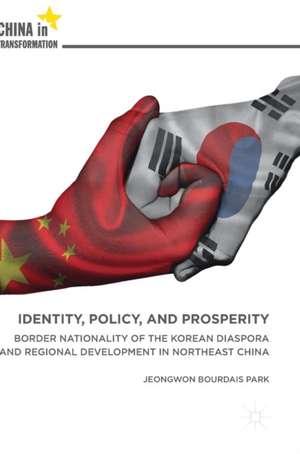
Identity, Policy, and Prosperity: China in Transformation
Autor Jeongwon Bourdais Parken Limba Engleză Hardback – 29 aug 2017


Preț: 617.22 lei
Preț vechi: 726.14 lei
-15%
Puncte Express: 926
Carte tipărită la comandă
Livrare economică 11-25 noiembrie
Livrare prin curier în România Termenul estimat este afișat lângă disponibilitate.
Transport gratuit pentru acest produs Plată online sau ramburs, în funcție de opțiunile comenzii.
Retur gratuit în 14 zile Comandă securizată și suport în română.
Specificații
ISBN-13: 9789811048487
ISBN-10: 9811048487
Pagini: 212
Ilustrații: XV, 193 p. 2 illus.
Dimensiuni: 153 x 216 x 17 mm
Greutate: 0.39 kg
Ediția:1st edition 2018
Editura: Springer
Colecția China in Transformation
Seria China in Transformation
Locul publicării:Singapore, Singapore
ISBN-10: 9811048487
Pagini: 212
Ilustrații: XV, 193 p. 2 illus.
Dimensiuni: 153 x 216 x 17 mm
Greutate: 0.39 kg
Ediția:1st edition 2018
Editura: Springer
Colecția China in Transformation
Seria China in Transformation
Locul publicării:Singapore, Singapore
Cuprins
1. Introduction.- 2: Diaspora, national identity, and reciprocal prosperity.- 3: Communist Nation Building and Territorialized Ethnicization .- 4: Economic reforms, de-ethnicization, and the survival of identity.- 5: Developmentalism, nationalism, and the prosperity of China’s northeast.- 6: Conclusions.
Notă biografică
Dr Jeongwon Bourdais Park holds a Ph.D. from the Government Department of the London School of Economics and Political Science (U.K.). The author was a Visiting Professor at the Conservatoire National dés Arts et Métiers in France between September 2010 and June 2013, and a Visiting Assistant Professor at Lingnan University Hong Kong between August 2013 and June 2017.
Textul de pe ultima copertă
This book offers a rare glimpse into China's Korean minority, which dominates the area bordering North Korea; even as Korea is riven into capitalist and communist societies, China's Koreans register this dilemma as one internal to the society they live in, in China's postindustrial Northeast. As this research makes clear, once driven by state investment in industry, the Northeast is now struggling to define its identity as a post-industrial region; the ethnic Koreans there even more so. This monograph provides a distinctive look at a group shaped by political turmoil, economic transformation, and cultural struggle; the study may offer an idea of what the future of the Korean peninsula itself might be, disentangling the puzzling contradictions and synergies between nationality, locality and development in China.
Caracteristici
Offers insights into China's ethnic minorities in an era of post-industrial reform Sheds light onto the geopolitical issues of China's northeastern borders Gives a glimpse into the everyday realities and ideological dilemmas of Koreans in contemporary China Includes supplementary material: sn.pub/extras