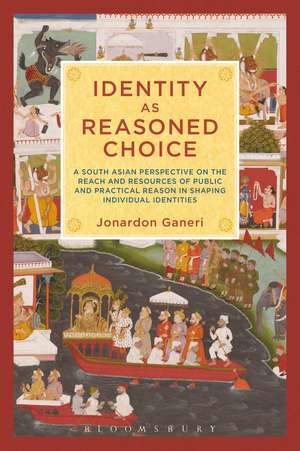
Identity as Reasoned Choice: A South Asian Perspective on The Reach and Resources of Public and Practical Reason in Shaping Individual Identities
Autor Dr. Jonardon Ganerien Limba Engleză Paperback – 19 dec 2013
Preț: 277.79 lei
Preț vechi: 329.44 lei
-16%
Puncte Express: 417
Carte tipărită la comandă
Livrare economică 03-17 decembrie
Livrare prin curier în România Termenul estimat este afișat lângă disponibilitate.
Transport gratuit de la 400.00 lei Plată online sau ramburs, în funcție de opțiunile comenzii.
Retur gratuit în 14 zile Comandă securizată și suport în română.
Specificații
ISBN-13: 9781623565886
ISBN-10: 162356588X
Pagini: 256
Dimensiuni: 153 x 234 x 14 mm
Greutate: 0.35 kg
Editura: Bloomsbury Publishing
Colecția Bloomsbury Academic
Locul publicării:New York, United States
ISBN-10: 162356588X
Pagini: 256
Dimensiuni: 153 x 234 x 14 mm
Greutate: 0.35 kg
Editura: Bloomsbury Publishing
Colecția Bloomsbury Academic
Locul publicării:New York, United States
V-ar putea interesa
-
 The Art of WarSun Tzu-19%Preț: 75.89 lei93.40 lei
 -
 -11%Preț: 352.78 lei397.68 lei
 -
 -31%Preț: 740.67 lei1076.24 lei
 -
 -20%Preț: 398.37 lei496.21 lei
 -
 The Essential HuainanziKing Of Huainan LiPreț: 255.82 lei
 -
 YinyangRobin WangPreț: 203.20 lei
 -
 Chinese PhilosophyHaiming WenPreț: 208.40 lei
 -
 Pilgrims to OpennessShambhavi SarasvatiPreț: 100.83 lei
 -
 Essence of the UpanishadsEknath EaswaranPreț: 101.63 lei
 -
 Secret Teachings of PadmasambhavaPadmasambhava-33%Preț: 93.92 lei139.23 lei
 -
 The Diamond in Your PocketGangajiPreț: 117.03 lei
 -
 Degrees of Excellence: A Fatimid Treatise on Leadership in IslamArzina R. Lalani-22%Preț: 350.58 lei452.28 lei
 -
 Freedom from the KnownJ. Krishnamurti-32%Preț: 62.09 lei91.58 lei
 -
 Creativity and Taoism: A Study of Chinese Philosophy, Art and PoetryChung-yuan Chang-19%Preț: 134.25 lei166.42 lei
Cuprins
Preface
Introduction: The Reach and Resources of Reason
PART I: PUBLIC REASON PROMOTED
1. An Ideal of Public Reason
Public reason in the Questions of Milinda
An ideal of public reason in the Nyaya-sutra
2. Ancient Indian Logic as a Theory of Case-Based Reasoning
A model of reasoning in the Nyaya-sutra
The theory transformed
Retrieving the ancient case-based model
3. Neutrality: a Theory From the Time of Asoka
A Buddhist treatise on public reason: the Elements of Dialogue
Eight stances in a dialogue
The 'way forward' and the 'way back'
4. Local Norms: the Priority of the Particular
Rules versus cases
Three models of particulars as standards
Particulars as paradigms in the Nyaya-sutra
Particulars as prototypes in the Ritual Sutras
PART II: PRACTICAL REASON RESOURCED
5. The Critic Within
Multiple Hinduisms
A dissenting voice
Meeting reason with reason
Evidence, expertise and assent
Religion and reason
6. Adapt and Substitute
The hermeneutics of ritual
Ethics in the Hindu canon
The reason of sages
Adaptive reasoning from paradigms
7. Model Humans and Moral Instincts
Persons as paradigms of exemplary conduct
Ethical dilemmas: the 'case'
The heart's approval: moral instinct
PART III: DISSENT
8. Implied Voices of Dissent
The paradox of inquiry
Inquiry as adjudication
The challenge reformulated in Sa?kara
9. Can One Seek to Answer any Question? Srihar?a
On questioning: the pragmatics of interrogative dialogue
The prior knowledge argument
Against aiming
The longing for knowledge
PART IV: IDENTITY, FOUND OR FASHIONED?
10. On the Formation of Self
Spiritual exercises and the aesthetic analogy
Philosophy as medicine
Plutarch and the Buddhists: returning oneself to the present
A life complete at every moment
Taming the self
Philosophy and the ends of life
11. Problems of Self and Identity
Reincarnation and personal identity
Higher and lower selves
Bad thoughts and conscience
No self?
Being true to your individual self
12. Identity and Illusions about the Self
Speaking about the self
Polestar and compass: two modes of practical reason
The ethics of self-deception and the reach of reason
Cognitive stories
13. "What You Are You Do Not See, What You See is Your Shadow"
The philosophical double
The double in Mauni's fiction
Self to self
Inhabiting an identity
PART V: IDENTITY & THE MODERN INTELLECTUAL
14. Interpreting Intellectual India
Questions of method
Objectivity
Immersion
15. An Exemplary Indian Intellectual
Bimal Krishna Matilal
A conversation among equals
A common ground?
16. India and the Shaping of Global Intellectual Culture
Covert borrowings
Other routes of influence
Concluding Summary
Bibliography
Introduction: The Reach and Resources of Reason
PART I: PUBLIC REASON PROMOTED
1. An Ideal of Public Reason
Public reason in the Questions of Milinda
An ideal of public reason in the Nyaya-sutra
2. Ancient Indian Logic as a Theory of Case-Based Reasoning
A model of reasoning in the Nyaya-sutra
The theory transformed
Retrieving the ancient case-based model
3. Neutrality: a Theory From the Time of Asoka
A Buddhist treatise on public reason: the Elements of Dialogue
Eight stances in a dialogue
The 'way forward' and the 'way back'
4. Local Norms: the Priority of the Particular
Rules versus cases
Three models of particulars as standards
Particulars as paradigms in the Nyaya-sutra
Particulars as prototypes in the Ritual Sutras
PART II: PRACTICAL REASON RESOURCED
5. The Critic Within
Multiple Hinduisms
A dissenting voice
Meeting reason with reason
Evidence, expertise and assent
Religion and reason
6. Adapt and Substitute
The hermeneutics of ritual
Ethics in the Hindu canon
The reason of sages
Adaptive reasoning from paradigms
7. Model Humans and Moral Instincts
Persons as paradigms of exemplary conduct
Ethical dilemmas: the 'case'
The heart's approval: moral instinct
PART III: DISSENT
8. Implied Voices of Dissent
The paradox of inquiry
Inquiry as adjudication
The challenge reformulated in Sa?kara
9. Can One Seek to Answer any Question? Srihar?a
On questioning: the pragmatics of interrogative dialogue
The prior knowledge argument
Against aiming
The longing for knowledge
PART IV: IDENTITY, FOUND OR FASHIONED?
10. On the Formation of Self
Spiritual exercises and the aesthetic analogy
Philosophy as medicine
Plutarch and the Buddhists: returning oneself to the present
A life complete at every moment
Taming the self
Philosophy and the ends of life
11. Problems of Self and Identity
Reincarnation and personal identity
Higher and lower selves
Bad thoughts and conscience
No self?
Being true to your individual self
12. Identity and Illusions about the Self
Speaking about the self
Polestar and compass: two modes of practical reason
The ethics of self-deception and the reach of reason
Cognitive stories
13. "What You Are You Do Not See, What You See is Your Shadow"
The philosophical double
The double in Mauni's fiction
Self to self
Inhabiting an identity
PART V: IDENTITY & THE MODERN INTELLECTUAL
14. Interpreting Intellectual India
Questions of method
Objectivity
Immersion
15. An Exemplary Indian Intellectual
Bimal Krishna Matilal
A conversation among equals
A common ground?
16. India and the Shaping of Global Intellectual Culture
Covert borrowings
Other routes of influence
Concluding Summary
Bibliography
Recenzii
"Drawing on premodern answers to rethink postmodern questions, and doing so with a philosopher's rigor, a non-philosopher's readability, and enormously creative thinking, Jonardon Ganeri does two important things at once. He suggests how to move forward into the future on the thorniest problems of self-identification, while revealing the depths of India's intellectual past and the resources it can offer for that task." -Sheldon Pollock, Columbia University
"Recent philosophical writing on the subject of identity. though often focused on distant parts of the globe, has failed to tap the philosophical traditions outside the West in the analyses it provides. This ambitious book admirably overcomes that limitation and locates in the tradition of Indian philosophy a basis for the idea that our identities are not given to us but are rationally chosen. Its range of historical reference --from Manu to Matilal-- is impressive and presented with confidence and verve. It will add rigour and detail and historical depth to a concept ('identity') that still remains relatively indisciplined in its deployment in the study of politics and culture." - Akeel Bilgrami, Johnsonian Professor of Philosophy, Department of Philosophy, Committee on Global Thought, Columbia University, New York.
Laudable both for its academic and philosophical rigor and the extent to which the traditions discussed in this book are deeply in play among individuals and groups interested in Eastern spirituality, I should hope that Ganeri is suitably commended for successfully meeting the criteria of both sets of readers - though I can't imagine how pleased the reader in the centre of this particular Venn diagram might be.
Taking Amartya Sen's claim about India's long traditions of debate and tolerance of diversity as his starting point, this engaging and thought-provoking book explores a number of specific examples of argumentation and public reasoning in traditional Indian sources. Yet Ganeri's approach is far more rigorous, examining a wide variety of sources, including: Nya¯ya texts on logic, philosophical narratives in the Upanis?ads, Nika¯yas, and the Maha¯bha¯rata, and S´abara's commentary on the Mi¯ma¯m?sa¯ Su¯tra. Throughout, Ganeri highlights the ways Indian sources make reasoned arguments, linking pre-modern examples of public and practical reason to current debates about politics and identity in India. One of Ganeri's central arguments is that India's religious traditions can sustain secular and democratic ideals. Such claims have much to offer recent debates about secularism and the role of religion in the public sphere.
"Recent philosophical writing on the subject of identity. though often focused on distant parts of the globe, has failed to tap the philosophical traditions outside the West in the analyses it provides. This ambitious book admirably overcomes that limitation and locates in the tradition of Indian philosophy a basis for the idea that our identities are not given to us but are rationally chosen. Its range of historical reference --from Manu to Matilal-- is impressive and presented with confidence and verve. It will add rigour and detail and historical depth to a concept ('identity') that still remains relatively indisciplined in its deployment in the study of politics and culture." - Akeel Bilgrami, Johnsonian Professor of Philosophy, Department of Philosophy, Committee on Global Thought, Columbia University, New York.
Laudable both for its academic and philosophical rigor and the extent to which the traditions discussed in this book are deeply in play among individuals and groups interested in Eastern spirituality, I should hope that Ganeri is suitably commended for successfully meeting the criteria of both sets of readers - though I can't imagine how pleased the reader in the centre of this particular Venn diagram might be.
Taking Amartya Sen's claim about India's long traditions of debate and tolerance of diversity as his starting point, this engaging and thought-provoking book explores a number of specific examples of argumentation and public reasoning in traditional Indian sources. Yet Ganeri's approach is far more rigorous, examining a wide variety of sources, including: Nya¯ya texts on logic, philosophical narratives in the Upanis?ads, Nika¯yas, and the Maha¯bha¯rata, and S´abara's commentary on the Mi¯ma¯m?sa¯ Su¯tra. Throughout, Ganeri highlights the ways Indian sources make reasoned arguments, linking pre-modern examples of public and practical reason to current debates about politics and identity in India. One of Ganeri's central arguments is that India's religious traditions can sustain secular and democratic ideals. Such claims have much to offer recent debates about secularism and the role of religion in the public sphere.