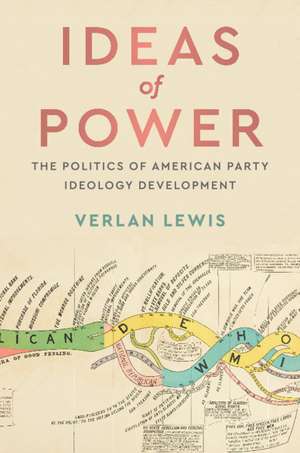
Ideas of Power: The Politics of American Party Ideology Development
Autor Verlan Lewisen Limba Engleză Paperback – mai 2019
În literatura academică dedicată sistemelor politice, persistă adesea o lacună în explicarea mecanismelor prin care conceptele de liberalism și conservatorism își modifică substanța în timp. Suntem de părere că Ideas of Power, publicată de Cambridge University Press, vine să completeze această lipsă, oferind o perspectivă dinamică asupra modului în care ideologiile nu sunt doar fundamente doctrinare, ci produse ale luptei pentru putere instituțională. Verlan Lewis demonstrează cum înțelesurile acestor termeni se transformă radical în funcție de cine controlează Congresul, Președinția sau Curtea Supremă.
Putem afirma că acest volum reprezintă o evoluție firească a cercetărilor autorului. Dacă în The Myth of Left and Right acesta critica inadecvarea spectrului politic actual, în Ideas of Power el investighează rădăcinile istorice ale acestei confuzii, urmărind traseul partidelor de la federaliștii lui Hamilton până la democrații și republicanii de astăzi. Această abordare istorică este susținută riguros de tabele și ilustrații care cartografiază schimbările ideologice.
Reținem că lucrarea acoperă o arie similară cu Political Ideologies and Political Parties in America de Hans Noel, dar cu o abordare care diferă prin accentul pus pe instituțiile statului ca motor al schimbării ideologice. În timp ce Hans Noel vede ideologiile ca forțe independente care modelează partidele, Verlan Lewis propune o viziune mai pragmatică, în care exercitarea puterii guvernamentale este cea care dictează redefinirea ideologică. Spre deosebire de Party Ideologies in America, 1828–1996 de John Gerring, care pune accent pe stabilitatea și coerența retoricii electorale, Verlan Lewis evidențiază tocmai fluiditatea și adaptabilitatea acestor constructe politice.
Preț: 277.62 lei
Carte tipărită la comandă
Livrare economică 09-23 iunie
Specificații
ISBN-10: 110870154X
Pagini: 214
Ilustrații: 4 b/w illus. 12 tables
Dimensiuni: 152 x 228 x 12 mm
Greutate: 0.32 kg
Editura: Cambridge University Press
Colecția Cambridge University Press
Locul publicării:New York, United States
De ce să citești această carte
Această lucrare este esențială pentru cercetătorii și studenții la științe politice care doresc să înțeleagă de ce partidele americane par să își schimbe principiile de la o decadă la alta. Cititorul câștigă o perspectivă istorică documentată asupra modului în care controlul instituțional modifică discursul politic, oferind instrumente critice pentru a analiza polarizarea actuală dincolo de etichetele simpliste de „stânga” sau „dreapta”.
Descriere scurtă
Cuprins
Recenzii
'In documenting how party ideologies have changed throughout American history - and with them the very meanings of liberalism and conservatism - Lewis challenges mainstream views about the origins and role of ideology, the value of DW-NOMINATE scores, and how the dynamics of American politics can best be understood. He is calling for a transformation in the analytics at the heart of the field. This is what contributions are made of.' Terry M. Moe, William Bennett Munro Professor of Political Science, Stanford University
'In this ambitious study, Verlan Lewis contends that American political parties, and American politics more broadly, can only be understood by paying serious attention to partisan ideas; by recognizing that they, and the meanings of 'liberal' and 'conservative', 'right' and 'left', change over time; and by understanding how wielding governing power can contribute to ideological change. Literatures in several fields will need to come to grip with these important arguments.' Rogers M. Smith, Christopher H. Browne Distinguished Professor of Political Science, University of Pennsylvania
'American party ideology, as taught in political science, philosophy, and history courses, needs to be reconceptualized given Verlan Lewis's study of how it evolves based on the interpretations of the two dominant parties and which one controls the executive, legislative, and judicial branches of government. Students of public opinion and political behavior will have an answer to their question of why it so often seems that average citizens, or non-elites, have difficulty correlating ideologies, specifically conservatism and liberalism, with policy positions.' M. J. Blumberg, Choice
'The vital lessons of and the many follow-up questions that arise from Ideas of Power attest to the enormous contribution Lewis has made to several fields–APD, political thought/ideas, parties, the Presidency, Congress, and the courts. Individually and collectively, these fields will be substantially improved by engaging with Lewis's crucial arguments that (1) party ideologies are not static over time and (2) party control over institutions drives party ideology development.' John A. Dearborn, The Forum