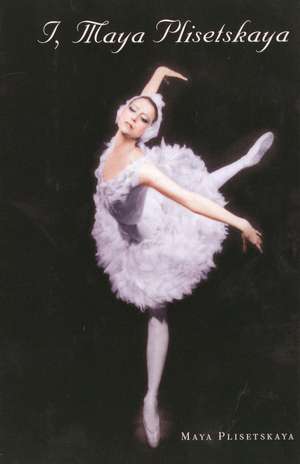
I, Maya Plisetskaya
Autor Maya Plisetskaya Traducere de Antonina W. Bouisen Limba Engleză Paperback – 5 sep 2001
Această monografie autobiografică, publicată de Yale University Press, ne oferă acces în culisele uneia dintre cele mai tumultuoase și strălucitoare cariere din istoria dansului. În volumul I, Maya Plisetskaya, celebra prim-balerină a Teatrului Bolșoi își recompune destinul cu o onestitate tăioasă, transformând paginile într-o experiență senzorială ce pendulează între grația scenei și brutalitatea sistemului sovietic. Formatul tipărit pe care îl avem în față păstrează rigoarea academică a editurii, oferind un text dens, de peste 400 de pagini, care funcționează atât ca document istoric, cât și ca mărturie artistică.
Ne-a atras atenția modul în care Maya Plisetskaya reușește să mențină un ritm narativ alert, descriind fără menajamente execuția tatălui său și exilul mamei în Gulag, evenimente care i-au marcat ascensiunea artistică începută în 1943. Putem afirma că forța cărții rezidă în contrastul dintre sublimul rolurilor interpretate — de la „Lacul Lebedelor” la colaborările avangardiste cu Maurice Béjart — și micimea hărțuirilor birocratice venite din partea oficialilor KGB. Complementar volumului Alla Osipenko de Joel Lobenthal, care explorează rebeliunea unei alte mari balerine împotriva statului, memoriile Mayei oferă o perspectivă mult mai personală și directă asupra supraviețuirii, evidențiind modul în care arta devine un mecanism de rezistență.
Recomandăm această lectură pentru bogăția detaliilor despre personalități precum George Balanchine sau Dmitri Shostakovich, dar și pentru curajul cu care Maya Plisetskaya expune realitățile turneelor internaționale, marcate de lipsuri materiale și supraveghere constantă. Este un portret viu al unei epoci de represiune și destindere culturală, scris de o artistă care a refuzat să fie redusă la tăcere.
Preț: 413.54 lei
Carte tipărită la comandă
Livrare economică 19 noiembrie-03 decembrie
Specificații
ISBN-10: 0300172478
Pagini: 470
Ilustrații: 74 b-w illus.
Dimensiuni: 152 x 229 x 32 mm
Greutate: 0.69 kg
Editura: Yale University Press
Colecția Yale University Press
V-ar putea interesa
-
 -11%Preț: 274.45 lei309.27 lei
 -
 The Little Devil and Other StoriesAlexei RemizovPreț: 114.09 lei
 -
 Preț: 255.31 lei
 -
 The Wandering of a Mind in SongBentley, Michael J.Preț: 49.40 lei
 -
 Leonard CohenMR Ian CarrollPreț: 75.74 lei
 -
 Music Manuscript - 8 StavesPublishers, Creative DesignsPreț: 62.52 lei
 -
 Music HistorySullivan, AndrewPreț: 49.16 lei
 -
 Album LeavesSmirnov, MR Dmitri N.Preț: 72.72 lei
 -
 My Music ManuscriptWsjdesignsPreț: 49.00 lei
 -
 My Vinyl Times Personal EditionMark BrenzelPreț: 69.95 lei
 -
 Preț: 110.48 lei
 -
 -28%Preț: 44.72 lei61.69 lei
 -
 -36%Preț: 45.57 lei71.55 lei
 -
 OblivionSergei LebedevPreț: 101.41 lei
 -
 A Present PastSergei LebedevPreț: 99.60 lei
De ce să citești această carte
Recomandăm această carte cititorilor care doresc să înțeleagă sacrificiile din spatele cortinei de fier. Dincolo de istoria baletului, volumul oferă o lecție de reziliență în fața totalitarismului. Veți câștiga o perspectivă unică asupra culturii sovietice, văzută prin ochii unei femei care a transformat suferința personală în artă universală. Este o resursă esențială pentru pasionații de muzică clasică, istorie și biografii puternice.
Despre autor
Maya Plisetskaya (1925–2015) este recunoscută la nivel mondial drept una dintre cele mai mari balerine ale tuturor timpurilor. Cu o carieră legată ombilical de Teatrul Bolșoi din Moscova, ea a redefinit standardele dansului clasic prin tehnica sa fenomenală și expresivitatea dramatică. În ciuda originii sale din „familie de dușmani ai poporului”, a reușit să devină un simbol cultural global, colaborând cu cei mai importanți coregrafi ai secolului XX. Recunoscută pentru longevitatea sa scenică și spiritul independent, Plisetskaya a rămas o figură emblematică a curajului artistic în fața opresiunii politice.
Descriere scurtă
Recenzii
“Like the swans she danced so often—800 performances of ‘Swan Lake’ and unnumbered renderings of the Dying Swan—Maya Plisetskaya, one of the great ballerinas of the last century, mingled beauty and fierceness. . . . She has much to be angry about and, as the Bolshoi’s prima ballerina assoluta for decades and celebrated worldwide, quite a bit to be grateful for. . . . The Plisetskaya memoir is a moving success. Here is the woman, I proclaims, and we see her—not entirely polished but overwhelming—as if she were dancing.”—Richard Eder, New York Times
“The fascinating story of how this artist of implacable will confronted and defied the Soviet regime—and eventually had her way. . . . I, Maya Plisetskaya has the virtues of candor and directness, and it has a real story to tell.”—Robert Gottlieb, Los Angeles Times Book Review
“A riveting account of pursuing artistic excellence under Soviet oppression. . . . Plisetskaya doesn’t just tell an incredible story. She also lays bare the hard work and uncertainty involved in putting it all in a book. . . . Reading this memoir feels like listening to a wonderfully strong-willed friend.”—Boston Globe
“Almost everything about Plisetskaya, now 76, seemed larger than life. And as her wonderfully intimate and detailed new autobiography reveals, that is the result of both her innately bold, born-to-be-a-diva personality, and of the often perilous Soviet political environment in which she forged her career. . . . This is a fascinating memoir, steeped in ambivalence.”—Chicago Sun-Times
“I, Maya Plisetskaya isa memoir of the Terror, the Gulag and the very fertile Soviet arts, by the athletic prima ballerina of the Bolshoi Ballet.”—Washington Post Book World
“[A]n autobiography that is also a searing indictment of Soviet Russia, of communism and of the blind naiveté with which the Isadoras of this world have often approached her country. . . . Plisetskaya’s memoirs invariably describe a life in dance. But the book’s biggest value lies in being much more than that. I, Maya is social history written by a dancer who transcends the mute language of her art to tell a universal story of suffering and endurance. The thud of irony continually disrupts the mellifluous strains of Tchaikovsky that sounds in the background of a career that spanned 50 years. . . . [A] deliciously subversive book.”—Deirdre Kelly, Toronto Globe & Mail
“Plisetskaya . . . has danced all over the world, with innumerable companies and for innumerable choreographers. And she has known ‘everyone’. She writes frankly and freely, holds strong opinions, and is never dull. The chronicle also gives insight, from her point of view, of a Soviet artist dancing through many troubled times.”—Dancing Times
“[I]nspiring. . . . Her story is frank, revealing, and never dull.”—Dance Magazine
“Now we have the English translation of Plisetskaya’s autobiography, and it is an enormously important document, both for the history of ballet and for the study of art under communism. . . . Her voice is strong, unedited, and impassioned. The book is a testimony as much as a life story. . . . It is a brave book, too, not so much for what it tells about the indignities of life under communism, but for its blind, honest style.”—Jackson Lears, New Republic
“Plisetskaya’s passionate characterizations reflected the new bravura style that became the trademark of the Bolshoi. These memoirs help explain some of the paradoxes in her life and also shed light on the Soviet Union’s relationship with its artists. Recommended for all who are fascinated with ballet, history, and Russia.”—Choice
Selected as one of the Best Nonfiction Books of 2001 by the Los Angeles Times Book Review