Cantitate/Preț
Produs

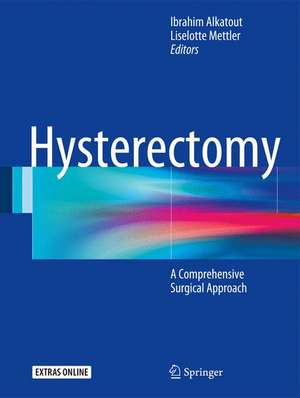
Hysterectomy: A Comprehensive Surgical Approach

Editat de Ibrahim Alkatout, Liselotte Mettler
en Limba Engleză Hardback – 4 oct 2017

Recomandăm Hysterectomy rezidenților în obstetrică-ginecologie și specialiștilor care doresc o sistematizare clinică a tehnicilor chirurgicale uterine moderne. Observăm că, deși histerectomia este o procedură cu o vechime de peste două secole, volumul editat de Ibrahim Alkatout și Liselotte Mettler reușește să ancoreze această intervenție în realitatea tehnologică a secolului XXI. Structura operei este riguroasă, debutând cu o perspectivă istorică necesară pentru a înțelege evoluția instrumentarului, urmată de o secțiune detaliată de anatomie topografică, esențială pentru siguranța chirurgicală.

Credem că valoarea adăugată a acestei lucrări rezidă în abordarea comparativă a căilor de abord. Spre deosebire de manualele clasice, aici tehnicile laparoscopice și cele asistate robotic sunt prezentate în oglindă cu metodele tradiționale de laparotomie și chirurgie vaginală. Hysterectomy completează excelent titluri precum Vaginal Hysterectomy de Shirish S Sheth, oferind o perspectivă mai largă ce include și abordul abdominal sau minim invaziv, nu doar pe cel vaginal. În contextul operei editorilor, acest volum continuă direcția stabilită în Advances in Minimally Invasive Gynecologic Reproductive Surgery, extinzând discuția de la medicina reproductivă la patologia chirurgicală generală a uterului.

Progresia conținutului este logică: de la diagnostic imagistic (ecografie și radio-imagistică pentru patologii benigne și maligne) până la dileme etice și tehnice precum morcelarea uterină. Această abordare exhaustivă face din lucrare un instrument de referință nu doar pentru sala de operație, ci și pentru decizia preoperatorie bazată pe dovezi.

Citește tot Restrânge

Preț: 292599 lei

Preț vechi: 307999 lei
-5%

Puncte Express: 4389

Carte disponibilă

Livrare economică 11-25 mai


Specificații

ISBN-13: 9783319224961
ISBN-10: 3319224964
Pagini: 600
Ilustrații: XXXVII, 1639 p. 2299 illus., 2117 illus. in color. In 2 volumes, not available separately.
Dimensiuni: 210 x 279 x 85 mm
Greutate: 4.99 kg
Ediția:1st ed. 2018
Editura: Springer International Publishing
Colecția Springer
Locul publicării:Cham, Switzerland

Public țintă

Professional/practitioner

De ce să citești această carte

Adresată chirurgilor ginecologi, această lucrare oferă un parcurs complet de la diagnosticul preoperator la alegerea tehnicii optime de histerectomie. Cititorul câștigă acces la protocoale clare pentru aborduri laparoscopice, robotice și deschise. Este o resursă indispensabilă pentru înțelegerea indicațiilor de salpingectomie și ooforectomie asociate, asigurând o practică chirurgicală sigură și adaptată ghidurilor internaționale actuale.


Despre autor

Ibrahim Alkatout și Liselotte Mettler sunt figuri proeminente în cadrul comunității chirurgicale internaționale, asociați cu Centrul de Chirurgie Minim Invazivă din Kiel, Germania. Liselotte Mettler este recunoscută ca pionier în laparoscopia ginecologică, contribuind fundamental la dezvoltarea tehnicilor moderne de chirurgie pelvină. Ibrahim Alkatout își concentrează activitatea pe educația chirurgicală și inovația în procedurile minim invazive, fiind editorul mai multor tratate de referință în domeniu. Expertiza lor combinată asigură o punte între rigoarea academică și pragmatismul necesar în sala de operație.


Descriere scurtă

This book initiates the descriptions of the practical performance of different hysterectomies with conventional and robotically assisted laparoscopy, laparotomy and vaginal surgery. Laparoscopic hysterectomy has been out as an additional technique for hysterectomies for the last couple of decades. As the necessary light, augmentation and advanced skill has only been introduced into this already 200 year old surgical procedure within the last few decades by laparoscopy, the editors aim to look at the laparoscopic procedures followed by the traditional techniques of hysterectomy with laparotomy and vaginal surgery.

Cuprins

Part I. Historical Background.- 1. The History of Hysterectomy.- 2. History of Radical Hysterectomy.- Part II. Topographical Anatomy.- 3. Topographical Anatomy for Hysterectomy Procedures.- Part III. Imaging and Diagnostics.- 4. Clinical Diagnostics before Hysterectomy.- 5.  Ultrasound imaging.- 6. Radio-imaging for benign uterine disease.- 7. Radio-imaging for malignant uterine disease.- 8. Interventional diagnostics before hysterectomy.- Part IV. Extended Aspects Regarding Indications and Contraindications.- 9. Evidence based review of Hysterectomy and Sexuality.- 10. Guidelines and recommendations of scientific societies and associations for hysterectomy.- 11.  Choosing the Correct Hysterectomy Technique.- 12. Indications for Salpingectomy.- 13. Indications for oophorectomy and adnexectomy.- 14. Uterine sarcomas and atypical smooth-muscle tumors – clinic, diagnostics and appropriate surgical therapy.- 15. Uterine Morcellation.- Part V. Surgical Education and Training.- 16. Learning by doing: How to teach hysterectomy.- 17. Communicative and ethical aspects of the doctor-patient relationship in extreme situations.- Part VI. Macroscopic and Microscopic Pathological Aspects.- 18. Processing and histopathological workup of Hysterectomy specimens.- VII. Specific Hematological and Anesthesiological Aspects.- 19. Perioperative management of antithrombotic therapy in the periprocedural period of patients undergoing hysterectomy.- 20. Anaesthesia in Gynaecology.- Part VIII. Laparoscopic Hysterectomy and Extended Procedures for Benign and Malignant Indications.- 21. Indications and Contraindications for Laparoscopic Hysterectomy.- 22. Preparation (Medical History, Surgical Set-up, Antibiotics, Anticoagulants).- 23. Instrumentation Systems, Apparatus and Materials in Hysterectomy.- 24. Uterine Manipulators for Total Laparoscopic Hysterectomy.- 25. Diagnostic laparoscopy and final site recognition.- 26. General Aspects and Their Handling: Adhesions.- 27. Comorbidities.- 28. General Surgery Conditions and Techniques for Gyne-Endoscopic Surgeons.- 29. Fibroids in laparoscopic hysterectomy.-30. Symptomatic fibroids as main indication for laparoscopic hysterectomy and their handling.- 31. Uterine-Preserving Operative Therapy of Uterus Myomatosus.- 32. Laparoscopic subtotal hysterectomy (LSH).- 33. Laparoscopic supracervical hysterectomy for large uteri.- 34. Cervical Stump Extirpation.- 35. Total laparoscopic hysterectomy for the small and normal-sized uterus.- 36. Total Laparoscopic Hysterectomy in Patients with Bulky Uterus.- 37. Total Laparoscopic Hysterectomy for the Patient with Concomitant Pelvic Organ Pelvic Prolapse.- 38. Laparoscopic assisted vaginal hysterectomy in prolapse situations.- 39. Radical Hysterectomy and Pelvic Lymphadenectomy (French school).- 40. Laparoscopic Radical Hysterectomy with Pelvic Lymphadenectomy (Spanish school).- 41. Total laparoscopic nerve-sparing radical hysterectomy.- 42. Modified nerve-sparing radical-like hysterectomy for deep infiltrating endometriosis.- 43. Laparoscopic Total Mesometrial Resection (L-TMMR).- 44. Laparoscopic radical hysterectomy for malignant indications:Laparoscopic trachelectomy.- 45. Laparoscopic radical hysterectomy with anterior and posterior exenteration - gynecological perspectives.- 46. Laparoscopic radical hysterectomy (LRH) with anterior and posterior exenteration .- 47. LRH with anterior and posterior exenteration: Surgical perspectives.- 48. Hysterectomy in the surgical management of endometriosis.- 49. Laparoscopic Hysterectomy (TLH) in obese patients.- 50. Laparoendoscopic Single-Site (LESS) Hysterectomy.- 51. Laparoscopic Pelvic and Paraaortic Lymphonodectomy.- 52. Surgical techniques of laparoscopic omentectomy.- 53. Final steps and postoperative considerations.- 54. Extraperitoneal hysterectomy- total pelvic peritonectomy combined with the segmental resection of the rectosigmoid.- Part IX. Robotic-assisted Laparoscopic Hysterectomy and Extended Procedures for Benign and Malignant Indication.- 55. Indications and Contraindications to Robotic-Assisted Hysterectomy.- 56. Preparation of Robotic-Assisted Laparoscopic Hysterectomy.- 57. Instruments, apparatuses and uterine manipulators for hysterectomy with special focus on robotic-assisted laparoscopic hysterectomy.- 58. Diagnostic laparoscopy via the Da Vinci robot in general and site recognition.- 59. General Aspects and their Handling: Adhesions.- 60. General Aspects and their Handling: Comorbidities.- 61. General aspects and their handling: General surgery conditions and techniques for robotic hysterectomy.- 62. Robotic assisted supracervical hysterectomy.- 63. Cervical stump extirpation with regard to robotic-assisted laparoscopic hysterectomy.- 64. Robotic-assisted total hysterectomy: Hysterectomy Techniques in the Normal-Sized and Small Uterus.- 65. Robotic-assisted total hysterectomy: Hysterectomy techniques for the large uterus.- 66. Robotic-assisted total hysterectomy: Hysterectomy techniques in prolapse situations.- 67. Robotic-assisted Radical Hysterectomy.- 68. Robotic-assisted radical hysterectomy (RRH) as nerve-sparing procedure.- 69. Robotic-assisted radical hysterectomy as compartmental resection according to rTMMR and rPMMR.- 70. Robotically assisted therapeutic pelvic and paraaortic lymphadenectomy in uterine cancer.- 71. Robot assisted laparoscopic fertility sparing radical trachelectomy .- 72. Robotic-Assisted Radical Hysterectomy with Anterior and Posterior Exenteration – Urological Perspectives.- 73. Robotic-assisted radical hysterectomy with anterior and posterior exenteration - Surgical perspective74. Robotic-Assisted Laparoscopic Hysterectomy and Endometriosis.- 75. Hysterectomy techniques for obese patients.- 76. Robotic-assisted single-port laparoscopic hysterectomy.- 77. Robot assisted laparoscopic pelvic and paraaortic.- lymphadenectomy.- 78. Techniques for Gastrocolic and Infracolic Robotic Omentectomy.- 79. Robotic-assisted Laparoscopic Hysterectomy: Final steps and postoperative considerations.- Part X. Abdominal Hysterectomy and Extended Procedures for Benign and Malignant Indications.- 80. Abdominal Hysterectomy: Indications and contraindications.- 81. Abdominal Hysterectomy: Preparation.- 82. Abdominal Hysterectomy: Instrumentation and Apparatuses.- 83. Midline Laparotomy.- 84. Transverse Incisions.- 85. Adhesions.- 86. Comorbidities and Abdominal Hysterectomy.- 87. Subtotal Abdominal Hysterectomy.- 88. Cervical Stump Extirpation.-89. Total abdominal hysterectomy in benign conditions: Hysterectomy techniques for the normal-sized and small uterus.- 90. Total Abdominal Hysterectomy in Benign Indications: Hysterectomy Techniques for the Large Uterus.- 91. Total abdominal hysterectomy in benign indications: Hysterectomy techniques for prolapse situations - Cervico-Sacropexy (CESA) and Cervico-Recto-Sacropexy (CERESA).- 92. Total abdominal hysterectomy in benign indications: Hysterectomy techniques for prolapse situations - Vagino-Sacropexy (VASA)  and Vagino-Recto-Sacropexy (VARESA).- 93. Total abdominal hysterectomy in benign indications: Hysterectomy techniques for prolapse situations - Uterosacropexy and Uterorectosacropexy.- 94. Total Abdominal Hysterectomy with Electrosurgical Bipolar Vessel Sealing.- 95. Peripartum Hysterectomy.- 96. Abdominal Hysterectomy for obese patients.- 97. Wertheim-Meigs abdominal radical hysterectomy and lymphadenectomy.- 98. Okabayashi Radical Hysterectomy.- 99. Radical abdominal hysterectomy with electrosurgical bipolar vessel sealing.- 100. ARH as a Nerve-Sparing Procedure.- 101. Total and Peritoneal Mesometrial Resection.- 102. Radical abdominal trachelectomy.- 103. Radical Abdominal Hysterectomy with Anterior and Posterior Exenteration – Gynecological Perspectives.- 104. Radical abdominal hysterectomy with anterior exenteration: Urological Perspectives.- 105. Radical abdominal hysterectomy (RAH) with anterior and posterior exenteration: Surgical perspectives.- 106. Pelvic and para-aortic lymph node dissection.- 107. Omentectomy.- 108. Abdominal closure at longitudinal and horizontal abdominal incisions.- 109. Abdominal Hysterectomy: Postoperative care.- Part XI. Abdominal Hysterectomy and Extended Procedures for Benign and Malignant Indications.- 110. Indications and Contraindications of Vaginal Hysterectomy.- 111. Preparation for Vaginal Hysterectomy: history, preoperative assessment, operative set-up, table, antibiotics.- 112. Vaginal Hysterectomy: Instrumentation and Apparatuses.- 113. Colpotomy and the modalities for closure.- 114. Adhesions.- 115. Comorbidities associated with vaginal hysterectomy.- 116. Vaginal total hysterectomy in benign indications: Hysterectomy techniques in the normal-sized uterus.- 117.       Hysterectomy Techniques for the Large Uterus.- 118. Vaginal total hysterectomy in benign indications: Hysterectomy techniques with bipolar diathermy system.- 119. The advantages in the selection and use of bipolar vessel sealing devices in vaginal hysterectomy, dependent on the different degrees of operative difficulty.- 120. Hysterectomy Techniques in Prolapse Situations.- 121. Trachelectomy: Removal of cervical stump following supracervical hysterectomy.- 122. Vaginal Salpingo-Oophorectomy.- 123. The Mayo Technique for Vaginal Hysterectomy.- 124. Vaginal-assisted laparoscopic radical hysterectomy and pelvic lymphadenectomy.- 125. Radical vaginal trachelectomy.- 126. Difficult Vaginal Hysterectomy.- 127. Hysterectomy in Women without Previous Vaginal Delivery.- 128. Vaginal Hysterectomy in the Obese Patient.- 129. Vaginal Cuff Dehiscence Following Hysterectomy.- 130. Postoperative care.- Part XII. Conservative Management.- 131. What is the place of myoma surgery with the advent of selective progesterone receptor modulators (SPRMs)?.- 132. Future Perspectives in Hysterectomy

Notă biografică

Ibrahim Alkatout studied medicine and medical ethics in Marburg, Dresden and Kiel. He was a resident in the Kiel Institute of Pathology from 2005 to 2007 and in the Kiel University Department for General Surgery from 2007 to 2009. Since 2009 he has been working in the Department of Obstetrics and Gynaecology, University Hospitals Schleswig-Holstein, Campus Kiel. In 2013 he was appointed senior consultant in obstetrics and gynecology with the subspecialty endoscopic surgery. In 2014 he became Head of the Kiel School of Gynaecological Endoscopy and was appointed university lecturer.

Liselotte Mettler was born in Vienna, Austria. From 1959-1981 she conducted her medical studies, doctorate, gynaecological specialist training, habilitation, and professorship in Tübingen, Vienna, and Kiel. From 1981-2008 she was Deputy Director of the Department of Obstetrics and Gynaecology at the University Hospitals Schleswig-Holstein. From 1990-2008 she was Director of the Kiel School of Gynecological Endoscopy and also Head of the Kiel Gynaecological Endocrinology and Reproductive Medicine Division. Her main fields of activity are reproductive medicine, gynaecological endoscopy, and gynaecological endocrinology. Professor Mettler is actively participating in many societies and organisations. Despite retiring in 2008 she also serves as General Secretary of the International Academy of Human Reproduction (IAHR) with the 15th World Congress planned for March 2013 in Venice, Italy.

Caracteristici

This book presents a step by step surgical description including series of pictures of vaginal hysterectomy, abdominal hysterectomy and laparoscopic hysterectomies
The book contains sectional anatomic and operation site photographs of every surgical step
Operative pictures will be set next to anatomic explanations, including schematic diagrams, tables and charts