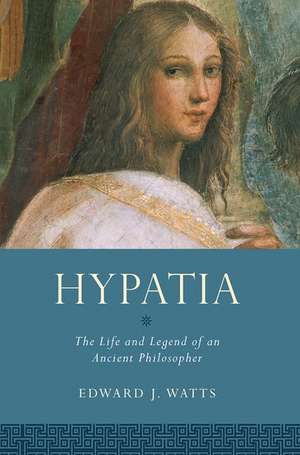
Hypatia: The Life and Legend of an Ancient Philosopher: Women in Antiquity
Autor Edward J. Wattsen Limba Engleză Paperback – 15 noi 2019
Din seria Women in Antiquity
- 16%
 Preț: 176.30 lei
 - 14%
 Preț: 142.73 lei
 - 25%
 Preț: 133.78 lei
 - 24%
 Preț: 135.04 lei
 - 24%
 Preț: 135.00 lei
 - 16%
 Preț: 215.57 lei
 - 10%
 Preț: 376.87 lei
 - 12%
 Preț: 335.31 lei
 - 17%
 Preț: 90.69 lei
 - 10%
 Preț: 363.29 lei
 - 10%
 Preț: 363.74 lei
 - 31%
 Preț: 694.76 lei
 - 11%
 Preț: 359.22 lei
 - 15%
 Preț: 327.02 lei
 - 16%
 Preț: 146.25 lei
 - 11%
 Preț: 285.69 lei
 - 16%
 Preț: 172.35 lei
 - 16%
 Preț: 167.77 lei
 -
 Preț: 448.85 lei
 - 34%
 Preț: 625.35 lei
 - 16%
 Preț: 204.27 lei
 - 15%
 Preț: 222.62 lei
 - 17%
 Preț: 170.14 lei
 - 26%
 Preț: 170.05 lei
 - 21%
 Preț: 125.37 lei
Preț: 242.09 lei
Preț vechi: 273.05 lei
-11%
Puncte Express: 363
Carte tipărită la comandă
Livrare economică 10-16 decembrie
Livrare prin curier în România Termenul estimat este afișat lângă disponibilitate.
Transport gratuit de la 400.00 lei Plată online sau ramburs, în funcție de opțiunile comenzii.
Retur gratuit în 14 zile Comandă securizată și suport în română.
Specificații
ISBN-13: 9780190073701
ISBN-10: 0190073705
Pagini: 224
Dimensiuni: 155 x 231 x 15 mm
Greutate: 0.32 kg
Editura: Oxford University Press
Colecția OUP USA
Seria Women in Antiquity
Locul publicării:New York, United States
ISBN-10: 0190073705
Pagini: 224
Dimensiuni: 155 x 231 x 15 mm
Greutate: 0.32 kg
Editura: Oxford University Press
Colecția OUP USA
Seria Women in Antiquity
Locul publicării:New York, United States
V-ar putea interesa
-
 Student Study Guide to The Ancient Near Eastern WorldAmanda H. Podany-22%Preț: 74.78 lei96.19 lei
 -
 -17%Preț: 72.17 lei87.05 lei
 -
 The Getty Hexameters: Poetry, Magic, and Mystery in Ancient SelinousChristopher A. Faraone-30%Preț: 794.62 lei1141.90 lei
 -
 -30%Preț: 774.96 lei1100.90 lei
 -
 -31%Preț: 1024.82 lei1492.99 lei
 -
 Louis MacNeice: The Classical Radio PlaysAmanda Wrigley-30%Preț: 801.85 lei1144.59 lei
 -
 Conversation and Self-Sufficiency in PlatoA. G. Long-28%Preț: 539.59 lei745.04 lei
 -
 -30%Preț: 715.51 lei1023.99 lei
 -
 Preț: 371.75 lei
 -
 -22%Preț: 57.78 lei74.35 lei
 -
 The Poets of AlexandriaSusan A. Stephens-15%Preț: 132.83 lei155.90 lei
 -
 War: Antiquity and Its LegacyAlfred S Bradford-20%Preț: 139.58 lei175.40 lei
 -
 Djekhy & SonKoenraad Donker Van HeelPreț: 191.04 lei
Recenzii
The book is written in a readable style, without sacrificing rigor or intellectual transparency. The research is thorough. References and details are put in end notes ordered by chapter, easily accessible to the interested reader without disturbing the text ow. I can recommend this book to university students as well as to the general reader interested in late Roman philosophy or in the life of one of the few known female philosophers from before modern times.
This monograph is undoubtedly an important addition to the scholarship on Hypatia, not least because there has been no monograph-length study for more than two decades. Arguably one of the most significant contributions of this study is the argument that the murder of Hypatia was not, as is often argued in the existing scholarship, a pre-meditated attack but rather a circumstantial event. Apart from Hypatia's life, this book is also notable for painting a detailed picture of late-antique Alexandria and for showing how much information about an ancient figure can be teased out of indirect evidence about historical circumstances, parallel cases and similar. The writing style is extremely accessible. Quite a few comparisons to modern history and popular culture-although almost exclusively American-make the book very approachable to a wide range of audiences, not only the specialists.
Watts' account of Hypatia's life is a work of scholarship, the product of some very thorough research, which provides a detailed and plausible interpretation of the life of a fascinating woman ... I would recommended this book for a university rather than school library, though it might have an appeal for a school pupil with an interest in studying prominent female figures in antiquity ... It is also a book for the thoughtful reader who wishes to examine their own beliefs about how to live the good life and its compatibility with public life.
Watts is most compelling in the summations of his findings and narratives...A careful historical portrait of one of antiquity's most accomplished women.
To shine as a mathematician; to alter decisively the teaching curriculum of an ancient university; to work for the peace of an explosive city: Hypatia of Alexandria had done all this before her senseless murder by a Christian mob in 415 CE. With zest and exemplary scholarship, Ed Watts has brought alive the vivid world of Alexandria that both made Hypatia's achievements possible and also led to her unexpected, shocking death. It is a book that shows that truth is stranger (and a lot more interesting) than the rose-tinted fiction which has usually enveloped the life and death of this remarkable woman.
Hypatia of Alexandria led an exceptional life as a celibate teacher of philosophy and political adviser. Edward Watts uses his expert knowledge of her city, and of late antique education, to explain the content and context of her teaching, and to show how Alexandria made possible both her career and her appalling death. Hypatia's death made her a symbol of repression, but for her, philosophy was a way of life, and that is the focus of this excellent book.
Immersing Hypatia into her world of competing philosophers, jockeying bishops and local potentates, loyal students and rival monks, Watts restores the brilliant mathematician and philosophical leader, a woman all but submerged under the mask her violent death created. In the process, he also evokes the fabric of cosmopolitan late Roman Alexandria, a city in which Christians and others coexisted despite tensions that could and did erupt into moments of spectacular violence.
This monograph is undoubtedly an important addition to the scholarship on Hypatia, not least because there has been no monograph-length study for more than two decades. Arguably one of the most significant contributions of this study is the argument that the murder of Hypatia was not, as is often argued in the existing scholarship, a pre-meditated attack but rather a circumstantial event. Apart from Hypatia's life, this book is also notable for painting a detailed picture of late-antique Alexandria and for showing how much information about an ancient figure can be teased out of indirect evidence about historical circumstances, parallel cases and similar. The writing style is extremely accessible. Quite a few comparisons to modern history and popular culture-although almost exclusively American-make the book very approachable to a wide range of audiences, not only the specialists.
Watts' account of Hypatia's life is a work of scholarship, the product of some very thorough research, which provides a detailed and plausible interpretation of the life of a fascinating woman ... I would recommended this book for a university rather than school library, though it might have an appeal for a school pupil with an interest in studying prominent female figures in antiquity ... It is also a book for the thoughtful reader who wishes to examine their own beliefs about how to live the good life and its compatibility with public life.
Watts is most compelling in the summations of his findings and narratives...A careful historical portrait of one of antiquity's most accomplished women.
To shine as a mathematician; to alter decisively the teaching curriculum of an ancient university; to work for the peace of an explosive city: Hypatia of Alexandria had done all this before her senseless murder by a Christian mob in 415 CE. With zest and exemplary scholarship, Ed Watts has brought alive the vivid world of Alexandria that both made Hypatia's achievements possible and also led to her unexpected, shocking death. It is a book that shows that truth is stranger (and a lot more interesting) than the rose-tinted fiction which has usually enveloped the life and death of this remarkable woman.
Hypatia of Alexandria led an exceptional life as a celibate teacher of philosophy and political adviser. Edward Watts uses his expert knowledge of her city, and of late antique education, to explain the content and context of her teaching, and to show how Alexandria made possible both her career and her appalling death. Hypatia's death made her a symbol of repression, but for her, philosophy was a way of life, and that is the focus of this excellent book.
Immersing Hypatia into her world of competing philosophers, jockeying bishops and local potentates, loyal students and rival monks, Watts restores the brilliant mathematician and philosophical leader, a woman all but submerged under the mask her violent death created. In the process, he also evokes the fabric of cosmopolitan late Roman Alexandria, a city in which Christians and others coexisted despite tensions that could and did erupt into moments of spectacular violence.
Notă biografică
The Alkiviadis Vassiliadis Chair and Professor of History at the University of California, San Diego, Edward Watts studies the intellectual and religious history of the later Roman and early Byzantine Empires. He is the author of three prize-winning books and the editor of three edited volumes. This is his first of two upcoming works for OUP.
Cuprins
- Table of Contents
- List of figures
- Introduction: A Lenten Murder
- Chapter 1: Alexandria
- Chapter 2: Childhood and Education
- Chapter 3: The School of Hypatia
- Chapter 4: Middle Age
- Chapter 5: A Philosophical Mother and her Children
- Chapter 6: The Public Intellectual
- Chapter 7: Hypatia's Sisters
- Chapter 8: Murder in the Street
- Chapter 9: The Memory of Hypatia
- Chapter 10: A Modern Symbol
- Reconsidering A Legend
- Bibliography