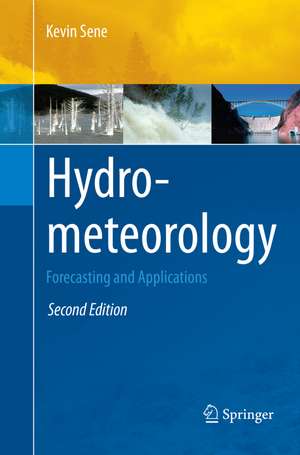
Hydrometeorology
Autor Kevin Seneen Limba Engleză Paperback – 27 mar 2019
As in the first edition, the first section considers topics such as monitoring and forecasting techniques, demand forecasting and how forecasts are interpreted when issuing warnings or advice. Separate chapters are now included for meteorological and catchment monitoring techniques allowing a more in-depth discussion of topics such as weather radar and water quality observations. The chapters on meteorological and hydrological forecasting now include a greater emphasis on rainfall forecasting and ensemble and probabilistic techniques. Regarding the interpretation of forecasts, an updated chapter discusses topics such as approaches to issuing warnings and the use of decision support systems and risk-based techniques.
Given the rapid pace of development in flash flood fore
casting techniques, flash floods and slower responding riverine floods are now considered in separate chapters. This includes more detail on forecasting floods in large river basins and on methods for providing early warnings of debris flows, surface water flooding and ice jam and dam break floods. Later chapters now include more information on developing areas such as environmental modelling and seasonal flow forecasting. As before examples of operational systems are provided throughout and the extensive sets of references which were a feature of the first edition have been revised and updated. Key themes • floods • droughts • meteorological observations • catchment monitoring • meteorological forecasts • hydrological forecasts • demand forecasts • reservoirs • water resources • water quality • decision support • data assimilation • probabilistic forecasts
Kevin Sene is a civil engineer and researcher with wide experience in flood risk management, water resources and hydrometeorology. He has previously published books on flood warning, forecasting and emergency response and flash floods (Springer 2008, 2013).
Preț: 629.26 lei
Preț vechi: 786.57 lei
-20%
Puncte Express: 944
Carte tipărită la comandă
Livrare economică 07-13 august
Livrare prin curier în România Termenul estimat este afișat lângă disponibilitate.
Transport gratuit pentru acest produs Plată online sau ramburs, în funcție de opțiunile comenzii.
Retur gratuit în 14 zile Comandă securizată și suport în română.
Specificații
ISBN-13: 9783319794969
ISBN-10: 3319794965
Pagini: 444
Ilustrații: XIV, 427 p. 124 illus., 106 illus. in color.
Dimensiuni: 155 x 235 x 23 mm
Greutate: 0.75 kg
Ediția:Second Edition 2016
Editura: Springer
Locul publicării:Cham, Switzerland
ISBN-10: 3319794965
Pagini: 444
Ilustrații: XIV, 427 p. 124 illus., 106 illus. in color.
Dimensiuni: 155 x 235 x 23 mm
Greutate: 0.75 kg
Ediția:Second Edition 2016
Editura: Springer
Locul publicării:Cham, Switzerland
Cuprins
1. Introduction.- Part I: Techniques.- 2. Meteorological Observations.- 3. Catchment Monitoring.- 4. Meteorological Forecasting.- Hydrological Forecasting.- 6. Demand Forecasting.- 7. Forecast Interpretation.- Part II: Selected Applications.- 8. River floods.- 9. Flash Floods.- 10. Droughts.- 11. Flow Control.- 12. Environmental Impacts.- 13. Water Resources.
Notă biografică
Kevin Sene is a civil engineer and researcher with wide experience in flood forecasting, water resources and hydrometeorological applications. In addition to ‘Hydrometerology: Forecasting and Applications’ he has published books on forecasting and warning techniques for flash floods and riverine and coastal flooding (Springer, 2008, 2013).
Textul de pe ultima copertă
This second edition explores some of the latest techniques used to provide forecasts for a wide range of water-related applications in areas such as floods, droughts, water resources and environmental impacts. The practical uses can range from decisions on whether to issue a flood warning through to providing longer-term advice such as on when to plant and harvest crops or how to operate reservoirs for water supply and hydropower schemes. It provides an introduction to the topic for practitioners and researchers and useful background for courses in areas such as civil engineering, water resources, meteorology and hydrology.
As in the first edition, the first section considers topics such as monitoring and forecasting techniques, demand forecasting and how forecasts are interpreted when issuing warnings or advice. Separate chapters are now included for meteorological and catchment monitoring techniques allowing a more in-depth discussion of topics such as weather radar and
water quality observations. The chapters on meteorological and hydrological forecasting now include a greater emphasis on rainfall forecasting and ensemble and probabilistic techniques. Regarding the interpretation of forecasts, an updated chapter discusses topics such as approaches to issuing warnings and the use of decision support systems and risk-based techniques. Given the rapid pace of development in flash flood forecasting techniques, flash floods and slower responding riverine
floods are now considered in separate chapters. This includes more detail on forecasting floods in large river basins and on methods for providing early warnings of debris flows, surface water flooding and ice jam and dam break floods. Later chapters now include more information on developing areas such as environmental modelling and seasonal flow forecasting. As before examples of operational systems are provided throughout and the extensive sets of references which were a feature of the first edition have been revised and updated. Key themes • floods • droughts • meteorological observations • catchment monitoring • meteorological forecasts • hydrological forecasts • demand forecasts • reservoirs • water resources • water quality • decision support • data assimilation • probabilistic forecasts
Kevin Sene is a civil engineer and researcher with wide experience in flood risk management, water resources and hydrometeorology. He has previously published books on flood warning, forecasting and emergency response and flash floods (Springer 2008, 2013).
As in the first edition, the first section considers topics such as monitoring and forecasting techniques, demand forecasting and how forecasts are interpreted when issuing warnings or advice. Separate chapters are now included for meteorological and catchment monitoring techniques allowing a more in-depth discussion of topics such as weather radar and
water quality observations. The chapters on meteorological and hydrological forecasting now include a greater emphasis on rainfall forecasting and ensemble and probabilistic techniques. Regarding the interpretation of forecasts, an updated chapter discusses topics such as approaches to issuing warnings and the use of decision support systems and risk-based techniques. Given the rapid pace of development in flash flood forecasting techniques, flash floods and slower responding riverine
floods are now considered in separate chapters. This includes more detail on forecasting floods in large river basins and on methods for providing early warnings of debris flows, surface water flooding and ice jam and dam break floods. Later chapters now include more information on developing areas such as environmental modelling and seasonal flow forecasting. As before examples of operational systems are provided throughout and the extensive sets of references which were a feature of the first edition have been revised and updated. Key themes • floods • droughts • meteorological observations • catchment monitoring • meteorological forecasts • hydrological forecasts • demand forecasts • reservoirs • water resources • water quality • decision support • data assimilation • probabilistic forecasts
Kevin Sene is a civil engineer and researcher with wide experience in flood risk management, water resources and hydrometeorology. He has previously published books on flood warning, forecasting and emergency response and flash floods (Springer 2008, 2013).
Caracteristici
A fully revised and extended version of this text providing a review of recent developments in hydrometeorological monitoring and forecasting techniques More details included on topics such as precipitation measurement, catchment monitoring, early warning systems, and seasonal and probabilistic techniques International examples in the application of techniques in agriculture, water resources, urban hydrology, flood forecasting, flash floods, environmental impacts, river basin management and other areas Brings together both the meteorological and hydrological aspects in a single volume with a focus on practical applications
Recenzii
From the reviews:
“This book is an introduction to the wide range of disciplines which define hydrometeorology, and it is very thorough in its subject manner. … would appeal to any person interested in the subject of hydrometeorology. … is suitable for teaching and could serve as an introductory text book to the subject of hydrometeorology, mostly at the freshman or sophomore level of an undergraduate curriculum. … I am not aware of any other book as comprehensive as this one that covers all aspects of hydrometeorology.” (Greg Story, Bulletin of the American Meteorological Society, June, 2011)
“This book is an introduction to the wide range of disciplines which define hydrometeorology, and it is very thorough in its subject manner. … would appeal to any person interested in the subject of hydrometeorology. … is suitable for teaching and could serve as an introductory text book to the subject of hydrometeorology, mostly at the freshman or sophomore level of an undergraduate curriculum. … I am not aware of any other book as comprehensive as this one that covers all aspects of hydrometeorology.” (Greg Story, Bulletin of the American Meteorological Society, June, 2011)