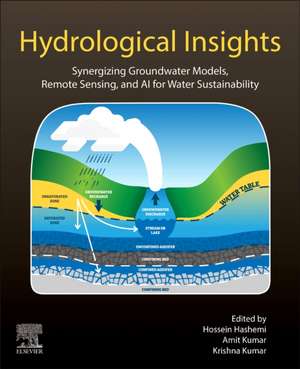
Hydrological Insights: Synergizing Groundwater Models, Remote Sensing, and AI for Water Sustainability
Editat de Hossein Hashemi, Amit Kumar, Krishna Kumaren Limba Engleză Paperback – 15 ian 2026
Part IV focuses on environmental impact assessment and management strategies, outlining effective methods for sustainable water resource management. Part V covers the latest advancements in remote sensing and machine learning, emphasizing their pivotal role in contemporary hydrology. Finally, Part VI presents real-world case studies and future directions, offering practical insights and forward-looking perspectives. With meticulously crafted chapters that combine theoretical foundations with practical applications, this book is an essential resource for students, researchers, and professionals seeking to advance their understanding of hydrology through the integration of remote sensing and AI.
- Covers the latest developments and future trends in AI and machine-learning in the fields of hydrology and water resource engineering
- Includes advanced groundwater methods and techniques demonstrated through real-world case studies with step-by-step analysis
- Offers an easy-to-follow structure with data-driven approaches
- Authored by world acclaimed experts in the fields of hydrology and AI
Preț: 920.97 lei
Preț vechi: 1315.14 lei
-30%
Puncte Express: 1381
Carte tipărită la comandă
Livrare economică 30 noiembrie-14 decembrie
Livrare prin curier în România Termenul estimat este afișat lângă disponibilitate.
Transport gratuit pentru acest produs Plată online sau ramburs, în funcție de opțiunile comenzii.
Retur gratuit în 14 zile Comandă securizată și suport în română.
Specificații
ISBN-13: 9780443363948
ISBN-10: 0443363943
Pagini: 296
Dimensiuni: 216 x 276 mm
Greutate: 0.45 kg
Editura: ELSEVIER SCIENCE
ISBN-10: 0443363943
Pagini: 296
Dimensiuni: 216 x 276 mm
Greutate: 0.45 kg
Editura: ELSEVIER SCIENCE
V-ar putea interesa
-
 Groundwater ScienceCharles R. Fitts-29%Preț: 367.95 lei521.78 lei
 -
 Fundamentals of HydrologyTim DaviePreț: 450.25 lei
 -
 Advances in AI for Cloud, Edge, and Mobile Computing ApplicationsShrikaant Kulkarni-20%Preț: 1296.62 lei1620.78 lei
 -
 Groundwater Resources Development and Planning in the Semi-Arid RegionChaitanya B. Pande-24%Preț: 722.10 lei950.14 lei
 -
 Satellite Remote Sensing of Terrestrial HydrologyChristopher Ndehedehe-18%Preț: 915.17 lei1116.06 lei
 -
 -24%Preț: 892.23 lei1173.99 lei
 -
 -18%Preț: 932.22 lei1136.86 lei
 -
 Sustainable Management of Land, Water and Pollution of Built-up AreaChandra Shekhar Prasad Ojha-18%Preț: 928.18 lei1131.93 lei
 -
 Surface, Sub-Surface Hydrology and ManagementSubodh Chandra Pal-18%Preț: 1183.87 lei1443.74 lei
 -
 Applications of Machine Learning in HydroclimatologyRoshan Srivastav-18%Preț: 1033.91 lei1260.87 lei
 -
 Abbay River BasinAssefa MelessePreț: 484.00 lei
 -
 Water Security and SustainabilityChandrashekhar Bhuiyan-24%Preț: 859.01 lei1130.27 lei
 -
 Advanced Modelling and Innovations in Water Resources EngineeringChintalacheruvu Madhusudana Rao-24%Preț: 1454.74 lei1914.14 lei
 -
 Water Resources Management and SustainabilityPankaj Kumar-18%Preț: 976.47 lei1190.82 lei
 -
 Hydrology and Hydrologic ModellingP. V. Timbadiya-24%Preț: 1266.22 lei1666.09 lei
 -
 Water InformaticsSupreeti Kamilya-18%Preț: 1153.38 lei1406.56 lei
 -
 Geospatial and Soft Computing TechniquesP. V. Timbadiya-18%Preț: 1458.37 lei1778.50 lei
 -
 Advances in Water Resource Planning and SustainabilityPraveen Kumar Rai-18%Preț: 932.22 lei1136.86 lei
Cuprins
Part I: Foundations of Hydrological Modeling
1. Introduction to Data-Driven Groundwater Modeling: Methods, Applications & Challenges
2. InSAR-Based Estimation of Head and Storage Changes: Numerical Models and Data Driven Techniques
3. Surfacewater Flow as a Mitigation Measure for Land Subsidence Mitigation in Rural and Urban Areas
4. Hydro-Meteorological Droughts: Patterns, Trends, and the Role of Accumulation Periods on Groundwater Condition
Part II: Advanced Techniques in Hydrological Studies
5. Automated Hydrological Variable Estimation: Novel Approaches and Optimization Algorithms
6. Spatiotemporal Variability of Hydrometeorological Parametrs: Insights from River Basin Analysis
7. Monitoring Carbon Exchange in Wetlands and Peatlands Using InSAR-Based Methods
8. Impact of Drinking and Sanitary Water Separation on Drinking Water Quality: Groundwater Quality Mapping
Part III: Integration of Remote Sensing and Artificial Intelligence in Hydrology
9. InSAR-AI-Based Approach for Groundwater Level Prediction in Arid Regions
10. Spatiotemporal Variation of Environmental Hazards: Remote Sensing and AI Applications
11. Detecting Changes in Global Satellite-Based Hydrological Observations using AI Techniques
12. Satellite Monitoring of Infrastructure using Interferometric Synthetic Aperture Radar (InSAR)
Part IV: Environmental Impact Assessment and Management Strategies
13. Quantitative and Qualitative Assessment of Streamflow Variation: Climate vs. Human Impact
14. Assessing Contaminated Groundwater Sites in Industrial Areas with Limited Data Availability
15. Flood Spreading Project Suitability Mapping: Water Resources Management using Machine Learning Algorithms
Part V: Advances in Remote Sensing and Machine Learning
16. Advanced Machine Learning Algorithms for Assessing Groundwater Potential using Remote Sensing-Derived Data
17. Extreme Gradient Boosting and Random Forest Algorithms for Assessing Groundwater Spring Potential using DEM-Derived Factors
18. Remote Sensing Techniques and Machine Learning Algorithms in Groundwater Vulnerability Mapping
Part VI: Case Studies and Future Directions
19. Evaluation of Weather Radar Systems for Operational Use in Hydrological Studies
20. Towards Intelligent Assessment of Groundwater Resources: Trends, Challenges, and Future Directions
1. Introduction to Data-Driven Groundwater Modeling: Methods, Applications & Challenges
2. InSAR-Based Estimation of Head and Storage Changes: Numerical Models and Data Driven Techniques
3. Surfacewater Flow as a Mitigation Measure for Land Subsidence Mitigation in Rural and Urban Areas
4. Hydro-Meteorological Droughts: Patterns, Trends, and the Role of Accumulation Periods on Groundwater Condition
Part II: Advanced Techniques in Hydrological Studies
5. Automated Hydrological Variable Estimation: Novel Approaches and Optimization Algorithms
6. Spatiotemporal Variability of Hydrometeorological Parametrs: Insights from River Basin Analysis
7. Monitoring Carbon Exchange in Wetlands and Peatlands Using InSAR-Based Methods
8. Impact of Drinking and Sanitary Water Separation on Drinking Water Quality: Groundwater Quality Mapping
Part III: Integration of Remote Sensing and Artificial Intelligence in Hydrology
9. InSAR-AI-Based Approach for Groundwater Level Prediction in Arid Regions
10. Spatiotemporal Variation of Environmental Hazards: Remote Sensing and AI Applications
11. Detecting Changes in Global Satellite-Based Hydrological Observations using AI Techniques
12. Satellite Monitoring of Infrastructure using Interferometric Synthetic Aperture Radar (InSAR)
Part IV: Environmental Impact Assessment and Management Strategies
13. Quantitative and Qualitative Assessment of Streamflow Variation: Climate vs. Human Impact
14. Assessing Contaminated Groundwater Sites in Industrial Areas with Limited Data Availability
15. Flood Spreading Project Suitability Mapping: Water Resources Management using Machine Learning Algorithms
Part V: Advances in Remote Sensing and Machine Learning
16. Advanced Machine Learning Algorithms for Assessing Groundwater Potential using Remote Sensing-Derived Data
17. Extreme Gradient Boosting and Random Forest Algorithms for Assessing Groundwater Spring Potential using DEM-Derived Factors
18. Remote Sensing Techniques and Machine Learning Algorithms in Groundwater Vulnerability Mapping
Part VI: Case Studies and Future Directions
19. Evaluation of Weather Radar Systems for Operational Use in Hydrological Studies
20. Towards Intelligent Assessment of Groundwater Resources: Trends, Challenges, and Future Directions