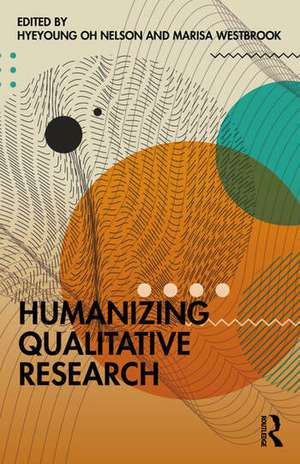
Humanizing Qualitative Research
Editat de Hyeyoung Oh Nelson, Marisa Westbrooken Limba Engleză Paperback – 28 dec 2026
Contributors from sociology, anthropology, public health, and social work share personal and professional reflections on the tensions, joys, and challenges of conducting qualitative studies, particularly when working with historically marginalized communities. Chapters address critical issues including trauma, exhaustion, intimacy, resilience, joy, and community accountability, providing insight into research as an embodied and relational practice. This book validates the struggles and strengths of researchers—especially those holding marginalized identities—and demonstrates how reflexivity can be a methodological tool that enhances both rigor and care. By engaging with issues of identity, power, and accountability, the book provides essential guidance for cultivating reflexive, ethical, and resilient qualitative scholarship.
This accessible, interdisciplinary volume serves graduate students, early career researchers, and established scholars seeking to deepen their understanding of qualitative research as a profoundly human endeavour. It offers vital perspectives for those committed to conducting research that honours the full humanity of both researchers and participants, making it an indispensable resource for anyone engaged in qualitative inquiry across social science disciplines.
Preț: 343.58 lei
Preț vechi: 384.37 lei
-11% Precomandă
Puncte Express: 515
Carte nepublicată încă
Livrare prin curier în România Precomanda se expediază când titlul devine disponibil.
Transport gratuit de la 400.00 lei Plată online sau ramburs, în funcție de opțiunile comenzii.
Retur gratuit în 14 zile Comandă securizată și suport în română.
Doresc să fiu notificat când acest titlu va fi disponibil:
Se trimite...
Specificații
ISBN-13: 9781041263159
ISBN-10: 1041263155
Pagini: 130
Dimensiuni: 138 x 216 mm
Ediția:1
Editura: Taylor & Francis
Colecția Routledge
Locul publicării:Oxford, United Kingdom
ISBN-10: 1041263155
Pagini: 130
Dimensiuni: 138 x 216 mm
Ediția:1
Editura: Taylor & Francis
Colecția Routledge
Locul publicării:Oxford, United Kingdom
Public țintă
PostgraduateCuprins
Notes on Contributors Chapter 1: Introduction by Hyeyoung Oh Nelson and Marisa Westbrook Chapter 2: The Afro-Latino “Triple-Consciousness” as a Methodological Tool by Randol Contreras Chapter 3: When Our Aliveness Wells Up So Piercingly We Cannot Quiet It by Danielle Maude Littman Chapter 4: Embodying the Motor City: Situating Myself, the ‘Body’ and ‘Place’ in Qualitative Research by Greer A. Hamilton Chapter 5: Doing Intimacy and the Permeability of Public and Private Spheres by Laura A. Orrico Chapter 6: What We Owe Community by Sebastian Espinal, Yoheidy Feliz, Adelio Lechuga-Kanapilly, Audrey Liu, Fernando A. León, and Phi Hong Su Chapter 7: Conclusion by Hyeyoung Oh Nelson and Marisa Westbrook Appendix: Vignettes by Stephanie Chamberlin, Paulina Erices Ocampo, Anne Taylor and Shannon Whittaker Index
Notă biografică
Hyeyoung Oh Nelson, PhD, is Assistant Professor of Public Health in the Department of Health and Behavioral Sciences at the University of Colorado-Denver, USA. She is the author of Conflicted Care (Stanford University Press, 2022) and has published widely on qualitative research in health contexts.
Marisa Westbrook, PhD, MPH, is Assistant Professor of Community Health/Health Promotion at the OHSU-PSU School of Public Health, Portland State University, USA. A public health social scientist, her work explores community engagement, housing insecurity, and the process of qualitative research.
Marisa Westbrook, PhD, MPH, is Assistant Professor of Community Health/Health Promotion at the OHSU-PSU School of Public Health, Portland State University, USA. A public health social scientist, her work explores community engagement, housing insecurity, and the process of qualitative research.
Descriere
Humanizing Qualitative Research foregrounds the lived experiences, identities, and positionalities of qualitative researchers and participants, challenging the disembodied, procedural approaches that dominate many methods texts.