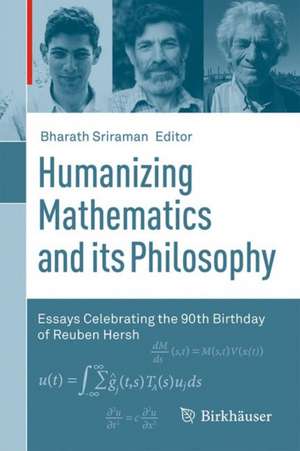
Humanizing Mathematics and its Philosophy
Editat de Bharath Sriramanen Limba Engleză Hardback – 22 noi 2017
Recomandăm Humanizing Mathematics and its Philosophy ca o lucrare de referință profesională și academică esențială pentru studenții de la licență și cercetătorii interesați de intersecția dintre științele exacte și umanism. Această primă ediție, publicată sub egida Palgrave MacMillan, nu este doar un omagiu adus logicianului Reuben Hersh la împlinirea a 90 de ani, ci o analiză critică a modului în care matematica este practicată și percepută în societate. Ne-a atras atenția modul în care editorul Bharath Sriraman a structurat volumul, pornind de la un interviu revelator și o cronică vizuală a carierei lui Hersh, continuând cu eseuri care chestionează dacă matematicienii pot contribui la filosofie și invers. Putem afirma că forța acestui volum rezidă în diversitatea perspectivelor: de la „XENOMATH!” și rețele cognitive, până la moștenirea lui Gödel și limitele automatizării înțelegerii matematice. Cititorii familiarizați cu 18 Unconventional Essays on the Nature of Mathematics vor aprecia modul în care acest nou volum extinde dialogul interdisciplinar, aducând laolaltă nume sonore pentru a discuta nu doar despre cifre, ci despre responsabilitatea socială a matematicianului și evoluția rațiunii. În contextul operei lui Bharath Sriraman, lucrarea completează viziunea sa enciclopedică regăsită în Handbook of the Mathematics of the Arts and Sciences, oferind o abordare mai personală și mai ancorată în experiența umană a descoperirii. Structura este una non-liniară, permițând o lectură fragmentată, unde eseuri despre logica non-euclidiană coexistă cu reflecții despre matematica școlară, oferind o panoramă completă asupra unei discipline care, deși abstractă, rămâne fundamental legată de experiența temporală și culturală.
Preț: 935.08 lei
Preț vechi: 1140.34 lei
-18%
Carte disponibilă
Livrare economică 09-23 noiembrie
Specificații
ISBN-10: 3319612301
Pagini: 376
Ilustrații: X, 363 p. 20 illus., 8 illus. in color.
Dimensiuni: 160 x 241 x 25 mm
Greutate: 0.75 kg
Ediția:1st ed. 2017
Editura: birkhäuser
Locul publicării:Cham, Switzerland
De ce să citești această carte
Această carte se adresează celor care doresc să depășească viziunea matematicii ca un set de formule reci. Cititorul câștigă acces la gândirea unora dintre cei mai importanți intelectuali ai secolului XX, explorând modul în care intuiția, istoria și cultura modelează gândirea logică. Este o recomandare certă pentru oricine dorește să înțeleagă „de ce” și „pentru cine” facem matematică, oferind o perspectivă umanistă rară într-un domeniu tehnic.
Despre autor
Bharath Sriraman este un editor și cercetător prolific, cunoscut pentru capacitatea sa de a sintetiza domenii complexe. În calitate de editor al acestui volum, el continuă tradiția de a explora fundamentele educației și filosofiei matematice, teme prezente și în lucrările sale anterioare dedicate învățământului matematic. Activitatea sa la universități de prestigiu și coordonarea unor lucrări monumentale precum Handbook of the History and Philosophy of Mathematical Practice îl poziționează ca o autoritate în medierea dialogului dintre matematicienii practicieni și filosofii științei.
Cuprins
Recenzii
“This Festschrift … is a wonderful collection of nearly thirty essays exploring the ideas that Reuben made his life’s work. The book begins by introducing us to Reuben, first in a lively interview with him and then by sharing with us a dozen family photos. By the time we begin reading the serious essays, we already feel as if he is a good friend. Many of the contributors have known and worked with Reuben for many years, and the warmth of their friendships is quite apparent.” (John J. Watkins, The Mathematical Intelligencer, Vol. 41, No. 2, 2019)
Bharath Sriraman has collected in this book 27 texts, comprising five chapters from Hersh himself (including one interview with the author), and 22 texts from authors whose work has been influenced by Hersh. These are mathematicians, philosophers, logicians, and linguistics, and altogether they offer the reader a cornucopia of lives, visions, positions, and contradictions about the nature of mathematics and its role in science and society.” (Alexandre Pais, Educational Studies in Mathematics, Vol. 99, 2019)
Bharath Sriraman has collected twenty-five essays from mathematicians and philosophers, an educator, and a linguist for a Festschrift volume to celebrate Hersh’s ninetieth birthday. As one might expect, this is an extremely varied collection of articles. Several contain heartfelt appreciation of Hersh. Some attempt to develop and elucidate his Humanist philosophy. Others just mention him in passing or not at all. A few contain some nontrivial mathematics. … Anyone interested in the philosophy of mathematics will profit from reading and engaging with it.” (Joseph Auslander, Notices of the AMS, Vol. 65, No. 11, 2018).
Notă biografică
Textul de pe ultima copertă
- Can practicing mathematicians, as such, contribute anything to the philosophy of math? Can or should philosophers of math, as such, say anything to practicing mathematicians?
- Twenty or fifty years from now, what will be similar, and what will, or could, or should be altogether different: About the philosophy of math? About math education? About math research institutions? About data processing and scientific computing?
Caracteristici
Explores the relationship between the philosophy of math and math as practiced
Portrays the humanistic side of mathematics
Looks ahead to what mathematics might look like in the future