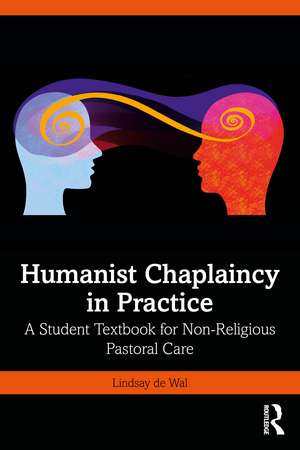
Humanist Chaplaincy in Practice: A Student Textbook for Non-Religious Pastoral Care
Autor Lindsay de Walen Limba Engleză Paperback – 7 mai 2026
Structured across ten chapters, the book combines theory, policy and real-world case studies to explore core topics such as end-of-life care, staff wellbeing, ethical decision-making, multi-faith teamwork, and humanist rituals. It draws on the author’s doctoral research into the lived experience of non-religious chaplains working in faith-based teams, as well as her leadership in shaping national policy and EU-wide training standards.
Designed for formal education and professional development, each chapter includes learning objectives, reflective exercises, discussion prompts, and further reading. The book is already under consideration for integration into European training frameworks and responds to growing global demand for non-religious pastoral care in healthcare, prisons, universities, and beyond.
This is an essential guide for the next generation of chaplains and care professionals seeking to offer compassionate, ethical, and human-centred support in today’s pluralist societies.
Preț: 346.01 lei
Puncte Express: 519
Carte disponibilă
Livrare economică 22 octombrie-05 noiembrie
Livrare express 07-13 octombrie pentru 28.39 lei
Livrare prin curier în România Termenul estimat este afișat lângă disponibilitate.
Transport gratuit de la 400.00 lei Plată online sau ramburs, în funcție de opțiunile comenzii.
Retur gratuit în 14 zile Comandă securizată și suport în română.
Specificații
ISBN-13: 9781041215714
ISBN-10: 1041215711
Pagini: 210
Dimensiuni: 156 x 234 mm
Greutate: 0.3 kg
Ediția:1
Editura: Taylor & Francis
Colecția Routledge
Locul publicării:Oxford, United Kingdom
ISBN-10: 1041215711
Pagini: 210
Dimensiuni: 156 x 234 mm
Greutate: 0.3 kg
Ediția:1
Editura: Taylor & Francis
Colecția Routledge
Locul publicării:Oxford, United Kingdom
Public țintă
Professional Reference and Professional TrainingNotă biografică
Lindsay de Wal is Director for Humanist-Existential Care with the European Humanist Services Network, Head of Pastoral Care for the Non-Religious Pastoral Support Network (NRPSN), and an internationally recognised leader in humanist chaplaincy. Her doctoral research explored the lived experiences of non-religious chaplains in UK healthcare teams, and she has shared this work globally following extensive media coverage of her historic appointment as the UK’s first humanist Head of Healthcare Chaplaincy.
Cuprins
1. Introduction to Humanist Chaplaincy 2. The Foundations of Humanist Chaplaincy 3. The Role and Scope of Humanist Chaplaincy 4. Training, Accreditation, and Professionalism 5. Working in Multi- Faith and Faith- Based Teams 6. Supporting Staff Wellbeing in Healthcare Settings 7. Grief, Bereavement, and End-of-Life Care in Humanist Chaplaincy 8. Humanist Rituals, Ceremonies, and Meaning- Making in Healthcare 9. Identity, Resilience, and Reflective Practice in Humanist Chaplaincy 10. Looking Forward – The Future of Humanist Chaplaincy in Healthcare
Recenzii
"Dr de Wal provides a timely handbook for the growing number of Humanists who offer chaplaincy support in our hospitals, educational institutions, and workplaces of all kinds. Chaplaincy is a fast-growing form of ministry, and Humanism is a growing area of practice. While there are practical and theological guides and training courses for faith chaplains, particularly those in Christian traditions, de Wal has spotted the gap in Humanist guidance, and steps in wisely and compassionately to meet it."
- Revd Dr Harriet Harris, MBE FRSE, University Chaplain at the University of Edinburgh
“This comprehensive and timely book is a much-needed resource for everyone involved in pastoral support, blending robust theory with practical application. It is certain to become an essential manual for practitioners at every career stage wanting to provide the very best care across a diverse range of settings.”
- Andrew Copson, OBE FCIPD FCMI, Chief Executive of Humanists UK
“This book provides a much-needed analysis of humanist chaplaincy and the complex and demanding places in which it operates. It is both an effective resource for people providing non-religious care and, importantly, an invaluable insight into the humanist approach to chaplaincy for religious practitioners. Lindsay de Wal’s book is a seminal work in the evolving field of chaplaincy studies, skilfully informed by both practice and study. Written with clarity and conviction, it is an essential addition to the library of contemporary chaplaincy.”
- The Rev Dr Chris Swift, former President of the College of Health Care Chaplains
“Having read through the first chapter it is clear that the author has researched the topic in great detail. The extensive bibliography shows this, but also provides material for anyone wanting to obtain more information about certain points; an important resource for a topic such as this.
The order in which it is presented, from historical to present day, shows very clearly how Humanist pastoral care has evolved and developed.
Having discussion questions at the end is an excellent idea as the chapter certainly has enough material for enquiring minds and covers questions which are important and help understand the material.”
- Sandy Edwards, Hon. Humanist Chaplain for the University of St. Andrews and volunteer for the Tayside Spiritual and Health Care Committee
“This book would have been invaluable when I first began my journey into humanist chaplaincy three years ago. It places humanist chaplaincy in its historical and social context, clearly mapping overlaps and distinctions with religious chaplaincy and other forms of support such as counselling and psychotherapy.
Each chapter thoughtfully explores a key areas of humanist chaplaincy; ranging from inter-belief team dynamics, bereavement and end-of-life care, to supporting individuals with religious needs. Insights are grounded in research, Lindsay de Wal’s lived experience, and a broad selection of case studies that bring the material to life. Succinct summaries and reflective questions at the end of each chapter support learning in an accessible and engaging way.
While the book draws extensively from healthcare chaplaincy examples, which is an area where non-religious chaplaincy has become most established, its core principles are readily applicable across a wide range of pastoral care settings.
The book concludes with a compelling and hopeful vision for the future of humanist chaplaincy. It is both practical and inspiring and an essential read for anyone entering the field.”
- Mark Salter, Volunteer Humanist Chaplain, the University of Nottingham
"This is a very welcome student guide to chaplaincy work. It is clear, well-written, comprehensive, and authoritative, covering all the essentials in an accessible, well-structured way."
- Stephen Law, Thinking BIG, UK
"This book on humanist chaplaincy and non-religious pastoral care is a valuable contribution to the field. It offers an accessible and inspiring introduction for students, professionals, and anyone interested in providing guidance and support from a non-religious perspective. The author challenges persistent misconceptions about humanist care and shed light on the unique challenges faced by humanist and non-religious chaplains working within traditionally faith-based organisations and teams. At the same time, the book demonstrates the depth, diversity, and relevance of this form of care. Through a wide range of approaches, practical examples, and different areas of chaplaincy, readers gain a vivid and comprehensive understanding of the profession. The book also addresses an often-overlooked subject: the existential needs and personal development of chaplains and pastoral caregivers themselves.
With its engaging case studies, reflection questions, and discussion prompts, this book not only informs but also encourages critical thinking and deeper reflection. It is an essential guide for anyone wishing to explore humanist chaplaincy and non-religious pastoral care in both a professional and personal context."
- Gaby Jacobs, Professor of Chaplaincy Studies at Universiteit voor Humanistiek, and Chair of the Knowledge Centre on Meaning in Life and Spiritual Care
"Effective chaplaincy has to engage with the diverse beliefs and moral frameworks of the people it serves including those who have no religious affiliation. The humanist perspective has been largely absent from the chaplaincy discourse and so de Wal’s text makes an important and engaging contribution to the field. Combining insightful personal reflections, practical guidance and case studies this book, aimed at students, will also be valuable to those seeking more inclusive approaches to chaplaincy. de Wal is to be congratulated for providing a much-needed systematic account of the practice of humanist chaplaincy."
- Mark Cobb, Clinical Director, Sheffield Teaching Hospitals NHS Foundation Trust and Honorary Senior Research Fellow, University of Sheffield
"This book is exceptionally clear, well-structured, and highly instructive, making complex material accessible to both students and practitioners alike. With this impressive volume, Lindsay de Wal delivers a real milestone: the first truly comprehensive textbook in Humanist Chaplaincy, bringing together a field that has been established for quite some time but has not previously been presented in such a unified and systematic way in a single work. Each chapter offers clear objectives, summaries, and engaging discussion questions, supported by strong references and insightful case analyses, and provides valuable tools for practice, collaboration, and professional development in diverse healthcare settings."
- Adelheid Rigo, Professor of Practical Humanism and Vice-President of Secular Studies Association Brussels at Vrije Universiteit, Brussel
"For anyone who wants to deeply understand my profession - caring for the ethical and existential needs of nonreligious people - this book is not only welcome or even important, but necessary. In it, Lindsay de Wal provides the most thorough and rigorous study yet of a fast-growing field that is well-positioned to become a global force for good. In a world that seems to grow more unstable and uncertain by the day, Humanist Chaplaincy in Practice deserves to become a prominent landmark on the path towards a culture of greater sustainability, health, and humanity."
- Greg M. Epstein, Humanist Chaplain at Harvard & MIT, and author of Good Without God and Tech Agnostic
- Revd Dr Harriet Harris, MBE FRSE, University Chaplain at the University of Edinburgh
“This comprehensive and timely book is a much-needed resource for everyone involved in pastoral support, blending robust theory with practical application. It is certain to become an essential manual for practitioners at every career stage wanting to provide the very best care across a diverse range of settings.”
- Andrew Copson, OBE FCIPD FCMI, Chief Executive of Humanists UK
“This book provides a much-needed analysis of humanist chaplaincy and the complex and demanding places in which it operates. It is both an effective resource for people providing non-religious care and, importantly, an invaluable insight into the humanist approach to chaplaincy for religious practitioners. Lindsay de Wal’s book is a seminal work in the evolving field of chaplaincy studies, skilfully informed by both practice and study. Written with clarity and conviction, it is an essential addition to the library of contemporary chaplaincy.”
- The Rev Dr Chris Swift, former President of the College of Health Care Chaplains
“Having read through the first chapter it is clear that the author has researched the topic in great detail. The extensive bibliography shows this, but also provides material for anyone wanting to obtain more information about certain points; an important resource for a topic such as this.
The order in which it is presented, from historical to present day, shows very clearly how Humanist pastoral care has evolved and developed.
Having discussion questions at the end is an excellent idea as the chapter certainly has enough material for enquiring minds and covers questions which are important and help understand the material.”
- Sandy Edwards, Hon. Humanist Chaplain for the University of St. Andrews and volunteer for the Tayside Spiritual and Health Care Committee
“This book would have been invaluable when I first began my journey into humanist chaplaincy three years ago. It places humanist chaplaincy in its historical and social context, clearly mapping overlaps and distinctions with religious chaplaincy and other forms of support such as counselling and psychotherapy.
Each chapter thoughtfully explores a key areas of humanist chaplaincy; ranging from inter-belief team dynamics, bereavement and end-of-life care, to supporting individuals with religious needs. Insights are grounded in research, Lindsay de Wal’s lived experience, and a broad selection of case studies that bring the material to life. Succinct summaries and reflective questions at the end of each chapter support learning in an accessible and engaging way.
While the book draws extensively from healthcare chaplaincy examples, which is an area where non-religious chaplaincy has become most established, its core principles are readily applicable across a wide range of pastoral care settings.
The book concludes with a compelling and hopeful vision for the future of humanist chaplaincy. It is both practical and inspiring and an essential read for anyone entering the field.”
- Mark Salter, Volunteer Humanist Chaplain, the University of Nottingham
"This is a very welcome student guide to chaplaincy work. It is clear, well-written, comprehensive, and authoritative, covering all the essentials in an accessible, well-structured way."
- Stephen Law, Thinking BIG, UK
"This book on humanist chaplaincy and non-religious pastoral care is a valuable contribution to the field. It offers an accessible and inspiring introduction for students, professionals, and anyone interested in providing guidance and support from a non-religious perspective. The author challenges persistent misconceptions about humanist care and shed light on the unique challenges faced by humanist and non-religious chaplains working within traditionally faith-based organisations and teams. At the same time, the book demonstrates the depth, diversity, and relevance of this form of care. Through a wide range of approaches, practical examples, and different areas of chaplaincy, readers gain a vivid and comprehensive understanding of the profession. The book also addresses an often-overlooked subject: the existential needs and personal development of chaplains and pastoral caregivers themselves.
With its engaging case studies, reflection questions, and discussion prompts, this book not only informs but also encourages critical thinking and deeper reflection. It is an essential guide for anyone wishing to explore humanist chaplaincy and non-religious pastoral care in both a professional and personal context."
- Gaby Jacobs, Professor of Chaplaincy Studies at Universiteit voor Humanistiek, and Chair of the Knowledge Centre on Meaning in Life and Spiritual Care
"Effective chaplaincy has to engage with the diverse beliefs and moral frameworks of the people it serves including those who have no religious affiliation. The humanist perspective has been largely absent from the chaplaincy discourse and so de Wal’s text makes an important and engaging contribution to the field. Combining insightful personal reflections, practical guidance and case studies this book, aimed at students, will also be valuable to those seeking more inclusive approaches to chaplaincy. de Wal is to be congratulated for providing a much-needed systematic account of the practice of humanist chaplaincy."
- Mark Cobb, Clinical Director, Sheffield Teaching Hospitals NHS Foundation Trust and Honorary Senior Research Fellow, University of Sheffield
"This book is exceptionally clear, well-structured, and highly instructive, making complex material accessible to both students and practitioners alike. With this impressive volume, Lindsay de Wal delivers a real milestone: the first truly comprehensive textbook in Humanist Chaplaincy, bringing together a field that has been established for quite some time but has not previously been presented in such a unified and systematic way in a single work. Each chapter offers clear objectives, summaries, and engaging discussion questions, supported by strong references and insightful case analyses, and provides valuable tools for practice, collaboration, and professional development in diverse healthcare settings."
- Adelheid Rigo, Professor of Practical Humanism and Vice-President of Secular Studies Association Brussels at Vrije Universiteit, Brussel
"For anyone who wants to deeply understand my profession - caring for the ethical and existential needs of nonreligious people - this book is not only welcome or even important, but necessary. In it, Lindsay de Wal provides the most thorough and rigorous study yet of a fast-growing field that is well-positioned to become a global force for good. In a world that seems to grow more unstable and uncertain by the day, Humanist Chaplaincy in Practice deserves to become a prominent landmark on the path towards a culture of greater sustainability, health, and humanity."
- Greg M. Epstein, Humanist Chaplain at Harvard & MIT, and author of Good Without God and Tech Agnostic
Descriere
This accessible and timely book equips students, professionals, and institutions to deliver inclusive emotional and spiritual support across belief systems. This is an essential guide for the next generation of chaplains and care professionals seeking to offer compassionate, ethical and human-centred support in today’s pluralist societies.