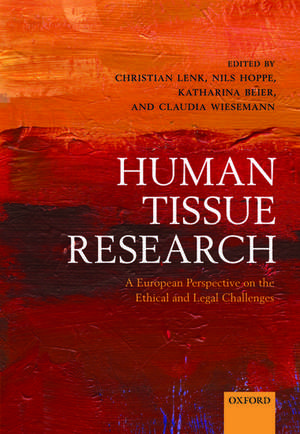
Human Tissue Research: A European perspective on the ethical and legal challenges
Editat de Christian Lenk, Nils Hoppe, Katharina Beier, Claudia Wiesemannen Limba Engleză Hardback – 27 ian 2011
Preț: 888.27 lei
Preț vechi: 1204.54 lei
-26%
Puncte Express: 1332
Carte tipărită la comandă
Livrare economică 27 noiembrie-02 decembrie
Livrare prin curier în România Termenul estimat este afișat lângă disponibilitate.
Transport gratuit pentru acest produs Plată online sau ramburs, în funcție de opțiunile comenzii.
Retur gratuit în 14 zile Comandă securizată și suport în română.
Specificații
ISBN-13: 9780199587551
ISBN-10: 0199587558
Pagini: 216
Ilustrații: 1 black and white line drawing
Dimensiuni: 186 x 250 x 26 mm
Greutate: 0.53 kg
Editura: OUP OXFORD
Colecția OUP Oxford
Locul publicării:Oxford, United Kingdom
ISBN-10: 0199587558
Pagini: 216
Ilustrații: 1 black and white line drawing
Dimensiuni: 186 x 250 x 26 mm
Greutate: 0.53 kg
Editura: OUP OXFORD
Colecția OUP Oxford
Locul publicării:Oxford, United Kingdom
V-ar putea interesa
-
 Principles and Practice of Clinical ResearchJohn I. Gallin-9%Preț: 644.18 lei707.89 lei
 -
 StiffMary RoachPreț: 64.20 lei
 -
 Bioethics: Passing the Boards, Providing Patient Care, and BeyondJeffrey W. Bulger-24%Preț: 603.02 lei795.81 lei
 -
 Principles of Medical LawJudith Laing-23%Preț: 2551.96 lei3301.28 lei
 -
 Medical Law: A Very Short IntroductionCharles Foster-20%Preț: 57.12 lei71.12 lei
 -
 Don't Burn Anyone at the Stake TodayNaomi AldermanPreț: 121.01 lei
 -
 Rethinking Race and Ethnicity in Biomedical ResearchBoard On Health Care Services-5%Preț: 211.64 lei222.78 lei
 -
 Legal Medicine: Health Care Law and Medical EthicsAmerican College of Legal Medicine-29%Preț: 1283.09 lei1796.47 lei
 -
 -31%Preț: 221.67 lei320.80 lei
 -
 Against the MachinePaul KingsnorthPreț: 193.57 lei
 -
 Human RemainsMargaret CleggPreț: 307.70 lei
 -
 Qualitative Research Ethics: Research MethodsDr. Rose Wiles-11%Preț: 130.58 lei146.01 lei
 -
 Medicine, patients and the lawEmma CavePreț: 372.31 lei
 -
 Between the WavesTom McTaguePreț: 169.28 lei
 -
 Confluences of Law and HistoryNiamh HowlinPreț: 444.00 lei
 -
 The ImmortalistsAleks KrotoskiPreț: 123.00 lei
 -
 Ethical Approaches to Human RemainsKirsty Squires-18%Preț: 1019.99 lei1243.89 lei
 -
 Legal and Forensic MedicineRoy G. Beran-18%Preț: 5311.56 lei6477.52 lei
 -
 European Yearbook on Human Rights 2024Philip Czech-18%Preț: 1477.03 lei1801.26 lei
 -
 Handbook of Global BioethicsHenk A. M. J. Ten Have-18%Preț: 3223.45 lei3931.03 lei
Notă biografică
PD Dr Christian Lenk read philosophy, political science, and social anthropology at the University of Hamburg, Germany. From 2000 to 2002 he worked in two projects in the field of medical ethics and bioethics at the Universities of Marburg and Münster, financed by the German Research Community (DFG). He received his doctoral degree for a study on the ethical issues of enhancement technologies in biomedicine at the University of Münster in 2002. In 2002 he became a researcher and since 2004 has been assistant professor for medical ethics at the Department for Medical Ethics and History of Medicine at the University of Göttingen.Nils Hoppe read law, with a specialisation in medical law and human rights, in Nottingham, Erlangen-Nuremberg, Goettingen and Hannover. He completed his doctorate in 2008 with a thesis on property rights in the life sciences. Nils held positions as a legal assistant in a large English law firm, legal counsel in a university hospital and as research fellow in medical ethics. He is now a senior research fellow in health law and ethics as well as co-director of the Centre for Ethics and Law in the Life Sciences (CELLS) at Leibniz Universitaet Hannover.Katharina Beier majored in political science and German language and literature at the University of Greifswald in North-Eastern Germany. In February 2008 she finished her PhD "Between persistence and revision - The biomedical challenge to political liberalism " (Campus 2009). Since April 2008 she has been working as a research fellow and Project Officer for the Tiss.EU project at the Department of Medical Ethics and History in Göttingen (Germany). Her research interests comprise modern liberal theories, liberal biopolitics, questions of biomedical/genetic justice, utilitarianism as well as ethical and legal aspects of biobanks.Claudia Wiesemann is a medical ethicist and head of the Department of Medical Ethics and History of Medicine at Göttingen University Medical School, Germany. She is also President of the German Academy of Ethics in Medicine, an academic society for Medical Ethics. In 1995, she completed her habilitation in medical history and medical ethics at the University of Erlangen-Nuernberg, Germany. Her dissertation in medical history at Muenster University, Germany, was published in 1991. She has completed all medical exams in Muenster University, Germany, in 1985 and has worked as resident from 1986 to 1988. Claudia Wiesemann has coordinated several European research projects, e.g., on the ethics of tissue research and on information and documentation networks in ethics in medicine and biotechnology. Her research focuses on the ethics of research with humans, reproductive medicine and the family. She serves as an editorial board member of several journals in the field of medical humanities.