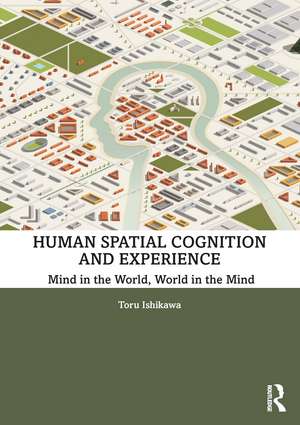
Human Spatial Cognition and Experience: Mind in the World, World in the Mind
Autor Toru Ishikawaen Limba Engleză Hardback – 7 iul 2020
We live in space and space surrounds us. We interact with space all the time, consciously or unconsciously, and make decisions and actions based on our perceptions of that space. Have you ever wondered how some people navigate perfectly using maps in their heads while other people get lost even with a physical map? What do you mean when you say you have a poor "sense of direction"? How do we know where we are? How do we use and represent information about space?
This book clarifies that our knowledge and feelings emerge as a consequence of our interactions with the surrounding space, and show that the knowledge and feelings direct, guide, or limit our spatial behavior and experience. Space matters, or more specifically space we perceive matters. Research into spatial cognition and experience, asking fundamental questions about how and why space and spatiality matters to humans, has thus attracted attention. It is no coincidence that the 2014 Nobel Prize in Physiology or Medicine was awarded for research into a positioning system in the brain or "inner GPS" and that spatial information and technology are recognized as an important social infrastructure in recent years.
This is the first book aimed at graduate and advanced undergraduate students pursuing this fascinating area of research. The content introduces the reader to the field of spatial cognition and experience with a series of chapters covering theoretical, empirical, and practical issues, including cognitive maps, spatial orientation, spatial ability and thinking, geospatial information, navigation assistance, and environmental aesthetics.
Preț: 1129.34 lei
Preț vechi: 1377.23 lei
-18%
Puncte Express: 1694
Carte tipărită la comandă
Livrare economică 01-15 decembrie
Livrare prin curier în România Termenul estimat este afișat lângă disponibilitate.
Transport gratuit pentru acest produs Plată online sau ramburs, în funcție de opțiunile comenzii.
Retur gratuit în 14 zile Comandă securizată și suport în română.
Specificații
ISBN-13: 9780815369851
ISBN-10: 0815369859
Pagini: 292
Ilustrații: 272
Dimensiuni: 174 x 246 x 16 mm
Greutate: 0.7 kg
Ediția:1
Editura: Taylor & Francis
Colecția Routledge
Locul publicării:Oxford, United Kingdom
ISBN-10: 0815369859
Pagini: 292
Ilustrații: 272
Dimensiuni: 174 x 246 x 16 mm
Greutate: 0.7 kg
Ediția:1
Editura: Taylor & Francis
Colecția Routledge
Locul publicării:Oxford, United Kingdom
V-ar putea interesa
-
 Metacognitive Diversity: An Interdisciplinary ApproachJoëlle Proust-31%Preț: 701.88 lei1012.09 lei
 -
 The Oxford Handbook of Evolutionary Psychology and ReligionJames R. Liddle-32%Preț: 928.22 lei1365.57 lei
 -
 Foundations of ConsciousnessAntti RevonsuoPreț: 339.58 lei
 -
 -15%Preț: 444.99 lei523.51 lei
 -
 Reading AcquisitionPhilip B. Gough-18%Preț: 1128.07 lei1375.70 lei
 -
 Evolutionary PsychologyLance WorkmanPreț: 443.25 lei
 -
 Psychology of Language: Theory and ApplicationsShelia M. Kennison-20%Preț: 371.33 lei462.26 lei
 -
 Being Skilled: The Socializations of Learning to ReadStuart McNaughton-18%Preț: 1011.88 lei1234.00 lei
 -
 Psychophysiological Aspects of Reading and LearningVictor M. Rentel-18%Preț: 1017.12 lei1240.38 lei
 -
 Preț: 391.02 lei
 -
 The Mystery of DreamsWilliam Oliver Stevens-18%Preț: 1003.26 lei1223.49 lei
 -
 Artificial Intelligence: An IntroductionAlan Garnham-18%Preț: 1003.26 lei1223.49 lei
 -
 The Nature of Human IntelligenceRobert J. SternbergPreț: 291.62 lei
 -
 -11%Preț: 495.57 lei556.82 lei
 -
 Motivation and ActionJutta Heckhausen-18%Preț: 1087.66 lei1326.41 lei
 -
 State-Trace AnalysisJohn C. DunnPreț: 364.71 lei
 -
 Coaching for Rational LivingMichael E. Bernard-15%Preț: 680.59 lei800.69 lei
 -
 Preț: 440.41 lei
 -
 CREATIVITYTan Ai-Girl-15%Preț: 609.83 lei717.45 lei
Public țintă
Postgraduate and UndergraduateCuprins
Preface List of Figures List of Tables 1. Why Is Spatial Special? 2. Brief History of Research into Spatial Cognition 3. Maps in the Head 4. The Structure of Cognitive Maps 5. The Acquisition of Cognitive Maps 6. Spatial Abilities and Individual Differences 7. Communicating Information about Space 8. Development of Spatial Cognition in Children 9. Feelings about Space 10. Space, Information, and Society References Index
Notă biografică
Toru Ishikawa is a Professor in the Department of Information Networking for Innovation and Design (INIAD) at Toyo University, Tokyo, Japan. He has a PhD in geography from the University of California, Santa Barbara, and is an associate member of the Science Council of Japan. He specializes in cognitive-behavioral geography, geographic information science, and urban residential environments and planning. His research interests include cognitive maps and mapping, wayfinding and navigation, spatial thinking in geoscience, and geospatial awareness and technology.
Recenzii
"This book gives us a readable and comprehensive overview of a fast-developing interdisciplinary field. An excellent introduction for beginners, a welcome refresher for working scientists."—Nora S. Newcombe, Laura H. Carnell Professor of Psychology and James H. Glackin Distinguished Faculty Fellow, Temple University, USA
"This book is a timely addition to the literature on spatial and environmental cognition and experience. In this era of nearly unbridled enthusiasm for what neuroscience can reveal, Toru’s book reminds us that mind and behavior are not just in the brain, but in the brain and nervous system in the body in the physical and sociocultural world."—Daniel R. Montello, Professor of Geography, University of California, Santa Barbara, USA
"Toru Ishikawa presents an excellently written and concise account of research done on human spatial cognition. The book covers a full range of topics including motivation and history through methodological issues, empirical results to applications, and societal implications. A great introduction to the fascinating field of spatial cognition. The book should be read by everyone interested to understand how we know where we are."—Christian Freksa, Professor for informatics and director of the Bremen Spatial Cognition Center, University of Bremen, Germany
"This book is a timely addition to the literature on spatial and environmental cognition and experience. In this era of nearly unbridled enthusiasm for what neuroscience can reveal, Toru’s book reminds us that mind and behavior are not just in the brain, but in the brain and nervous system in the body in the physical and sociocultural world."—Daniel R. Montello, Professor of Geography, University of California, Santa Barbara, USA
"Toru Ishikawa presents an excellently written and concise account of research done on human spatial cognition. The book covers a full range of topics including motivation and history through methodological issues, empirical results to applications, and societal implications. A great introduction to the fascinating field of spatial cognition. The book should be read by everyone interested to understand how we know where we are."—Christian Freksa, Professor for informatics and director of the Bremen Spatial Cognition Center, University of Bremen, Germany
Descriere
This book offers students an introduction to human spatial cognition and experience and is designed for graduate and advanced undergraduate students who are interested in the study of maps in the head and the psychology of space.