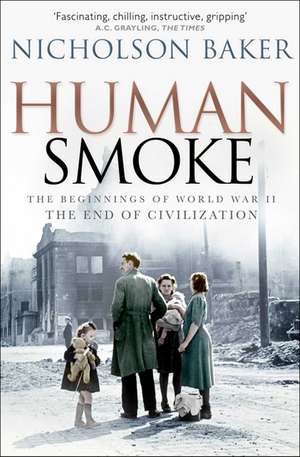
Human Smoke: The Beginnings of World War II, the End of Civilization
Autor Nicholson Bakeren Limba Engleză Paperback – 2 mar 2009
Remarcăm în Human Smoke o metodologie atipică pentru istoriografia tradițională: Nicholson Baker renunță la analiza liniară în favoarea unei structuri compuse din viniete fin detaliate și fragmente documentare. Materialul este organizat pentru a evidenția deciziile politice eronate și prejudecățile personale care au precedat conflictul, oferind o perspectivă fragmentată, dar coerentă, asupra modului în care civilizația a alunecat spre dezastru. Apreciem rigoarea cercetării care scoate la lumină fapte mai puțin discutate, precum sprijinul oferit de Churchill lui Mussolini sau pozițiile timpurii ale lui FDR față de admiterea refugiaților evrei la Harvard.
Această lucrare reprezintă o evoluție naturală în opera lui Nicholson Baker. Dacă în Double Fold autorul manifesta o preocupare obsesivă pentru conservarea arhivelor și criticarea sistemelor instituționale, în Human Smoke el aplică aceeași privire microscopică asupra istoriei diplomatice. Stilul său, cunoscut din beletristică pentru introspecția amănunțită în lucrări precum The Mezzanine, este aici pus în serviciul unei cauze pacifiste, deconstruind miturile „războiului bun”.
Human Smoke constituie o alternativă necesară la The Origins of the Second World War de A. J. P. Taylor pentru cursurile de istorie modernă și relații internaționale. Deși ambele volume provoacă narațiunile stabilite, Baker aduce avantajul unei structuri narative umane, punând accent pe vocile disidente, precum cea a lui Gandhi, și pe eșecul moral al liderilor occidentali. Față de abordările strict academice ale unor autori precum Frank McDonough, Baker oferă o experiență de lectură viscerală, transformând datele de arhivă într-un avertisment contemporan despre natura agresiunii militare.
Preț: 60.05 lei
Preț vechi: 137.66 lei
-56%
Carte disponibilă
Livrare economică 20 noiembrie-02 decembrie
Specificații
ISBN-10: 1847393187
Pagini: 576
Dimensiuni: 129 x 198 x 37 mm
Greutate: 0.62 kg
Editura: Simon&Schuster
Colecția Simon & Schuster UK
Locul publicării:United Kingdom
V-ar putea interesa
-
 Winston's WarMichael DobbsPreț: 131.30 lei
 -
 Smoke in BerlinOriana RamunnoPreț: 125.69 lei
 -
 The Origins of the Second World WarA. J. P. TaylorPreț: 93.77 lei
 -
 Fateful ChoicesIan Kershaw-17%Preț: 102.42 lei124.02 lei
 -
 World War TwoNorman Stone-32%Preț: 62.46 lei91.24 lei
 -
 Why Britain is at WarHarold Nicolson-20%Preț: 50.99 lei63.76 lei
 -
 Hitler's American GambleBrendan Simms-18%Preț: 77.70 lei94.71 lei
 -
 Hitler's PeopleRichard J. EvansPreț: 109.66 lei
 -
 The Second World War: A Short HistoryR. A. C. Parker-18%Preț: 93.85 lei114.66 lei
 -
 The Second World WarJames Holland-16%Preț: 201.62 lei238.74 lei
 -
 IndignityLea Ypi-28%Preț: 102.94 lei142.26 lei
 -
 Churchill, Hitler, and the Unnecessary WarPatrick J BuchananPreț: 135.22 lei
 -
 Complete Illustrated History of World War TwoDonald SommervillePreț: 143.25 lei
 -
 The Phoney Victory: The World War II IllusionPeter Hitchens-34%Preț: 76.96 lei116.48 lei
 -
 The Second World WarSir Sir Winston S. Churchill-21%Preț: 211.80 lei267.41 lei
 -
 Scorched Earth: A Global History of World War IIPaul Thomas Chamberlin-22%Preț: 116.86 lei149.49 lei
 -
 -15%Preț: 69.00 lei81.45 lei
 -
 -16%Preț: 197.96 lei235.40 lei
De ce să citești această carte
Cititorul va câștiga o perspectivă critică asupra miturilor fondatoare ale secolului XX. Human Smoke se adresează celor interesați de istoria politică și etică, oferind o demitizare a figurilor emblematice ale Aliaților. Este o recomandare esențială pentru cei care doresc să înțeleagă mecanismele subtile prin care deciziile administrative și bias-urile individuale pot accelera drumul către un conflict global.
Despre autor
Nicholson Baker (născut în 1957) este un romancier și eseist american recunoscut pentru stilul său analitic și atenția neabătută asupra detaliilor cotidiene. Cariera sa literară pendulează între explorări ale conștiinței umane, precum în The Mezzanine, și lucrări de non-ficțiune curajoase. A primit National Book Critics Circle Award pentru Double Fold, o critică adusă gestionării bibliotecilor publice. Ca pacifist convins, Baker utilizează în Human Smoke expertiza sa de cercetător al arhivelor pentru a reevalua originile celui de-al Doilea Război Mondial, consolidându-și reputația de observator riguros al sistemelor care definesc societatea modernă.
Notă biografică
Descriere
At a time when the West seems ever more eager to call on military aggression as a means of securing international peace, Nicholson Baker's provocative narrative exploring the political misjudgements and personal biases that gave birth to the terrifying consequences of the Second World War could not be more pertinent.
With original and controversial insights brought about by meticulous research, Human Smokere-evaluates the political turning points that led up to war, challenging some of the treasured myths we hold about how war came about and how atrocities like the Holocaust were able to happen. Baker reminds us, for instance, not to forget that it was thanks in great part to Churchill and England that Mussolini ascended to power so quickly, and that, before leading the United States against Nazi Germany, a young FDR spent much of his time lobbying for a restriction in the number of Jews admitted to Harvard. Conversely, Human Smokealsoreminds us of those who had the foresight to anticipate the coming bloodshed and the courage to oppose the tide of history, as Gandhi demonstrated when he made his symbolic walk to the ocean.
Praised by critics and readers alike for his gifted writing and exquisitely observant eye, Baker offers a combination of sweeping narrative history and a series of finely delineated vignettes of the individuals and moments that shaped history.