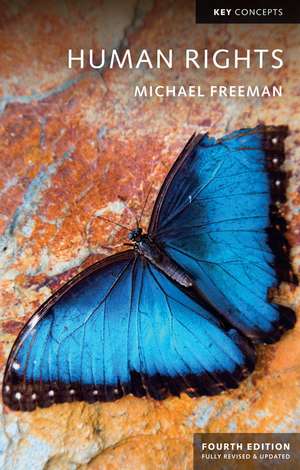
Human Rights
Autor Michael Freemanen Limba Engleză Hardback – 7 feb 2022
Recomandăm această a patra ediție a volumului Human Rights pentru modul în care reușește să transforme teoria abstractă într-un instrument de analiză a realităților politice imediate. Încă din primul capitol, autorul stabilește o premisă clară: studiul drepturilor omului nu trebuie să se limiteze la cadrul juridic, ci trebuie să integreze vocea victimelor și contextul social-științific. Ne-a atras atenția rigoarea cu care Michael Freeman deconstruiește istoria conceptului, de la ascensiunea drepturilor naturale până la revitalizarea acestora prin intermediul ONU după 1945. Cartea este organizată progresiv, pornind de la baze teoretice și istorice, pentru ca în a doua jumătate să exploreze rolul crucial al sociologiei, psihologiei și antropologiei în înțelegerea încălcărilor drepturilor omului. Cititorii familiarizați cu Philosophy of Human Rights de Anat Biletzki vor aprecia în acest volum trecerea de la critica filosofică spre o aplicabilitate practică în relațiile internaționale și politici publice. Spre deosebire de alte abordări pur teoretice, Freeman pune întrebări incomode despre cauzele structurale ale opresiunii și despre modul în care diferențele culturale se ciocnesc cu pretenția de universalitate a drepturilor. Deși Michael Freeman este recunoscut și pentru lucrările sale tehnice, precum The Photography Bible sau The Photographer's Eye, în cadrul seriei de politologie de la Polity Press el demonstrează aceeași precizie analitică, de data aceasta aplicată asupra mecanismelor puterii și eticii globale. Tonul este echilibrat, evitând jargonul excesiv, ceea ce face textul accesibil nu doar studenților, ci și activiștilor sau publicului larg interesat de justiție socială.
Preț: 518.80 lei
Carte tipărită la comandă
Livrare economică 05-19 decembrie
Specificații
ISBN-10: 1509546030
Pagini: 272
Dimensiuni: 140 x 216 x 16 mm
Greutate: 0.46 kg
Ediția:4th edition
Editura: Polity Press
Locul publicării:Chichester, United Kingdom
V-ar putea interesa
-
 Law and Anthropology: Current Legal Issues Volume 12Michael Freeman-32%Preț: 1331.22 lei1945.57 lei
 -
 Preț: 359.21 lei
 -
 Human Rights in Contemporary China (Paper)R. Randle EdwardsPreț: 266.87 lei
 -
 Preț: 276.52 lei
 -
 Preț: 491.86 lei
 -
 Saudi–Yemen RelationsF. Gregory Gause Iii-23%Preț: 567.00 lei736.36 lei
 -
 -23%Preț: 597.08 lei775.43 lei
 -
 -22%Preț: 192.87 lei247.97 lei
 -
 Families in Perpetual CrisisRichard KaganPreț: 329.76 lei
 -
 CongressRandall B Ripley-11%Preț: 436.87 lei490.88 lei
 -
 Understanding Arms ControlM MccainPreț: 133.06 lei
 -
 Arab NationalismB. TibiPreț: 368.75 lei
De ce să citești această carte
Credem că acest volum este esențial pentru oricine dorește să înțeleagă dincolo de limbajul juridic al tratatelor internaționale. Cititorul câștigă o perspectivă critică asupra modului în care politica și cultura influențează aplicarea drepturilor omului. Este un ghid indispensabil pentru studenții la științe politice și sociologie, oferind argumente solide pentru dezbaterile actuale despre universalism și diversitate culturală.
Despre autor
Michael Freeman (n. 1945) este un autor și cercetător britanic cu o carieră polivalentă, fiind recunoscut atât pentru expertiza sa în științe politice, cât și pentru contribuțiile remarcabile în domeniul fotografiei și culturii asiatice. A colaborat timp de trei decenii cu revista Smithsonian și a publicat numeroase volume despre arhitectură și arheologie. În paralel cu succesul seriei The Photographer's Eye, Freeman s-a impus în mediul academic prin analize interdisciplinare riguroase. Lucrarea de față, ajunsă la a patra ediție, reflectă angajamentul său de lungă durată față de studiul drepturilor omului și al impactului social al conceptelor politice.
Cuprins
Descriere scurtă
Notă biografică
Descriere
Human Rights is an introductory text that is both innovative and challenging. It invites students to think conceptually about one of the most important and influential political concepts of our time. In this unique interdisciplinary approach, Michael Freeman emphasizes the complex ways in which the experiences of the victims of human rights violations are related to legal, philosophical and social–scientific approaches to human rights. By tracing the history of the concept, the book shows that there is a fundamental tension between the philosophy of human rights and the way in which it is understood in the social sciences. This analysis throws light on some of the most controversial issues in the field: Is the idea of the universality of human rights consistent with respect for cultural difference? Are there collective human rights? Should feminists embrace, revise or reject the idea of human rights? Does the idea of human rights distract our attention from the structural causes of oppression and exploitation? What are the underlying causes of human rights violations? And why do some countries have much worse human rights records than others?
The book will appeal to students in the social sciences, as well as students of human rights law who want an introduction to the non–legal aspects of their subject. It will also be read by scholars interested in ethics and the social sciences, as well as the general reader.
Recenzii
"A unique five star Baedeker to an expanding landscape of serious research introducing the reader to the diverse ways academic fields of scolarship come to grips with the important topic of human rights ... it will attract bright and inquiring minds who will want to dig more deeply into the literature to which they have been so gracefully initiated." Richard Pierre Claude, Human Rights Quarterly
"The treatment of the background concepts and theories as well of the different issues is up to date, substantially focussed and presented in a balanced way. In this Freeman succeeds in presenting the complexity of the discussions without demanding prior knowledge" Mikael Spang, Ethnic and Racial Studies
"′Human rights,′ states Freeman with justifiable certainty in the Introduction to this excellent book, ′is an interdisciplinary concept par excellence′. ...Throughout this engaging text, Freeman is sensitive to the debates but wholly committed to the issues. ...What a gift this is for students of various disciplines interested in human rights but intimidated by the complex legal and philosophical jargon contained in much of the literature." Darren J. O′Byrne, University of Surrey Roehampton
"Human Rights is an introductory text that is both innovative and challenging. [...] In this unique interdisciplinary approach, Michael Freeman emphasizes the complex ways n which the experiences of the victims of human rights violations are related to legal, philosophical and socio–scientific approaches to human rights." Philosophical Inquiry