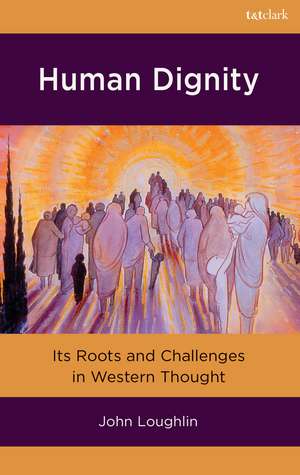
Human Dignity: Its Roots and Challenges in Western Thought: T&T Clark
Autor Professor John Loughlinen Limba Engleză Hardback – 30 apr 2026
Din seria T&T Clark
- 44%
 Preț: 193.75 lei
 - nou
 Preț: 251.73 lei
 - 44%
 Preț: 196.06 lei
 - 42%
 Preț: 204.82 lei
 - 44%
 Preț: 481.45 lei
 - 17%
 Preț: 121.19 lei
 - 52%
 Preț: 212.93 lei
 - 24%
 Preț: 148.24 lei
 - 25%
 Preț: 214.54 lei
 - 19%
 Preț: 340.37 lei
 - 25%
 Preț: 291.03 lei
 - 47%
 Preț: 921.34 lei
 - 26%
 Preț: 207.74 lei
 - 16%
 Preț: 359.67 lei
 - 7%
 Preț: 181.19 lei
 - 23%
 Preț: 273.18 lei
 - 44%
 Preț: 492.70 lei
 - 26%
 Preț: 207.19 lei
 - 21%
 Preț: 262.30 lei
 - 30%
 Preț: 437.98 lei
 - 33%
 Preț: 550.25 lei
 - 26%
 Preț: 519.76 lei
 - 26%
 Preț: 210.68 lei
 - 25%
 Preț: 208.34 lei
 - 24%
 Preț: 200.81 lei
 - 25%
 Preț: 188.72 lei
 - 20%
 Preț: 278.95 lei
 - 21%
 Preț: 320.71 lei
 - 23%
 Preț: 308.75 lei
 - 21%
 Preț: 273.32 lei
 - 24%
 Preț: 206.13 lei
 - 44%
 Preț: 872.96 lei
 - 26%
 Preț: 206.16 lei
 - 50%
 Preț: 243.97 lei
 -
 Preț: 155.84 lei
 - 19%
 Preț: 175.12 lei
 - 24%
 Preț: 207.84 lei
 - 38%
 Preț: 372.63 lei
 - 23%
 Preț: 238.95 lei
 - 25%
 Preț: 181.53 lei
 - 33%
 Preț: 550.78 lei
 - 27%
 Preț: 438.54 lei
 -
 Preț: 236.11 lei
 - 17%
 Preț: 263.94 lei
 - 25%
 Preț: 178.97 lei
 - 24%
 Preț: 836.81 lei
 - 19%
 Preț: 170.21 lei
 - 46%
 Preț: 343.36 lei
Preț: 505.53 lei
Preț vechi: 689.58 lei
-27%
Puncte Express: 758
Carte tipărită la comandă
Livrare economică 07-21 decembrie
Livrare prin curier în România Termenul estimat este afișat lângă disponibilitate.
Transport gratuit pentru acest produs Plată online sau ramburs, în funcție de opțiunile comenzii.
Retur gratuit în 14 zile Comandă securizată și suport în română.
Specificații
ISBN-13: 9780567726414
ISBN-10: 056772641X
Pagini: 256
Dimensiuni: 160 x 232 x 20 mm
Greutate: 0.52 kg
Editura: Bloomsbury Publishing
Colecția T&T Clark
Seria T&T Clark
Locul publicării:New York, United States
ISBN-10: 056772641X
Pagini: 256
Dimensiuni: 160 x 232 x 20 mm
Greutate: 0.52 kg
Editura: Bloomsbury Publishing
Colecția T&T Clark
Seria T&T Clark
Locul publicării:New York, United States
Cuprins
Preface
Introduction
1. Human Beings Made 'In the Image and Likeness of God - The Biblical Breakthrough
2. The New Testament Understanding of the 'Imago Dei'
3. The Patristic and Mediaeval Theological Development of 'Image and Likeness
4.The Renaissance Vision of the Human Being
5. The Reformation: The Collapse of the Christian Humanist Synthesis?
6. The Enlightenment and the Rise of Secular Modernity
7. Romanticism, Reaction, and the Fragmentation of Modern Concepts of Human Dignity
8. Twentieth-Century Challenges and the renewal of the Catholic Understanding of Human Dignity
9. Human Dignity in Contemporary Ethical Conflicts - A Concluding Reflection
References
Index
Introduction
1. Human Beings Made 'In the Image and Likeness of God - The Biblical Breakthrough
2. The New Testament Understanding of the 'Imago Dei'
3. The Patristic and Mediaeval Theological Development of 'Image and Likeness
4.The Renaissance Vision of the Human Being
5. The Reformation: The Collapse of the Christian Humanist Synthesis?
6. The Enlightenment and the Rise of Secular Modernity
7. Romanticism, Reaction, and the Fragmentation of Modern Concepts of Human Dignity
8. Twentieth-Century Challenges and the renewal of the Catholic Understanding of Human Dignity
9. Human Dignity in Contemporary Ethical Conflicts - A Concluding Reflection
References
Index
Recenzii
At a time when answering the question of what it means to be human is more and more urgent, the idea of 'human dignity' is increasingly offered as an influential response, but what does it mean? John Loughlin's book provides a welcome assessment of current debates on what the concept means from a Catholic perspective, tracing its origins in Imago Dei and its subsequent complex and contested history, through to contemporary debates on its meaning and functions. The book is a timely and penetrating reassessment of this critical concept from a scholar immersed in the diversity of Catholic thought but sensitive also to other religious and non-religious narratives that challenge that tradition. A tour de force.
This work offers a panoramic vision of the Catholic understanding of human dignity, following the twists and turns in the intellectual and political history of some two millennia. It will make an excellent introduction to the field for students of political philosophy, jurisprudence and church history. The author has a gift for making clear the movements in human thought that intersect, for better or worse, with the Catholic teaching.
This work offers a panoramic vision of the Catholic understanding of human dignity, following the twists and turns in the intellectual and political history of some two millennia. It will make an excellent introduction to the field for students of political philosophy, jurisprudence and church history. The author has a gift for making clear the movements in human thought that intersect, for better or worse, with the Catholic teaching.