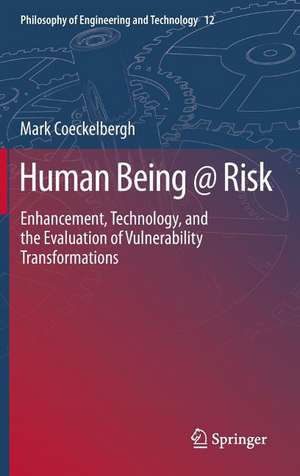
Human Being @ Risk
Autor Mark Coeckelberghen Limba Engleză Hardback – 2 mar 2013
Responding to the discussion about human enhancement and information technologies, the book then shows that this dynamic-relational approach has important implications for the evaluation of new technologies and their risks. It calls for a normative anthropology of vulnerability that does not ask which objective risks are acceptable, how we can become invulnerable, or which technologies threaten human nature, but which vulnerability transformations we want. To the extent that we can steer the growth of new technologies at all, this tragic and sometimes comic project should therefore beguided by what we want to become.
Preț: 1150.93 lei
Preț vechi: 1403.57 lei
-18%
Carte tipărită la comandă
Livrare economică 23 noiembrie-07 decembrie
Specificații
ISBN-10: 9400760248
Pagini: 232
Ilustrații: XIV, 218 p.
Dimensiuni: 160 x 241 x 18 mm
Greutate: 0.47 kg
Ediția:2013
Editura: Springer
Locul publicării:Dordrecht, Netherlands
V-ar putea interesa
-
 NauseaJean-Paul SartrePreț: 78.69 lei
 -
 Existentialism: A Very Short IntroductionThomas Flynn-20%Preț: 57.12 lei71.12 lei
 -
 The Measure of Things: Humanism, Humility, and MysteryDavid E. Cooper-11%Preț: 364.12 lei408.17 lei
 -
 Thomas Hobbes: Writings on Common Law and Hereditary RightAlan Cromartie-22%Preț: 381.20 lei491.33 lei
 -
 Objectivity and InsightMark Sacks-28%Preț: 348.87 lei484.04 lei
 -
 Irrational ManWilliam BarrettPreț: 99.68 lei
 -
 Existentialism and HumanismJean-Paul SartrePreț: 75.97 lei
 -
 Introduction to PhenomenologyDermont MoranPreț: 387.08 lei
 -
 Between Man and ManMartin BuberPreț: 139.50 lei
 -
 Preț: 278.42 lei
 -
 The Jargon of AuthenticityTheodor AdornoPreț: 139.94 lei
 -
 Body Images: Embodiment as IntercorporealityGail WeissPreț: 409.25 lei
 -
 Unfashionable Observations: Volume 2Friedrich NietzschePreț: 205.51 lei
 -
 Genesis and Structure of Hegel's "Phenomenology of Spirit"Jean HyppolitePreț: 244.23 lei
 -
 Merleau-Ponty: A Guide for the PerplexedProfessor Eric Matthews-23%Preț: 190.40 lei246.38 lei
 -
 The Basic Problems of PhenomenologyEdmund Husserl-18%Preț: 1027.13 lei1252.59 lei
Public țintă
ResearchCuprins
Recenzii
“It is thoroughly unique and original in showing the importance and extreme usefulness of philosophical anthropology and the phenomenological tradition for thinking through the consequences of the epochal technological mutations of our time … . author has succeeded in crafting a muchmore profound and sophisticated ethical and political perspective on human enhancement than almost any other book … . It deserves to be widely read and has the potential of becoming a key reference for the debate on enhancement.” (Pieter Lemmens, Human Studies, Vol. 37, 2014)
“The book offers a complex and ambitious programme to establish a normative anthropology of vulnerability … . Coeckelbergh has written an important and original book, with a carefully constructed argument. He provides a rich discussion of fundamental and topical issues from a wide range of perspectives. … The book is valuable for scholars in many fields, not only philosophy of technology, anthropology or ethics, but also other disciplines dealing with technology and regulation of technology.” (Bert-Jaap Koops, Law, Innovation and Technology, Vol. 5 (2), 2013)
Textul de pe ultima copertă
Responding to the discussion about human enhancement and information technologies, the book then shows that this dynamic-relational approach has important implications for the evaluation of new technologies and their risks. It calls for a normative anthropology of vulnerability that does not ask which objective risks are acceptable, how we can become invulnerable, or which technologies threaten human nature, but which vulnerability transformations we want. To the extent that we can steer the growth of new technologies at all, this tragic and sometimes comic project should therefore beguided by what we want to become.
Caracteristici
Notă biografică
Mark Coeckelbergh is full Professor of Philosophy of Media and Technology at the University of Vienna, ERA Chair at Institute of Philosophy of the Czech Academy of Sciences, and former President of the Society for Philosophy and Technology (SPT). He is also member of various entities that support policy development concerning AI Ethics. He is the author of numerous books including AI Ethics and Why AI Undermines Democracy.
Mark Thomas Young is a postdoctoral researcher at the University of Oslo. His research covers two fields; the Philosophy of Technology, where he focuses on practices of maintenance and the use of automating technologies and the History and Philosophy of Science, where he explores instruments, craft practices and tacit knowledge in the early modern period.
Wessel Reijers is a postdoctoral researcher at Paderborn University and holds visiting positions at the Technion and the European University Institute. His research focuses on the philosophy and ethics of technology, notably on the development of a critical hermeneutical approach to technology and the investigation of the role of emerging technologies in the shaping of citizenship.