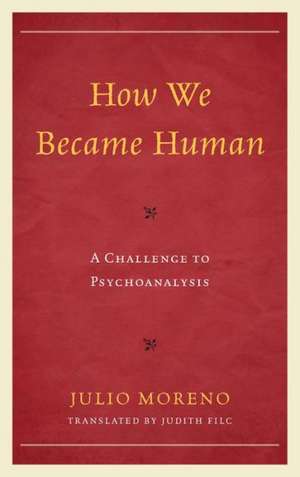
How We Became Human: A Challenge to Psychoanalysis: The Library of Object Relations
Autor Julio Moreno Traducere de Judith Filcen Limba Engleză Hardback – 6 mar 2014
Din seria The Library of Object Relations
- 29%
 Preț: 563.09 lei
 - 32%
 Preț: 591.33 lei
 - 21%
 Preț: 449.79 lei
 - 29%
 Preț: 647.54 lei
 - 34%
 Preț: 648.51 lei
 - 5%
 Preț: 793.57 lei
 - 28%
 Preț: 334.13 lei
 - 33%
 Preț: 675.02 lei
 - 32%
 Preț: 343.07 lei
 - 29%
 Preț: 424.03 lei
 - 23%
 Preț: 368.61 lei
 - 33%
 Preț: 370.77 lei
 - 25%
 Preț: 306.55 lei
 - 24%
 Preț: 694.66 lei
 - 31%
 Preț: 353.30 lei
 - 24%
 Preț: 629.36 lei
 - 24%
 Preț: 555.80 lei
 - 33%
 Preț: 371.67 lei
 - 28%
 Preț: 496.91 lei
 - 23%
 Preț: 277.28 lei
 - 33%
 Preț: 914.23 lei
Preț: 619.81 lei
Preț vechi: 913.59 lei
-32%
Puncte Express: 930
Carte tipărită la comandă
Livrare economică 05-19 decembrie
Livrare prin curier în România Termenul estimat este afișat lângă disponibilitate.
Transport gratuit pentru acest produs Plată online sau ramburs, în funcție de opțiunile comenzii.
Retur gratuit în 14 zile Comandă securizată și suport în română.
Specificații
ISBN-13: 9781442228856
ISBN-10: 1442228857
Pagini: 197
Dimensiuni: 158 x 237 x 21 mm
Greutate: 0.45 kg
Editura: Bloomsbury Publishing
Colecția Rowman & Littlefield
Seria The Library of Object Relations
Locul publicării:New York, United States
ISBN-10: 1442228857
Pagini: 197
Dimensiuni: 158 x 237 x 21 mm
Greutate: 0.45 kg
Editura: Bloomsbury Publishing
Colecția Rowman & Littlefield
Seria The Library of Object Relations
Locul publicării:New York, United States
V-ar putea interesa
-
 Imperial Geographies in Byzantine and Ottoman SpaceSahar BazzazPreț: 196.11 lei
 -
 -27%Preț: 282.18 lei386.85 lei
 -
 The Origins of UNICEF, 1946–1953Jennifer M. Morris-34%Preț: 554.54 lei836.63 lei
 -
 -34%Preț: 391.83 lei590.50 lei
 -
 -33%Preț: 356.17 lei531.99 lei
 -
 A Second Appeal: A Consideration of Freedom and Social JusticeDaphne M. Rolle-30%Preț: 212.99 lei304.33 lei
 -
 Mysteries and Legends of UtahMichael O'ReillyPreț: 102.63 lei
 -
 Yankee Don't Go Home!Julio MorenoPreț: 363.68 lei
 -
 -18%Preț: 337.30 lei411.87 lei
 -
 -29%Preț: 344.06 lei485.66 lei
 -
 The Indianization of Lewis and Clark Two Volume SetWilliam R. Swagerty-23%Preț: 548.95 lei712.92 lei
 -
 Harvest HeritageRichard D ScheuermanPreț: 218.57 lei
 -
 FixedDavid PorterPreț: 112.84 lei
 -
 Preț: 119.27 lei
 -
 Preț: 228.78 lei
 -
 Preț: 93.67 lei
 -
 High Times Hard TimesAnita O'Day-15%Preț: 128.73 lei151.97 lei
 -
 -27%Preț: 436.42 lei600.60 lei
 -
 Choral-Orchestral Works of Ralph Vaughan WilliamsStephen Town-18%Preț: 801.66 lei977.63 lei
 -
 Preț: 175.55 lei
 -
 Preț: 365.84 lei
 -
 Preț: 450.99 lei
 -
 Preț: 458.81 lei
 -
 The Soils of EcuadorJosé Espinosa-24%Preț: 678.41 lei892.64 lei
Cuprins
Acknowledgments
Preface
Chapter 1: Humanness
Chapter 2: Virtual Reality
Chapter 3: Connection and Association
Chapter 4: The Link I: Theory
Chapter 5: The Link II: Manifestations
Chapter 6: Belief
Chapter 7. Childishness
Chapter 8: Childishness II: The History of Childhood and Toys
Chapter 9: The Emergence of Humanness
Chapter 10: The Biological History of the Parent-Child Link: Childrearing Strategies
References
Index
About the Author
Preface
Chapter 1: Humanness
Chapter 2: Virtual Reality
Chapter 3: Connection and Association
Chapter 4: The Link I: Theory
Chapter 5: The Link II: Manifestations
Chapter 6: Belief
Chapter 7. Childishness
Chapter 8: Childishness II: The History of Childhood and Toys
Chapter 9: The Emergence of Humanness
Chapter 10: The Biological History of the Parent-Child Link: Childrearing Strategies
References
Index
About the Author
Recenzii
This English translation of Moreno's idiosyncratic and demanding reading of what it means to be human, originally published in Spanish in 2002, will repay the Anglophone who makes the effort to follow its multiple trajectories of thinking. A psychoanalyst based in Argentina, Moreno covers an impressive terrain of ideas, all tied. . . .to the question of how humanness differs from animalness and how humans' understandings of their world are, in the end, faulty. Ranging across the disciplines of psychology, biology, philosophy, anthropology, and physics, Moreno situates the strengths and deficiencies of Freudian metapsychology. Students of psychoanalysis and psychology, especially those interested in problems related to child analysis and treatment, will find this book rewarding. Not a book easily compared with others, Moreno's speculative treatment of what is human about humans is an important contribution to the more generally defined, and growing, turn back to humanism. Summing Up: Recommended. Graduate students, researchers, faculty, professionals.
This lucid and deep, simple and complex book raises a basic question: What is human about humans? Equipped with a solid training as a researcher and a psychoanalyst, Moreno daringlyties research from a variety of fields, from ethology to psychoanalysis, from logic to neurophysiology, from anthropology to computer science and virtual reality-resulting in a very broad outlook that How We Became Human encompasses in a careful and accomplished manner.
The Argentine psychoanalyst Julio Moreno has written an intellectual tour de force that is breathtaking in the scope of its knowledge and challenging in the complexity of its arguments. Starting from his unique view of what makes us human, Moreno returns to examine some of Freud's basic assumptions and, from an entirely new perspective, sheds light on the clinical situation today. His book is essential reading for Freud scholars.
Drawing with equal facility from his training in biophysics, neurobiology, and psychoanalytic practice, Julio Moreno deftly explores how we became human. The result is a richly entertaining book that makes for fascinating reading. Highly recommended.
This lucid and deep, simple and complex book raises a basic question: What is human about humans? Equipped with a solid training as a researcher and a psychoanalyst, Moreno daringlyties research from a variety of fields, from ethology to psychoanalysis, from logic to neurophysiology, from anthropology to computer science and virtual reality-resulting in a very broad outlook that How We Became Human encompasses in a careful and accomplished manner.
The Argentine psychoanalyst Julio Moreno has written an intellectual tour de force that is breathtaking in the scope of its knowledge and challenging in the complexity of its arguments. Starting from his unique view of what makes us human, Moreno returns to examine some of Freud's basic assumptions and, from an entirely new perspective, sheds light on the clinical situation today. His book is essential reading for Freud scholars.
Drawing with equal facility from his training in biophysics, neurobiology, and psychoanalytic practice, Julio Moreno deftly explores how we became human. The result is a richly entertaining book that makes for fascinating reading. Highly recommended.