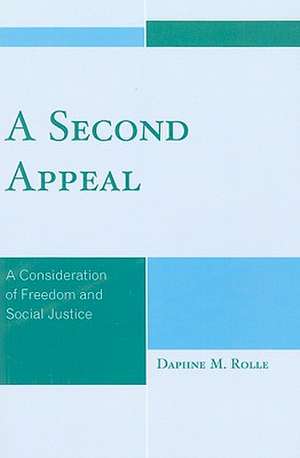
A Second Appeal: A Consideration of Freedom and Social Justice
Autor Daphne M. Rolleen Limba Engleză Paperback – 2 feb 2010
Preț: 212.99 lei
Preț vechi: 304.33 lei
-30%
Puncte Express: 319
Carte tipărită la comandă
Livrare economică 26 noiembrie-10 decembrie
Livrare prin curier în România Termenul estimat este afișat lângă disponibilitate.
Transport gratuit de la 400.00 lei Plată online sau ramburs, în funcție de opțiunile comenzii.
Retur gratuit în 14 zile Comandă securizată și suport în română.
Specificații
ISBN-13: 9780761849612
ISBN-10: 0761849610
Pagini: 30
Dimensiuni: 155 x 232 x 3 mm
Greutate: 0.07 kg
Editura: Bloomsbury Publishing
Colecția University Press of America
Locul publicării:New York, United States
ISBN-10: 0761849610
Pagini: 30
Dimensiuni: 155 x 232 x 3 mm
Greutate: 0.07 kg
Editura: Bloomsbury Publishing
Colecția University Press of America
Locul publicării:New York, United States
V-ar putea interesa
-
 -16%Preț: 281.94 lei337.26 lei
 -
 -18%Preț: 211.65 lei257.51 lei
 -
 Harlem Is NowhereSharifa Rhodes-PittsPreț: 128.60 lei
 -
 Amazing GraceJonathan KozolPreț: 128.86 lei
 -
 Thunder of FreedomSojournerPreț: 277.02 lei
 -
 The Last DarkyLouis Chude-SokeiPreț: 251.70 lei
 -
 Preț: 144.83 lei
 -
 African Roots, Brazilian RitesC. SterlingPreț: 402.64 lei
 -
 Punjabi Immigrant Mobility in the United StatesDiditi MitraPreț: 388.17 lei
 -
 BrainwashedTom BurrellPreț: 118.66 lei
Cuprins
Chapter 1 Preface
Chapter 2 Article I: Analysis of David Walker's Appeal
Chapter 3 Article II: Against Identity Theology
Chapter 4 Article III: The Essence of Freedom
Chapter 5 Article IV: On Values
Chapter 6 Index
Chapter 7 Author Bio
Chapter 2 Article I: Analysis of David Walker's Appeal
Chapter 3 Article II: Against Identity Theology
Chapter 4 Article III: The Essence of Freedom
Chapter 5 Article IV: On Values
Chapter 6 Index
Chapter 7 Author Bio
Recenzii
Dr. Rolle's passion for philosophers to move beyond platitudes and esoteric debates is inspiring and contagious. My deep hope is that her colleagues will take seriously their role in effecting positive, lasting change in the larger society.
Rolle uncovers Walker's concept of freedom - not one based on liberal individual free will but one based on freedom from insult and race-based oppression. Rolle also uncovers Walker's justification for insurrection, his biblical basis, and his rejection of pacifism or moral suasion. Walker's 'identity theology,' similar to 'liberation theology' is made explicit - God is a God that makes 'distinctions' and thereby favors one social category over another. Here is where Rolle enters.making values central; foregrounding concepts such as salvation, responsibility, reciprocity; and Rolle argues for a concept of freedom that is neither contingent on romanticizing individual freedom of the will nor social liberation. Occasionally speaking in the same collective voice as Walker, (We), Rolle's "we" is different than Walker's. Rolle's literary strategy works. It creates a 'Second' Appeal and thereby contributes a fascinating, albeit controversial, intellectual dialogue on a classical text.
Rolle uncovers Walker's concept of freedom - not one based on liberal individual free will but one based on freedom from insult and race-based oppression. Rolle also uncovers Walker's justification for insurrection, his biblical basis, and his rejection of pacifism or moral suasion. Walker's 'identity theology,' similar to 'liberation theology' is made explicit - God is a God that makes 'distinctions' and thereby favors one social category over another. Here is where Rolle enters.making values central; foregrounding concepts such as salvation, responsibility, reciprocity; and Rolle argues for a concept of freedom that is neither contingent on romanticizing individual freedom of the will nor social liberation. Occasionally speaking in the same collective voice as Walker, (We), Rolle's "we" is different than Walker's. Rolle's literary strategy works. It creates a 'Second' Appeal and thereby contributes a fascinating, albeit controversial, intellectual dialogue on a classical text.