
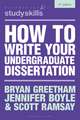
How to Write Your Undergraduate Dissertation: Bloomsbury Study Skills
Autor Bryan Greethamen Limba Engleză Paperback – 19 mar 2019
This book is an essential resource for undergraduates of all disciplines who are required to write a dissertation as part of their degree.
New to this Edition:
- Includes expanded material on research ethics
- Contains two new chapters on presenting research posters and delivering oral presentations
Accompanying online resources for this title can be found at bloomsburyonlineresources.com/how-to-write-your-undergraduate-dissertation. These resources are designed to support teaching and learning when using this textbook and are available at no extra cost.
Din seria Bloomsbury Study Skills
- 9%
 Preț: 136.51 lei
 - 14%
 Preț: 140.88 lei
 -
 Preț: 241.52 lei
 - 10%
 Preț: 110.16 lei
 - 16%
 Preț: 125.26 lei
 - 14%
 Preț: 114.84 lei
 - 10%
 Preț: 132.29 lei
 - 7%
 Preț: 127.06 lei
 - 9%
 Preț: 145.81 lei
 - 15%
 Preț: 125.41 lei
 - 21%
 Preț: 137.54 lei
 - 9%
 Preț: 145.60 lei
 - 24%
 Preț: 172.46 lei
 - 20%
 Preț: 162.49 lei
 - 13%
 Preț: 147.40 lei
 - 9%
 Preț: 113.10 lei
 - 20%
 Preț: 133.61 lei
 -
 Preț: 92.49 lei
 - 24%
 Preț: 175.27 lei
 - 10%
 Preț: 162.55 lei
 - 19%
 Preț: 149.56 lei
 - 14%
 Preț: 135.39 lei
 - 13%
 Preț: 125.21 lei
 - 6%
 Preț: 165.28 lei
 - 20%
 Preț: 166.73 lei
 - 20%
 Preț: 179.49 lei
 -
 Preț: 133.09 lei
 - 10%
 Preț: 109.56 lei
 - 14%
 Preț: 129.25 lei
 - 14%
 Preț: 160.55 lei
 - 14%
 Preț: 137.21 lei
 - 24%
 Preț: 134.90 lei
 - 14%
 Preț: 171.16 lei
 - 19%
 Preț: 240.54 lei
 -
 Preț: 233.01 lei
 - 24%
 Preț: 232.32 lei
 - 17%
 Preț: 210.58 lei
 -
 Preț: 213.66 lei
 - 24%
 Preț: 233.42 lei
 -
 Preț: 212.40 lei
 -
 Preț: 232.32 lei
 -
 Preț: 211.73 lei
 -
 Preț: 223.76 lei
 - 11%
 Preț: 232.22 lei
 -
 Preț: 249.34 lei
 - 26%
 Preț: 170.42 lei
 - 27%
 Preț: 215.20 lei
 - 14%
 Preț: 128.01 lei
 - 14%
 Preț: 127.72 lei
Preț: 130.41 lei
Preț vechi: 150.01 lei
-13%
Puncte Express: 196
Carte disponibilă
Livrare economică 12-26 noiembrie
Livrare prin curier în România Termenul estimat este afișat lângă disponibilitate.
Transport gratuit de la 400.00 lei Plată online sau ramburs, în funcție de opțiunile comenzii.
Retur gratuit în 14 zile Comandă securizată și suport în română.
Specificații
ISBN-13: 9781352005226
ISBN-10: 1352005220
Pagini: 384
Ilustrații: 44 bw illus
Dimensiuni: 156 x 234 x 20 mm
Greutate: 0.64 kg
Ediția:3. Auflage
Editura: Bloomsbury Publishing
Colecția Bloomsbury Academic
Seria Bloomsbury Study Skills
Locul publicării:London, United Kingdom
ISBN-10: 1352005220
Pagini: 384
Ilustrații: 44 bw illus
Dimensiuni: 156 x 234 x 20 mm
Greutate: 0.64 kg
Ediția:3. Auflage
Editura: Bloomsbury Publishing
Colecția Bloomsbury Academic
Seria Bloomsbury Study Skills
Locul publicării:London, United Kingdom
V-ar putea interesa
-
 Key Concepts in SociologyKenneth RobertsPreț: 237.51 lei
 -
 Key Concepts in Social Research MethodsDr Roger GommPreț: 239.96 lei
 -
 Key Concepts in PhilosophyPaddy McQueen-27%Preț: 214.63 lei293.74 lei
 -
 Key Concepts in Drama and PerformanceProfessor Kenneth Pickering-23%Preț: 236.01 lei307.51 lei
 -
 Key Concepts in InnovationZunaira MunirPreț: 236.49 lei
 -
 -24%Preț: 232.03 lei305.87 lei
 -
 How to Study a Charles Dickens NovelKeith SelbyPreț: 231.92 lei
 -
 Making a ValedictorianAndrew GoliszekPreț: 96.47 lei
 -
 Super Easy Dictionary SkillsPaula PiercePreț: 70.73 lei
 -
 Preț: 49.88 lei
 -
 Preț: 102.95 lei
 -
 Study Less, Learn MoreMichael W. Wiederman PhdPreț: 63.00 lei
 -
 Preț: 311.63 lei
 -
 Time Management Workbook for StudentsEmily SchwartzPreț: 84.58 lei
 -
 PMP in 28 DAYS: Exam Preparation GuideJean BolesPreț: 296.56 lei
 -
 Key Concepts in Politics and International RelationsAndrew Heywood-24%Preț: 193.31 lei254.08 lei
 -
 -19%Preț: 143.01 lei176.37 lei
 -
 Preț: 72.59 lei
Cuprins
Acknowledgements
Introduction
PART I: EXAMINERS AND SUPERVISORS
1. Examiners - What Are They Looking For?
2. Working With Your Supervisor
PART II: GENERATING AND DEVELOPING ORIGINAL IDEAS
3. What Activities Suit You Best?
4. Types of Research
5. What Interests You Most?
6. Generating Your Own Ideas 1: Using Trigger Questions
7. Generating Your Own Ideas 2: Perspectives and Levels
8. Developing Your Ideas 1: Causal Relations
9. Developing Your Ideas 2: Conceptual Relations
10. Original Questions and Hypotheses 1: Using Analogies
11. Original Questions and Hypotheses 2: Working With Your Structures
PART III: DECIDING ON YOUR PROJECT
12. Searching the Literature 1: Knowing What to Look For
13. Searching the Literature 2: How to Search
14. Choosing the Topic 1: Feasibility
15. Choosing the Topic 2: Ethical Issues
PART IV: ORGANISING YOUR WORK
16. Planning Your Research
17. Managing Your Time
18. Your Retrieval System
19. Reading
20. Note-taking
PART V: DOING YOUR RESEARCH
21. Qualitative and Quantitative Research
22. Secondary Sources
23. Primary Sources 1: Quantitative Research
24. Primary Sources 2: Designing and Distributing Your Questionnaire
25. Primary Sources 3: Qualitative Research - Interviews and Focus Groups
26. Primary Sources 4: Qualitative Research - Case Studies and Observations
PART VI: PLANNING YOUR DISSERTATION
27. The Main Components and Introduction
28. The Literature Review
29. Research Methods, Findings, Conclusions and Appendices
PART VII: ORGANISING YOUR THINKING
30. Developing Consistent Arguments 1: The Components
31. Developing Consistent Arguments 2: The Connections
32. Using Evidence 1: Describing It
33. Using Evidence 2: Drawing Inferences
34. Using Evidence 3: Creating Causal Connections
35. Using Language 1: Clarity Jargon
36. Using Language 2: Clarity Manipulative Words
37. Using Language 3: Consistency
PART VIII: WRITING YOUR DISSERTATION
38. The First Draft
39. Style 1: Finding Your Own Voice
40. Style 2: Simplicity and Economy
PART IX: PLAGIARISM, REFERENCING AND BIBLIOGRAPHIES
41. Plagiarism
42. Referencing and Bibliographies
PART X: EDITING
43. Revision 1: The Structure
44. Revision 2: The Content
PART XI: PRESENTING YOUR WORK
45. Oral Presentations
46. Poster Presentations
Conclusion
Bibliography
Index.
Introduction
PART I: EXAMINERS AND SUPERVISORS
1. Examiners - What Are They Looking For?
2. Working With Your Supervisor
PART II: GENERATING AND DEVELOPING ORIGINAL IDEAS
3. What Activities Suit You Best?
4. Types of Research
5. What Interests You Most?
6. Generating Your Own Ideas 1: Using Trigger Questions
7. Generating Your Own Ideas 2: Perspectives and Levels
8. Developing Your Ideas 1: Causal Relations
9. Developing Your Ideas 2: Conceptual Relations
10. Original Questions and Hypotheses 1: Using Analogies
11. Original Questions and Hypotheses 2: Working With Your Structures
PART III: DECIDING ON YOUR PROJECT
12. Searching the Literature 1: Knowing What to Look For
13. Searching the Literature 2: How to Search
14. Choosing the Topic 1: Feasibility
15. Choosing the Topic 2: Ethical Issues
PART IV: ORGANISING YOUR WORK
16. Planning Your Research
17. Managing Your Time
18. Your Retrieval System
19. Reading
20. Note-taking
PART V: DOING YOUR RESEARCH
21. Qualitative and Quantitative Research
22. Secondary Sources
23. Primary Sources 1: Quantitative Research
24. Primary Sources 2: Designing and Distributing Your Questionnaire
25. Primary Sources 3: Qualitative Research - Interviews and Focus Groups
26. Primary Sources 4: Qualitative Research - Case Studies and Observations
PART VI: PLANNING YOUR DISSERTATION
27. The Main Components and Introduction
28. The Literature Review
29. Research Methods, Findings, Conclusions and Appendices
PART VII: ORGANISING YOUR THINKING
30. Developing Consistent Arguments 1: The Components
31. Developing Consistent Arguments 2: The Connections
32. Using Evidence 1: Describing It
33. Using Evidence 2: Drawing Inferences
34. Using Evidence 3: Creating Causal Connections
35. Using Language 1: Clarity Jargon
36. Using Language 2: Clarity Manipulative Words
37. Using Language 3: Consistency
PART VIII: WRITING YOUR DISSERTATION
38. The First Draft
39. Style 1: Finding Your Own Voice
40. Style 2: Simplicity and Economy
PART IX: PLAGIARISM, REFERENCING AND BIBLIOGRAPHIES
41. Plagiarism
42. Referencing and Bibliographies
PART X: EDITING
43. Revision 1: The Structure
44. Revision 2: The Content
PART XI: PRESENTING YOUR WORK
45. Oral Presentations
46. Poster Presentations
Conclusion
Bibliography
Index.