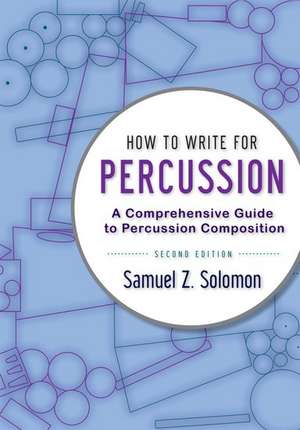
How to Write for Percussion: A Comprehensive Guide to Percussion Composition
Autor Samuel Z. Solomonen Limba Engleză Paperback – 19 mai 2016
Observăm în How to Write for Percussion o fuziune rară între rigoarea tehnică și fluiditatea practicii artistice. Dialogul dintre textul explicativ și resursele vizuale nu este doar unul informativ, ci devine o experiență senzorială completă; cele peste nouă ore de material video transformă conceptele abstracte de notație în vibrație și gest concret. Apreciem modul în care Samuel Z. Solomon nu se limitează la a lista instrumente, ci explorează dinamica intimă a colaborării dintre compozitor și interpret, oferind soluții pentru provocări logistice pe care manualele teoretice tind să le ignore.
Structura volumului este una organică, ghidând cititorul de la alegerea materialelor sonore până la complexitatea execuției pe scenă. Stilul este unul direct, ancorat în experiența de pedagog și interpret a autorului, ceea ce conferă textului o autoritate practică imediată. Pe raftul de artă, alături de The Cambridge Companion to Percussion, acest volum se distinge prin focalizarea sa ultra-specifică pe procesul de creație și compoziție, fiind mai degrabă un instrument de lucru decât o prezentare istorică. Dacă Practical Percussion de James Holland oferă o privire de ansamblu asupra evoluției instrumentelor, lucrarea lui Solomon intră în profunzimea tehnicii de scriere, oferind compozitorului instrumentarul necesar pentru a inova fără a sacrifica pragmatismul interpretativ. Credem că această ediție a doua, publicată de Oxford University Press, reprezintă o resursă esențială pentru oricine dorește să înțeleagă percuția nu doar ca ritm, ci ca o arhitectură sonoră complexă.
Preț: 348.71 lei
Preț vechi: 428.82 lei
-19%
Carte tipărită la comandă
Livrare economică 16-27 octombrie
Specificații
ISBN-10: 0199920362
Pagini: 304
Dimensiuni: 175 x 251 x 18 mm
Greutate: 0.57 kg
Ediția:2
Editura: Oxford University Press
Colecția OUP USA
Locul publicării:New York, United States
De ce să citești această carte
Recomandăm această carte compozitorilor și aranjatorilor care doresc să depășească barierele tehnice ale percuției moderne. Cititorul câștigă acces la decenii de experiență practică și la un material video vast care clarifică nuanțele execuției. Este un ghid indispensabil pentru a scrie partituri care sunt nu doar inovatoare, ci și perfect executabile, facilitând o comunicare fluidă între creator și interpret în contextul producțiilor de concert contemporane.
Despre autor
Samuel Z. Solomon este un percuționist și pedagog recunoscut, a cărui carieră este marcată de o explorare continuă a muzicii contemporane și a tehnicilor de interpretare. În calitate de profesor, el a identificat nevoia unei resurse care să medieze relația adesea complexă dintre cel care scrie muzica și cel care o aduce la viață pe scenă. Experiența sa vastă în spectacole camerale și orchestrale, combinată cu activitatea didactică, i-a permis să sintetizeze în How to Write for Percussion o viziune pragmatică și profundă asupra compoziției pentru instrumente de percuție.
Descriere
Notă biografică
Cuprins
- Table of Contents
- Introduction
- How This Book is Organized
- Instruments Covered
- Working with Percussionists
- Location Specifics
- The Value of Not Reading This Book
- 1. General Framework
- A Dysfunctional Family
- Comparison of Family Relationships
- The Problem of Pitch
- The Pitches of Percussion
- The Validations and Limitations of Novelty
- Three Methods for Indeterminately Pitch Instruments
- The Written/Improv Divide
- Expanding the Color Palette (to Shrink the Setup)
- The Value of Improvised and Non-Notated Music
- Social Composition
- Write for People, Not Sounds
- Write What is Wanted, Not What To Do
- Working with Percussionists
- 2. General Logistics
- Instrument Choice and Management
- Six Stories, Three Sad and Three Happy
- Why Use Fewer Instruments?
- How to Consolidate
- Inexpensive Instruments
- Exotic Instruments
- Electronic Percussion
- Multiple Options for a Specified Instrument
- Instruments Percussionists May Not Play
- Multiple Percussionists
- Section Setup
- Orchestra
- Wind Ensemble
- Broadway Pit
- Drum Corps and Marching Bands
- Specialists
- Non-Percussionists Playing Percussion
- Chairs and Stands
- Issues of Playability
- Excessive Polyphony
- How Fast Percussionists Can Play
- Unidiomatic Writing-Music that Often Requires Memorization
- Dynamics
- Reaching Instruments
- Instruments with Pedals
- Physical Exertion and Shaking
- Working with Headphones or Headset Microphones
- 3. General Notation
- Basics of Percussion Parts and Scores
- Instrument List
- Instrument Key
- Setup Diagram
- Language
- Parts
- Cues
- Percussion in the Conductor's Score
- Dynamics
- Designing a Notational System
- Clefs
- Staves
- Noteheads
- Mixing Determinately and Indeterminately Pitched Instruments
- Key Signatures
- What Goes Where on the Staff
- The Chicken or the Egg?
- Unspecified Instruments (Indeterminate Instrumentation)
- How Much to Notate
- Systems of Notation for Which There is No Standard
- Return to a "Normal " Method of Playing
- Note Length, Articulation, and Phrasing
- Note Length Chart
- Exact or Inexact Note-Length Indications
- Muting (Muffling, Dampening)
- Dead Stroke
- Damper Pedals
- Rolls
- Notations that are Not Recommended
- Symbol Notation
- Altered Keyboard Notation (Timbre-Staff)
- 4. Beaters
- To Indicate or Not to Indicate?
- Beater Lingo
- Logistical Beater Issues
- Sticks
- Mallets
- Triangle Beaters, Knitting Needles
- Brushes
- Rute
- Chime Hammers
- Superball Mallet
- Beaters as Instruments
- Hands
- Bows
- 5. Keyboard Percussion
- Ranges and Construction
- Writing for Keyboard Percussion
- Stacked Instruments
- Multiple Players
- Extended Techniques
- Miscellaneous
- 6. Drums
- Sticks on Drums
- Mallets on Drums
- Hands on Drums
- Playing on the Rim or Shell
- Beating Spot
- Mutes
- Pitch Bending
- Drum Size
- Two-Headed Drums
- Multiple Drums in Setups
- Idiomatic Writing for Drums
- Timpani
- Tom-toms
- Snare Drum, Field Drum, Tenor Drum
- Concert Bass Drum, Pedal Bass Drum
- Bongos, Congas
- Timbales
- Roto-Toms
- Frame Drums
- Tambourines
- Djembe, Doumbek
- Boobams
- Drumset
- 7. Metal
- Cymbals
- Gongs
- Finger Cymbals
- Cowbells, Almglocken
- Temple Bowls, Mixing Bowls
- Brake Drums, Metal Pipes, Anvils, Bell Plates
- Thundersheet
- Junk Metal, Tin Cans, Pots and Pans
- Ribbon Crasher
- Spring Coil
- Church Bells
- Hand Bells
- Steel Drums
- Tambourines
- Sleighbells
- Metal Wind Chimes, Mark Tree, Bell Tree
- Flexatone
- Extended Techniques
- 8. Wood
- Woodblocks, Templeblocks, Log Drum
- Wooden Planks
- Wood Drums, Wooden Boxes, Cajón, Mahler Hammer
- Claves
- Castanets
- Rute
- Guiro
- Slapstick
- Ratchet
- Bamboo Wind Chimes
- 9. Miscellaneous Instruments
- Bottles
- Cabasa
- Conch Shell
- Crystal Glasses
- Maracas, Shakers
- Rainstick
- Rice Bowls, Flower Pots
- Sandpaper Blocks
- Sirens
- String Drum, Cuica
- Stones, Prayer Stones
- Thumb Piano
- Vibraslap
- Wind Chimes
- Whistles
- Wind Machine
- Appendix A. Repertoire Analysis
- Percussion Ensemble
- Edgard Varèse, Ionisation (1929-31)
- John Cage, Constructions (1939-1942)
- Iannis Xenakis, Persephassa (1969)
- Steve Reich, Drumming (1970-71)
- Steve Mackey, It is Time (2010)
- John Luther Adams, Inuksuit (2009)
- Ryan Streber, Cold Pastoral (2004)
- Nico Muhly, Ta and Clap (2004)
- Adam Silverman, Naked and On Fire (2011)
- Paul Lansky, Travel Diary (2007)
- Orchestral
- Bela Bartók
- Sergei Prokofiev
- Maurice Ravel
- Gustav Mahler
- Dmitri Shostakovich
- Leonard Bernstein
- Carl Nielsen
- Jean Sibelius
- Wind Ensemble
- Smaller Mixed Ensemble
- John Adams, Chamber Symphony (1992)
- Stephan Hartke, Meanwhile (2007)
- Jacob Druckman, Come Round (1992)
- Charles Wuorinen, New York Notes (1982)
- Pierre Boulez, Sur Incises (1996/1998)
- Percussion Solo-Drums
- Michio Kitazume, Side by Side (1991)
- Elliott Carter, Eight Pieces for Four Timpani (1950/1966)
- Casey Cangelosi, Meditation No. 1 (2011)
- Percussion Solo-Keyboards
- Jacob Druckman, Reflections on the Nature of Water (1986)
- Paul Simon, Amulet (2008)
- Steve Mackey, See Ya Thursday (1992)
- Steve Swallow/Gary Burton, I'm Your Pal/Hullo Bolinas
- Donald Martino, Soliloquy (2003)
- Percussion Solo-Multi-Percussion
- Iannis Xenakis, Psappha (1975)
- David Lang, Anvil Chorus (1991)
- Roger Reynolds, Watershed (1995)
- Four Pieces for "Setup #1 "
- Nico Muhly, It's About Time (2004)
- Michael Early, Raingutter (2007)
- Marcos Balter, Descarga (2006)
- Judd Greenstein, We Shall Be Turned (2006)
- Percussion Concerto
- James MacMillan, Veni Veni Emmanuel (1992)
- Einojuhani Rautavaara, Incantations (2008)
- Steven Mackey, Micro-Concerto (1999)
- Orchestrating Native Sounds
- Appendix B. Sample Setups
- Appendix C. Extended Techniques
- Return to a "Normal " Method of Playing
- Manipulations of Timbre
- Striking Unusual Parts of an Instrument
- Unusual Usage of Beaters
- Dead Stroke
- Beating Spot
- Bowing
- Friction Roll
- Scrape
- Prepared Instruments
- Pitch Bending
- Vibrato
- Adding Mass
- Sympathetic Resonance
- Clusters
- Harmonics
- Appendix D. Pitch Specification
- Appendix E. Dynamics
- Appendix F. Register
- Appendix G. Beaters
- Appendix H. Percussion Family Tree
- Pitch Clarity Chart
- Note Length Chart
- Register Chart
- Sound Production Chart
- The Percussion Family Tree