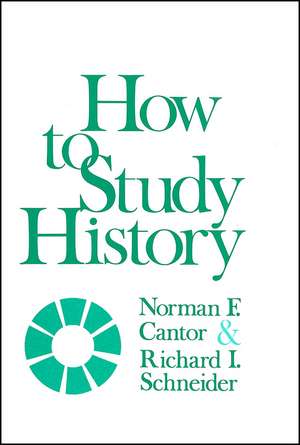
How to Study History
Autor Norman F. Cantoren Limba Engleză Paperback – 1967
We have no only set before the college student the standards of excellence one should strive to attain in historical study; we have attempted to show, step by step, how to reach these goals. We have presented the methods and principles that appear to have the widest consensus among academic historians, and we have sought to avoid extreme and idiosyncratic opinions.
Preț: 214.98 lei
Puncte Express: 322
Carte tipărită la comandă
Livrare economică 21 octombrie-04 noiembrie
Livrare prin curier în România Termenul estimat este afișat lângă disponibilitate.
Transport gratuit de la 400.00 lei Plată online sau ramburs, în funcție de opțiunile comenzii.
Retur gratuit în 14 zile Comandă securizată și suport în română.
Specificații
ISBN-13: 9780882957098
ISBN-10: 0882957090
Pagini: 288
Dimensiuni: 140 x 216 x 16 mm
Greutate: 0.37 kg
Editura: Wiley
Locul publicării:Hoboken, United States
ISBN-10: 0882957090
Pagini: 288
Dimensiuni: 140 x 216 x 16 mm
Greutate: 0.37 kg
Editura: Wiley
Locul publicării:Hoboken, United States
V-ar putea interesa
-
 -21%Preț: 193.35 lei245.95 lei
 -
 Idaho's PlaceAdam M SowardsPreț: 230.27 lei
 -
 Canadian History For Dummies 2eW FergusonPreț: 139.07 lei
 -
 Independence LostKathleen DuvalPreț: 119.15 lei
 -
 Preț: 442.26 lei
 -
 MississippiWestley F. BusbeePreț: 304.46 lei
 -
 The IncasTerence N. D'AltroyPreț: 288.76 lei
 -
 Preț: 298.15 lei
 -
 Preț: 366.90 lei
 -
 Once in a Great CityDavid MaranissPreț: 117.70 lei
 -
 Preț: 285.61 lei
 -
 Living the Ancient SouthwestDavid Grant NoblePreț: 172.95 lei
Notă biografică
Norman Frank Cantor was a Canadian-American historian who specialized in the medieval period. Known for his accessible writing and engaging narrative style, Cantor's books were among the most widely read treatments of medieval history in English. Richard I Schneider is the author of How to Study History, published by Wiley.
Cuprins
1. A Commitment to Excellence 1
Why Study History? 1
Prerequisites for Studying History 7
2. A Matter of Definition 17
3. The Materials of History 22
4. How to Use Primary Sources 39
Basic Rules and Considerations 39
A Practical Exercise in the Explication of Primary Sources 47
5. How to Read Secondary Sources 92
6. A Practical Lesson in How to Read a History Book 106
7. Excursus on Auxiliary Disciplines 130
For Students in Survey Courses: How to Use a Textbook and Take Lecture Notes 130
For Potential and Beginning History Majors: Planning an Undergraduate History Program 135
For History Majors and Potential Graduate Students: Ancillary Materials and Disciplines 139
8. Forms of Historical Communication 148
Examinations 149
Book Reviews 161
Papers and Essays 165
9. Shaping and Historical Essay 169
Creative Historical Thinking 169
The Nature of Historical Proof 176
10. Research Techniques 181
How to Use the Library 181
Research Note-Taking 196
11. Historical Prose 204
The Qualities of Style 204
Problems in Expository Writing 211
12. Two Student Papers Critically Examined 230
13. Historiography and the Philosophy of History 242
Historiography as a Formal Subject 242
Main Trends and Problems in the Philosophy of History 253
Index 263
Why Study History? 1
Prerequisites for Studying History 7
2. A Matter of Definition 17
3. The Materials of History 22
4. How to Use Primary Sources 39
Basic Rules and Considerations 39
A Practical Exercise in the Explication of Primary Sources 47
5. How to Read Secondary Sources 92
6. A Practical Lesson in How to Read a History Book 106
7. Excursus on Auxiliary Disciplines 130
For Students in Survey Courses: How to Use a Textbook and Take Lecture Notes 130
For Potential and Beginning History Majors: Planning an Undergraduate History Program 135
For History Majors and Potential Graduate Students: Ancillary Materials and Disciplines 139
8. Forms of Historical Communication 148
Examinations 149
Book Reviews 161
Papers and Essays 165
9. Shaping and Historical Essay 169
Creative Historical Thinking 169
The Nature of Historical Proof 176
10. Research Techniques 181
How to Use the Library 181
Research Note-Taking 196
11. Historical Prose 204
The Qualities of Style 204
Problems in Expository Writing 211
12. Two Student Papers Critically Examined 230
13. Historiography and the Philosophy of History 242
Historiography as a Formal Subject 242
Main Trends and Problems in the Philosophy of History 253
Index 263