
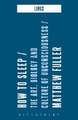
How to Sleep: The Art, Biology and Culture of Unconsciousness: Lines
Autor Matthew Fulleren Limba Engleză Hardback – 25 ian 2018
Arguing through examples drawn from contemporary, modern and renaissance art; from literature; film and computational media, and bringing these into relation with the history and findings of sleep science, this book argues for a new interplay between biology and culture. Meditations on sex, exhaustion, drugs, hormones and scientific instruments all play their part in this wide-ranging exposition of sleep as an ecology of interacting processes.
How to Sleep builds on the interlocking of theory, experience and experiment so that the text itself is a lively articulation of bodies, organs and the aesthetic systems that interact with them. This book won't enhance your sleeping skills, but will give you something surprising to think about whilst being ostensibly awake.
Preț: 580.33 lei
Preț vechi: 674.80 lei
-14%
Puncte Express: 870
Carte tipărită la comandă
Livrare economică 16-30 noiembrie
Livrare prin curier în România Termenul estimat este afișat lângă disponibilitate.
Transport gratuit pentru acest produs Plată online sau ramburs, în funcție de opțiunile comenzii.
Retur gratuit în 14 zile Comandă securizată și suport în română.
Specificații
ISBN-13: 9781474288712
ISBN-10: 1474288715
Pagini: 240
Dimensiuni: 138 x 216 mm
Greutate: 0.37 kg
Ediția:HPOD
Editura: Bloomsbury Publishing
Colecția Bloomsbury Academic
Seria Lines
Locul publicării:London, United Kingdom
ISBN-10: 1474288715
Pagini: 240
Dimensiuni: 138 x 216 mm
Greutate: 0.37 kg
Ediția:HPOD
Editura: Bloomsbury Publishing
Colecția Bloomsbury Academic
Seria Lines
Locul publicării:London, United Kingdom
Cuprins
preface
acknowledgements
1. How to Sleep
2. Without Thinking
3. Dormant
4. I Don't Want to be Awake
5. The Domestic Architecture of the Skull
6. Heroes of Sleep
7. Too Much Dream
8. Mediating
8. Sleep Acts
9. Repulsive Sleep
10. Ingredients of Sleep
11. Sleep Gltiches
12. Body Parts
13. Be Unconscious
14. The Luxuriance of Dissolving
15. Free-Running
16. Sleep in Love
17. Vulnerable
18. Hyperpassivity
19. The Eye Busy Unseeing
20. How to Thrive Biologically
21. Repetition
22. Architecture
23. Laws Governing Sleep
24. Film Sleep
25. Man Controls the Day.But We Will Control the Night
26. Headless Brim
27. Trains and Buses
28. The Smell of Sleep
29. The Child's Bed
30. Brain as Labourer
31. Melnikov's Promethean Sleepers
32. Sleep on the Road
33. Terraforming
34. Dozy-looking
35. Nocturne
36. Waking Up
37. Equipment
38. Sleep Upright In Order to Avoid Death
39. Animal Sleep
40. Wrap Up Warm
bibliography
index
acknowledgements
1. How to Sleep
2. Without Thinking
3. Dormant
4. I Don't Want to be Awake
5. The Domestic Architecture of the Skull
6. Heroes of Sleep
7. Too Much Dream
8. Mediating
8. Sleep Acts
9. Repulsive Sleep
10. Ingredients of Sleep
11. Sleep Gltiches
12. Body Parts
13. Be Unconscious
14. The Luxuriance of Dissolving
15. Free-Running
16. Sleep in Love
17. Vulnerable
18. Hyperpassivity
19. The Eye Busy Unseeing
20. How to Thrive Biologically
21. Repetition
22. Architecture
23. Laws Governing Sleep
24. Film Sleep
25. Man Controls the Day.But We Will Control the Night
26. Headless Brim
27. Trains and Buses
28. The Smell of Sleep
29. The Child's Bed
30. Brain as Labourer
31. Melnikov's Promethean Sleepers
32. Sleep on the Road
33. Terraforming
34. Dozy-looking
35. Nocturne
36. Waking Up
37. Equipment
38. Sleep Upright In Order to Avoid Death
39. Animal Sleep
40. Wrap Up Warm
bibliography
index
Recenzii
Matthew Fuller has composed a revelatory and brilliantly original book. This richly insightful and multifaceted work will be indispensable reading for anyone concerned with the increasingly urgent problem of sleep.
Where do you fall when you fall asleep? Out of consciousness and into a state of quasi-death, or into an unconscious form of activity? Do you withdraw from the world or get projected upon it differently? Who is the subject of sleep? Like love, sleep makes us creative and vulnerable at the same time. It is a democratic state, yet inaccessible to phenomenological accounts: it does not even make sense to state: "I am asleep", and yet sleep deprivation is torture.
Arguing passionately that sleep is both our posthuman, animal core and a form of power, this original volume performs a series of sleep acts, ranging from insomnia, apnea, narcolepsy, to sleep-walking, doziness, cataplexy and plain not wanting to wake up.
In a brilliant combination of aphorisms, meditations, snippets of self-help and shreds of critical analysis, the book explores the bio-politics of sleep, as well as its social, psychological and aesthetic aspects. This is Matthew Fuller at his best: witty, theoretically sharp and thoroughly enjoying his inimitable flair for paradoxes.
Where do you fall when you fall asleep? Out of consciousness and into a state of quasi-death, or into an unconscious form of activity? Do you withdraw from the world or get projected upon it differently? Who is the subject of sleep? Like love, sleep makes us creative and vulnerable at the same time. It is a democratic state, yet inaccessible to phenomenological accounts: it does not even make sense to state: "I am asleep", and yet sleep deprivation is torture.
Arguing passionately that sleep is both our posthuman, animal core and a form of power, this original volume performs a series of sleep acts, ranging from insomnia, apnea, narcolepsy, to sleep-walking, doziness, cataplexy and plain not wanting to wake up.
In a brilliant combination of aphorisms, meditations, snippets of self-help and shreds of critical analysis, the book explores the bio-politics of sleep, as well as its social, psychological and aesthetic aspects. This is Matthew Fuller at his best: witty, theoretically sharp and thoroughly enjoying his inimitable flair for paradoxes.