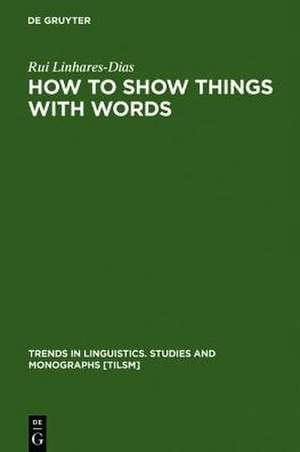
How to Show Things with Words: A Study on Logic, Language and Literature: Trends in Linguistics. Studies and Monographs [TiLSM], cartea 155
Autor Rui Linhares-Diasen Mixed media product – 31 dec 2005
Din seria Trends in Linguistics. Studies and Monographs [TiLSM]
- 23%
 Preț: 744.35 lei
 -
 Preț: 306.82 lei
 -
 Preț: 233.21 lei
 -
 Preț: 124.20 lei
 - 9%
 Preț: 1528.14 lei
 -
 Preț: 401.42 lei
 -
 Preț: 240.71 lei
 -
 Preț: 115.48 lei
 -
 Preț: 116.00 lei
 -
 Preț: 122.69 lei
 -
 Preț: 118.43 lei
 -
 Preț: 120.82 lei
 -
 Preț: 120.82 lei
 - 9%
 Preț: 762.76 lei
 -
 Preț: 222.56 lei
 -
 Preț: 224.01 lei
 -
 Preț: 137.85 lei
 -
 Preț: 138.14 lei
 -
 Preț: 146.06 lei
 - 23%
 Preț: 813.90 lei
 -
 Preț: 220.46 lei
 - 23%
 Preț: 731.51 lei
 - 27%
 Preț: 1244.25 lei
 - 27%
 Preț: 1596.91 lei
 - 27%
 Preț: 1560.18 lei
 - 27%
 Preț: 1395.35 lei
 - 27%
 Preț: 1384.75 lei
 - 27%
 Preț: 1524.46 lei
 - 27%
 Preț: 1560.18 lei
 - 27%
 Preț: 1384.75 lei
 - 27%
 Preț: 1384.75 lei
 - 27%
 Preț: 1505.24 lei
 - 27%
 Preț: 2104.08 lei
 - 27%
 Preț: 805.13 lei
 - 27%
 Preț: 1244.25 lei
 - 27%
 Preț: 1457.19 lei
 - 27%
 Preț: 1354.14 lei
 - 27%
 Preț: 1560.18 lei
 - 27%
 Preț: 1354.14 lei
 - 27%
 Preț: 1457.19 lei
 - 27%
 Preț: 1022.49 lei
Preț: 1244.25 lei
Preț vechi: 1704.46 lei
-27%
Puncte Express: 1866
Carte indisponibilă temporar
Doresc să fiu notificat când acest titlu va fi disponibil:
Se trimite...
Specificații
ISBN-13: 9783111799544
ISBN-10: 3111799549
Ilustrații: Includes a print version and an ebook
Ediția:
Editura: De Gruyter Mouton
Seria Trends in Linguistics. Studies and Monographs [TiLSM]
Locul publicării:Berlin/Boston
ISBN-10: 3111799549
Ilustrații: Includes a print version and an ebook
Ediția:
Editura: De Gruyter Mouton
Seria Trends in Linguistics. Studies and Monographs [TiLSM]
Locul publicării:Berlin/Boston
V-ar putea interesa
-
 Metaphor: A Practical IntroductionZoltan Kövescses-13%Preț: 279.01 lei318.89 lei
 -
 -20%Preț: 436.06 lei543.77 lei
 -
 Rhetoric: A Very Short IntroductionRichard Toye-20%Preț: 56.70 lei70.82 lei
 -
 The Code BookSimon SinghPreț: 117.88 lei
 -
 Toward a History of American LinguisticsE.F.K. KoernerPreț: 470.52 lei
 -
 On DialogueDavid BohmPreț: 230.67 lei
 -
 Multilingualism OnlineCarmen LeePreț: 404.47 lei
 -
 -25%Preț: 278.87 lei371.36 lei
 -
 Understanding SemanticsSebastian LöbnerPreț: 450.03 lei
 -
 Two Languages at WorkTara Goldstein-23%Preț: 1276.87 lei1658.26 lei
 -
 Lexicon and GrammarJoseph E. Emonds-23%Preț: 872.26 lei1132.81 lei
 -
 Discourse and the Continuity of ReferenceCornelia Zelinsky-Wibbelt-23%Preț: 1123.60 lei1459.22 lei
 -
 -23%Preț: 1434.76 lei1863.33 lei
 -
 -23%Preț: 1366.53 lei1774.71 lei
 -
 -23%Preț: 881.28 lei1144.53 lei
 -
 -23%Preț: 1066.01 lei1384.43 lei
 -
 La competenza scrittoria medialeBarbara Hans-Bianchi-23%Preț: 888.10 lei1153.38 lei
 -
 Deutsch-französische Übersetzungsübungen für das GrundstudiumCatherine RampfPreț: 143.92 lei
Notă biografică
Rui Linhares-Dias, Universidade dos Açores,Ponta Delgada, Azores Archipelago, Portugal.
Cuprins
AD>
Chapter 2 Linguistics in Narratology. A critical historical survey 1. Introduction 2. Ingarden, Stanzel, Hamburger: the neutralization of the 'episches Präteritum' as a past tense 3. Müller: quantitative indicators and beyond 4. Weinrich's textlinguistic theory: a tense-centered approach to backgrounded narrative discourse 5. Uspensky: synchronic and retrospective viewpoints as a function of both tense and aspect oppositions 6. Barthes: the semiotics of 'l'effet de réel' 7. Chatman, Prince, Toolan: 'Aktionsart' revisited 8. Caenepeel: perspectivally situated vs. perspectivally non-situated sentences
Chapter 3 The narrating instance as locutionary subjectivity 1. Introduction 2. Speech-act theory and narrative discourse 3. The philosophical research on linguistic functions 4. The phenomenological make-up of the narrating instance as locutionary subjectivity 5. Locutionary subjectivity as a(n) (indexical) function of tense, aspect and 'Aktionsart'
Chapter 4 Tense 1. Introduction 2. Reichenbach's theory of tense 3. Tense in narrative discourse 4. Tense, perception and memory
Chapter 5 Aspect 1. Introduction 2. Classificatory systems of aspectual oppositions 3. Viewpoint aspect and point of view: a first view on the role played by imperfective meaning 4. Imperfectivity as a two-edged aspectual form or another view on viewpoint aspect and point of view 5. A note on iterativity
Chapter 6 "Aktionsart" 1. Introduction 2. Vendler's aspectual classes 3. Formal semantic approaches to 'Aktionsart'
Chapter 7 The effect of "Aktionsart" on narrative transmission 1. Introduction 2. - STAT eventuality descriptions 3. + STAT eventuality discriptions 4. World-knowledge based event semantics
Chapter 2 Linguistics in Narratology. A critical historical survey 1. Introduction 2. Ingarden, Stanzel, Hamburger: the neutralization of the 'episches Präteritum' as a past tense 3. Müller: quantitative indicators and beyond 4. Weinrich's textlinguistic theory: a tense-centered approach to backgrounded narrative discourse 5. Uspensky: synchronic and retrospective viewpoints as a function of both tense and aspect oppositions 6. Barthes: the semiotics of 'l'effet de réel' 7. Chatman, Prince, Toolan: 'Aktionsart' revisited 8. Caenepeel: perspectivally situated vs. perspectivally non-situated sentences
Chapter 3 The narrating instance as locutionary subjectivity 1. Introduction 2. Speech-act theory and narrative discourse 3. The philosophical research on linguistic functions 4. The phenomenological make-up of the narrating instance as locutionary subjectivity 5. Locutionary subjectivity as a(n) (indexical) function of tense, aspect and 'Aktionsart'
Chapter 4 Tense 1. Introduction 2. Reichenbach's theory of tense 3. Tense in narrative discourse 4. Tense, perception and memory
Chapter 5 Aspect 1. Introduction 2. Classificatory systems of aspectual oppositions 3. Viewpoint aspect and point of view: a first view on the role played by imperfective meaning 4. Imperfectivity as a two-edged aspectual form or another view on viewpoint aspect and point of view 5. A note on iterativity
Chapter 6 "Aktionsart" 1. Introduction 2. Vendler's aspectual classes 3. Formal semantic approaches to 'Aktionsart'
Chapter 7 The effect of "Aktionsart" on narrative transmission 1. Introduction 2. - STAT eventuality descriptions 3. + STAT eventuality discriptions 4. World-knowledge based event semantics