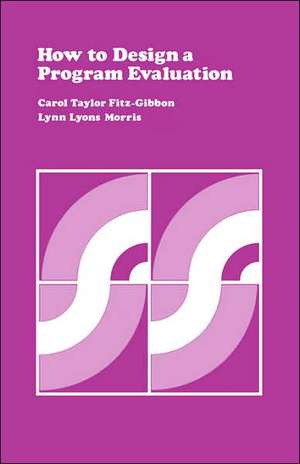
How to Design a Program Evaluation Volume 3
Autor Carol Taylor Fitz-Gibbon, Lynn Lyons Morrisen Limba Engleză Paperback – dec 1987
Preț: 438.95 lei
Preț vechi: 516.42 lei
-15%
Puncte Express: 658
Carte tipărită la comandă
Livrare economică 02-16 decembrie
Livrare prin curier în România Termenul estimat este afișat lângă disponibilitate.
Transport gratuit pentru acest produs Plată online sau ramburs, în funcție de opțiunile comenzii.
Retur gratuit în 14 zile Comandă securizată și suport în română.
Specificații
ISBN-13: 9780803931282
ISBN-10: 080393128X
Pagini: 172
Dimensiuni: 140 x 216 x 10 mm
Greutate: 0.23 kg
Ediția:2. Auflage
Editura: Sage Publications, Inc
Locul publicării:Thousand Oaks, United States
ISBN-10: 080393128X
Pagini: 172
Dimensiuni: 140 x 216 x 10 mm
Greutate: 0.23 kg
Ediția:2. Auflage
Editura: Sage Publications, Inc
Locul publicării:Thousand Oaks, United States
V-ar putea interesa
-
 Health, Prevention and EconomicsDavid R. Cohen-23%Preț: 319.10 lei412.41 lei
 -
 Public Procurement Reforms in Africa: Challenges in Institutions and GovernanceChristine Léon de Mariz-31%Preț: 787.86 lei1145.69 lei
 -
 -31%Preț: 806.27 lei1170.40 lei
 -
 The Economic ConstitutionTony Prosser-31%Preț: 900.54 lei1309.02 lei
 -
 -12%Preț: 292.14 lei332.25 lei
 -
 Governance Challenges and Innovations: Financial and Fiscal GovernanceHelmut K. Anheier-31%Preț: 826.04 lei1191.14 lei
 -
 Bank Behaviour and ResilienceC. Bakir-15%Preț: 665.66 lei783.13 lei
 -
 EndgameJohn MauldinPreț: 103.24 lei
 -
 Doing More with LessB. MarrPreț: 344.07 lei
 -
 Preț: 84.69 lei
 -
 The European Debt Crisis: A PrimerRobert GodbyPreț: 138.65 lei
 -
 Congressional Appropriations Process: Elements & ConsiderationsJerremy F Ellis-27%Preț: 1001.22 lei1363.55 lei
 -
 Local MoneyJohn RogersPreț: 139.25 lei
 -
 Federal Finance in IndiaGhazala AzizPreț: 272.16 lei
Cuprins
An Introduction to Evaluation Design
The Elements of Design
Designs - An Overview
Designs 1, 2 and 3
The Control Group Designs
Designs 4 and 5
The Time Series Designs
Design 6
The Before-and-After Design
A More Complex Design
Analysis of Variance (ANOVA)
How to Randomize
The Elements of Design
Designs - An Overview
Designs 1, 2 and 3
The Control Group Designs
Designs 4 and 5
The Time Series Designs
Design 6
The Before-and-After Design
A More Complex Design
Analysis of Variance (ANOVA)
How to Randomize
Notă biografică
Carol Fitz-Gibbon initiated the A-Level Information System in 1983 and was Director of the Curriculum, Evaluation and Management Centre from 1989-2003 and Professor of Education at Durham from 1996-2003. She has a continuing interest in cross-age tutoring and Reforms as Experiments in an active retirement.
Descriere
Education, business and human service settings are included in this revised edition of How to Design a Program Evaluation. Additional examples in these fields makes this volume more relevant to a wider audience in comparison with the first edition.
Through the use of diagrams, step-by-step directions, flow charts, and extensive examples, the book shows how a variety of design options can be conceived and implemented. Focusing on quantitative designs, it shows what to do when things go wrong and presents detailed methods for collecting, analyzing, and presenting data for each design.
Through the use of diagrams, step-by-step directions, flow charts, and extensive examples, the book shows how a variety of design options can be conceived and implemented. Focusing on quantitative designs, it shows what to do when things go wrong and presents detailed methods for collecting, analyzing, and presenting data for each design.