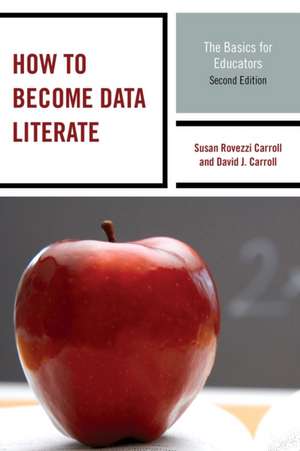
How to Become Data Literate: The Basics for Educators
Autor Susan Rovezzi Carroll, David J. Carrollen Limba Engleză Paperback – 6 mar 2015
Preț: 216.14 lei
Preț vechi: 291.95 lei
-26%
Puncte Express: 324
Carte tipărită la comandă
Livrare economică 07-21 decembrie
Livrare prin curier în România Termenul estimat este afișat lângă disponibilitate.
Transport gratuit de la 400.00 lei Plată online sau ramburs, în funcție de opțiunile comenzii.
Retur gratuit în 14 zile Comandă securizată și suport în română.
Specificații
ISBN-13: 9781475813326
ISBN-10: 1475813325
Pagini: 132
Dimensiuni: 154 x 229 x 11 mm
Greutate: 0.21 kg
Ediția:2 Rev ed.
Editura: Bloomsbury Publishing
Colecția Rowman & Littlefield
Locul publicării:New York, United States
ISBN-10: 1475813325
Pagini: 132
Dimensiuni: 154 x 229 x 11 mm
Greutate: 0.21 kg
Ediția:2 Rev ed.
Editura: Bloomsbury Publishing
Colecția Rowman & Littlefield
Locul publicării:New York, United States
V-ar putea interesa
-
 -27%Preț: 197.06 lei268.71 lei
 -
 -8%Preț: 444.64 lei483.31 lei
 -
 Teaching Languages to Young LearnersLynne Cameron-8%Preț: 384.73 lei418.18 lei
 -
 Understanding Art: A Guide for TeachersMartin W Wenham-8%Preț: 422.27 lei458.99 lei
 -
 Life SkillsSandra McTavishPreț: 219.68 lei
 -
 Getting the Buggers to Add Up 2nd EditionMike Ollerton-42%Preț: 97.45 lei167.79 lei
 -
 Developing Thinking in AlgebraJohn Mason-15%Preț: 603.10 lei709.52 lei
 -
 Exciting Writing: Activities for 5 to 11 year oldsJacqueline HarrettPreț: 396.16 lei
 -
 Language and Literacy 3-7Jeni Riley-15%Preț: 554.52 lei652.38 lei
 -
 -15%Preț: 540.09 lei635.40 lei
 -
 Preț: 414.37 lei
 -
 Preț: 213.22 lei
 -
 Preț: 290.38 lei
 -
 Adapting and Extending Secondary Mathematics Activities: New Tasks FOr OldStephanie PrestagePreț: 321.22 lei
Cuprins
Introduction: The compelling case for data literacy
Chapter One: Speaking the language correctly
Chapter Two: Creating a snap shot of data with a picture
Chapter Three: Presenting a mountain of data with one number
Chapter Four: Understanding why range in your data is important
Chapter Five: Drawing a sample to represent a whole group
Chapter Six: Putting your assumptions to the test
Chapter Seven: T-tests: Examining differences between two groups
Chapter Eight: ANOVA: What if there are more than two groups?
Chapter Nine: Chi Square: Examining distributions for differences
Chapter Ten: Correlations: Detecting relationships
Chapter Eleven: Reporting your data clearly and strategically
Chapter One: Speaking the language correctly
Chapter Two: Creating a snap shot of data with a picture
Chapter Three: Presenting a mountain of data with one number
Chapter Four: Understanding why range in your data is important
Chapter Five: Drawing a sample to represent a whole group
Chapter Six: Putting your assumptions to the test
Chapter Seven: T-tests: Examining differences between two groups
Chapter Eight: ANOVA: What if there are more than two groups?
Chapter Nine: Chi Square: Examining distributions for differences
Chapter Ten: Correlations: Detecting relationships
Chapter Eleven: Reporting your data clearly and strategically
Recenzii
In How to Become Data Literate, Susan Rovezzi Carroll and David J. Carroll, affiliated with Words & Numbers Research, provide succinct yet comprehensive support for administrators wading through applied basic quantitative statistics as a tool for data analysis. In fewer than 150 pages, the authors offer instruction for managing, manipulating, visualizing and interpreting the findings of data analysis projects. . . .[T]he book provides support for administrators seeking to understand and use common statistical techniques. I plan to apply this text in the education courses I teach and will strongly recommend it to my doctoral students. But the text also should be considered by educational leaders looking for an introduction to or a refresher of quantitative statistics. If your work responsibilities include making sense of data and analyzing results from a practical, programmatic perspective, or if you need support for quantitative statistics courses that you might be taking, I suggest you consider this work.
Ultimately, the book is what the authors intended to write-an easy-to-read statistics primer for educators. This book will be a welcome alternative to textbooks among educators who worry that they do not have the time or ability to make sense of the methods behind 'data-driven decision making' (p. v). By explaining the gist of statistics and providing concrete examples applied to simple problems in schools and classrooms, the book provides an entry point for practitioners who need to negotiate debates about how to translate research into practice. For educators who want to become active users and producers of data, this book should be viewed as a springboard-not a user's manual- to becoming data literate. I will keep this book on my shelf, ready to share with those students who request a supplement 'written in English' to make sense of their textbook. The contrasts between this light read and our heavy textbook will allow me to raise important questions about what it means to understand data and use data in the service of improving education.
As educators, we are increasingly called upon to make decisions for our districts, schools, classrooms, and individual students based on sometimes overwhelming amounts of frequently misunderstood data. This book is a much-needed gem, describing in easily understandable, straightforward language, the reasons for, uses of, and techniques for developing, manipulating and interpreting this data, ranging from mean, median and mode to ANOVA, Chi Square, and multiple regression. The data literacy described in this book is quite different from a poorly understood statistics textbook that many teachers remember from their graduate or undergraduate courses. This is something that every teacher and administrator will want to turn to again and again, as they frame questions and search for reliable, significant, evidence-based answers to critical issues they face every day.
Ultimately, the book is what the authors intended to write-an easy-to-read statistics primer for educators. This book will be a welcome alternative to textbooks among educators who worry that they do not have the time or ability to make sense of the methods behind 'data-driven decision making' (p. v). By explaining the gist of statistics and providing concrete examples applied to simple problems in schools and classrooms, the book provides an entry point for practitioners who need to negotiate debates about how to translate research into practice. For educators who want to become active users and producers of data, this book should be viewed as a springboard-not a user's manual- to becoming data literate. I will keep this book on my shelf, ready to share with those students who request a supplement 'written in English' to make sense of their textbook. The contrasts between this light read and our heavy textbook will allow me to raise important questions about what it means to understand data and use data in the service of improving education.
As educators, we are increasingly called upon to make decisions for our districts, schools, classrooms, and individual students based on sometimes overwhelming amounts of frequently misunderstood data. This book is a much-needed gem, describing in easily understandable, straightforward language, the reasons for, uses of, and techniques for developing, manipulating and interpreting this data, ranging from mean, median and mode to ANOVA, Chi Square, and multiple regression. The data literacy described in this book is quite different from a poorly understood statistics textbook that many teachers remember from their graduate or undergraduate courses. This is something that every teacher and administrator will want to turn to again and again, as they frame questions and search for reliable, significant, evidence-based answers to critical issues they face every day.