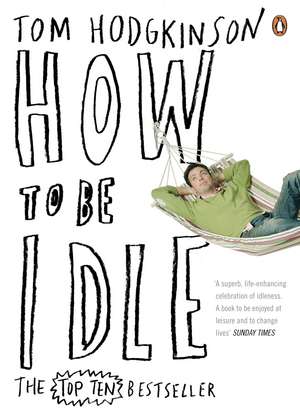
How to Be Idle
Autor Tom Hodgkinsonen Limba Engleză Paperback – 30 iun 2005
Imaginați-vă că vă treziți la ora unsprezece dimineața, fără vinovăție, savurând ideea că cele mai bune idei ale lui Oscar Wilde sau Nietzsche au apărut în timp ce aceștia refuzau să părăsească confortul patului. How to Be Idle nu este doar o pledoarie pentru lene, ci un ghid structurat cu precizie britanică: 24 de capitole care revendică fiecare oră a unei zile dominate, în mod normal, de dictatura agendei și a productivității forțate. Considerăm că Tom Hodgkinson reușește o performanță rară, transformând inactivitatea dintr-un viciu social într-o formă de artă rafinată. Recomandăm această lectură pentru modul în care autorul navighează între umor și filozofie practică. Spre deosebire de abordarea academică din Idleness – A Philosophical Essay de Brian O`connor, care analizează libertatea lenei la nivel conceptual, Tom Hodgkinson rămâne ancorat în realitatea imediată. Fanii lui Josh Cohen și ai volumului său Not Working vor recunoaște aceeași atenție la pericolele epuizării moderne, aplicată aici într-un context mult mai ludic și subversiv. Cartea se simte ca o extensie firească a manifestului său anterior, How to be Free, rafinând ideea că libertatea adevărată începe atunci când încetăm să mai măsurăm valoarea umană prin numărul de sarcini bifate. Stilul este unul relaxat, dar argumentat erudit, amintind de tradiția eseisticii engleze clasice. Este o lectură care nu vă cere să vă grăbiți, ci vă invită să „pierdeți timpul” în cel mai inteligent mod posibil, oferind un antidot necesar culturii noastre obsedate de activitate permanentă.
Preț: 64.75 lei
Preț vechi: 86.28 lei
-25%
Carte disponibilă
Livrare economică 12-18 noiembrie
Livrare express 23-29 octombrie pentru 42.58 lei
Specificații
ISBN-10: 0141015063
Pagini: 352
Dimensiuni: 130 x 177 x 27 mm
Greutate: 0.24 kg
Editura: Penguin Books
Colecția Penguin Classics
Locul publicării:London, United Kingdom
V-ar putea interesa
-
 The Sweetness of Doing NothingSophie MinchilliPreț: 93.36 lei
 -
 The Subtle Art of Not Giving a F*ck UKMark MansonPreț: 92.74 lei
 -
 The Book of Idle PleasuresDan Kieran-20%Preț: 97.84 lei121.58 lei
 -
 How to be FreeTom Hodgkinson-19%Preț: 64.17 lei79.02 lei
 -
 An Apology for IdlersRobert Louis Stevenson-21%Preț: 44.19 lei55.69 lei
 -
 Slow ProductivityCal Newport-19%Preț: 99.01 lei122.03 lei
 -
 -27%Preț: 66.73 lei91.65 lei
 -
 -26%Preț: 88.60 lei120.45 lei
 -
 MeditationsMarcus AureliusPreț: 34.00 lei
 -
 Twenty-Four Hours a DayANONYMOUSPreț: 105.65 lei
 -
 -35%Preț: 75.45 lei116.44 lei
 -
 Work Like A Monk: How to Connect, Lead and Grow in a Noisy WorldShoukei Matsumoto-11%Preț: 82.84 lei93.32 leiRecomandat
 -
 -28%Preț: 66.36 lei92.11 lei
 -
 -26%Preț: 59.01 lei79.46 lei
 -
 Idle ThoughtsTom HodgkinsonPreț: 63.64 lei
 -
 Not WorkingJosh CohenPreț: 77.88 lei
 -
 Preț: 111.06 lei
 -
 In Defence of LeisureAkshi SinghPreț: 121.15 lei
 -
 The French Art of Not Trying Too HardOllivier Pourriol-19%Preț: 63.43 lei78.55 lei
De ce să citești această carte
Pentru oricine se simte prins în mecanismul neobosit al muncii moderne, această carte oferă permisiunea de a încetini. Veți câștiga o perspectivă proaspătă asupra modului în care odihna și plăcerea pot alimenta creativitatea mai eficient decât stresul. Este recomandarea noastră pentru cei care vor să învețe arta de a nu face nimic, fără a renunța la curiozitatea intelectuală.
Despre autor
Tom Hodgkinson, născut în 1968, este un scriitor și editor britanic care și-a dedicat cariera explorării conceptelor de libertate și autonomie personală. În 1993 a fondat revista The Idler, o publicație dedicată celebrării timpului liber. Locuiește în Devon, unde continuă să scrie despre filosofia stilului de viață simplu. Opera sa include titluri de succes precum The Freedom Manifesto și The Idle Parent, lucrări care subminează convențiile societății axate pe consum și muncă excesivă, promovând în schimb o existență stoică și relaxată.
Notă biografică
Descriere scurtă
'Well written, funny and with a scholarly knowledge of the literature of laziness, it is both a book to be enjoyed at leisure and to change lives' Sunday Times
As Oscar Wilde said, doing nothing is hard work. A burn-out work ethic has most of us in its thrall, and the idlers of this world have the odds stacked against them. But here, at last, is a book that can help. Hodgkinson presents us with a laid-back argument for a new contract between routine and chaos, an argument for experiencing life to the full and living in the moment.
Ranging across a host of issues that affect the modern idler:
-Sleep
-Work
-Pleasure and hedonism
-Relationships
-Bohemian living
-Revolution
Drawing on the writings of such well-known apologists for idleness as Oscar Wilde, Robert Louis Stevenson and Nietzsche, his message is clear: take control of your life and reclaim your right to be idle.
Textul de pe ultima copertă
Recenzii
“There is, as usual, some effort involved in holding up the book and turning the pages. This time, hurrah -- it’s worth it!” — Giles Foden, author of Ladysmith and The Last King of Scotland
“Hodgkinson glories in reminding us that idleness has a long tradition. Indeed, I was so impressed by his chapter on the virtues of the nap, that one sunny lunchtime I headed for the park to fall asleep in the sun - which I did, feeling gloriously guiltless and assertive about it.” — The Guardian
” In this beguiling book, [Hodgkinson] persuasively advocates idleness as the way to gain access to the creativity of the subconscious mind, or at least to enjoy a few beers.” — The Spectator
“The beauty of How to Be Idle is that while Hodgkinson is perfectly serious about the benefits of loafing, he sets out his stall with a light touch. He wants us to live slow and die old, but to do it with elegance.” — Scotland on Sunday
“Charming, as all idlers should be.” — Kirkus Reviews
“Hodgkinson, a partisan in ‘the millennia-long battle between the materialists and the mystics,’ ...cares deeply enough for his subject to transcend its built-in cheekiness....In a rightly breezy style, Hodgkinson recommends stargazing, smoking, loafing in pubs, lying bed.” — East Bay Express
“You know you have uncovered a true literary gem when you annoy your family with an unceasing, unwanted, and uncontrollable laugh track while reading. In fact, the only thing I lamented about Tom Hodgkinson’s irresistable How to Be Idle is that the author waited so long to publish this — USA Today
“Great enjoyment . . . excellent jokes.” — New York Times Book Review
“Portraying history as an epic struggle between irritating go-getters and noble idlers, the book reads like a ramble through the centuries with a lanquid, likable companion who has scoured the world’s libraries to validate his obsession.” — St. Petersburg Times
“Tom Hodgkinson’s charming diversion on idleness is so persuasive that although I read it in June, it has taken me a month to return to the work ethic of my youth and review it. Filled with delightful anecdotes and quotes from famous and less known idlers -- some of whom produced a prodigious amount of work -- it is a joyful tribute to how we could live. ...[L]ovely, amusing...to be savoured, slowly.” — Providence Journal