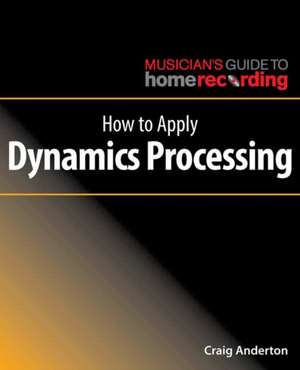
How to Apply Dynamics Processing: The Musician's Guide to Home Recording
Autor Craig Andertonen Limba Engleză Paperback – 30 mar 2019
Evoluția tehnologiei de înregistrare a democratizat accesul la unelte complexe, însă utilizarea corectă a procesării dinamicii rămâne una dintre cele mai mari provocări pentru producătorul modern. Descoperim aici că How to Apply Dynamics Processing nu este doar un manual tehnic, ci un ghid de bune practici care transformă procesarea dintr-o necesitate tehnică într-un instrument creativ. Notăm cu interes abordarea autorului Craig Anderton, care depășește explicațiile teoretice standard despre praguri și ratii, oferind soluții pentru obținerea unui sunet transparent sau, dimpotrivă, a acelei compresii „vintage” prin tehnici de „squashing”.
Structura volumului este una progresivă, pornind de la conceptele fundamentale ale decibelului în Capitolul 1 și avansând către utilizări sofisticate ale sidechaining-ului și de-essing-ului. Un element distinctiv îl reprezintă Capitolul 4, care tratează controlul dinamicii prin DSP și automatizare, abordând subiecte rar întâlnite în alte manuale, precum procesarea dinamicii prin date MIDI sau normalizarea manuală pentru narațiune. Această lucrare completează perspectiva oferită de Mixing Audio de Roey Izhaki, adăugând o explorare mult mai profundă a „micro-masterizării” și a modului în care poziția în lanțul de semnal influențează rezultatul final.
Poziționată în contextul operei sale, această carte rafinează temele abordate în The Musician's Guide to Audio, dar cu un accent mult mai punctual pe mixaj și mastering. Dacă în Electronic Projects for Musicians autorul se concentra pe construcția hardware-ului, aici accentul cade pe aplicarea acestuia în mediul hibrid de astăzi. Putem afirma că rigoarea tehnică este echilibrată de secțiunile „tech talk”, care explică nu doar „cum”, ci și „de ce” în spatele fiecărei decizii de procesare.



Preț: 182.73 lei
Preț vechi: 242.72 lei
-25%
Carte disponibilă
Livrare economică 05-19 noiembrie
Specificații
ISBN-10: 1540026906
Pagini: 112
Dimensiuni: 190 x 234 x 8 mm
Greutate: 0.3 kg
Editura: Bloomsbury Publishing
Colecția Hal Leonard
Seria The Musician's Guide to Home Recording
Locul publicării:New York, United States
De ce să citești această carte
Această carte este esențială pentru muzicienii și inginerii de sunet care doresc să stăpânească cel mai subtil, dar critic aspect al producției audio: dinamica. Cititorul câștigă acces la decenii de experiență practică a lui Craig Anderton, învățând cum să evite supra-compresia și cum să folosească sidechaining-ul sau procesarea multibandă pentru a obține un mixaj profesionist, fie că lucrează în format analog sau digital.
Despre autor
Craig Anderton este una dintre cele mai respectate autorități în domeniul audio profesional la nivel internațional. Cu o carieră ce se întinde din anii '60 până în prezent, a contribuit ca muzician, inginer sau producător la peste 20 de albume lansate la case de discuri majore. A cofondat prestigioasa revistă Electronic Musician și a publicat peste 35 de cărți de referință despre tehnologia muzicală. Experiența sa vastă, de la sesiuni de înregistrări în New York până la concerte pe scena Carnegie Hall și spectacole EDM moderne, îi conferă o perspectivă unică asupra intersecției dintre artă și tehnologie.
Descriere
Loaded with examples of real-world dynamics processors to explain their similarities and differences, How to Apply Dynamics Processing ventures further than similar books by covering dynamics processing with MIDI data, as well as "manual" dynamics processing done with recording software (phrase-by-phrase normalization for narration, "micro-mastering" to allow greater apparent volume when mastering, parallel dynamics, and more). There's also valuable information on how to achieve the most transparent effects possible, creative uses of sidechaining, and how to use creative "squashing" as an effect to obtain "vintage" compression sounds.
Chock full of illustrations and featuring selected "tech talk" sidebars to give details on specific topics for those who want to know "why" as well as "how " How to Apply Dynamics Processing tells everything today's musicians need to get the most out of these versatile processors.
Cuprins
Introduction. About This Book
Chapter 1. Dynamics Basics
The Beginning of Dynamics Control
The Decibel
Manual Gain-Riding
Level-Riding Plug-Ins
Common Dynamics Processor Parameters
Key Takeaways
Chapter 2. Dynamics Processing Devices
Limiter
Compressor
Multiband Compressor
Loudness Maximizer
Expander
Transient Shaper
Noise Gate
Dynamic Equalization
Key Takeaways
Chapter 3. Sidechaining and De-Essing
How to Access the Sidechain Input
Ways to Sidechain
Internal vs. External Sidechaining
De-Essing
Key Takeaways
Chapter 4. Dynamics Control with DSP
Normalization
Dynamics via Automation
Key Takeaways
Chapter 5. Dynamics Processor Applications
Processing on the Master Bus
Why You May Not Want to Compress the Master Bus When Mixing
Multiband Dynamics for Bass
Reduce Amp Sim Harshness with De-Essing
Dynamics Processing and Signal Chain Position
A Better Guitar Sustainer
Interfacing Electric Instruments with Studio Dynamics Processors
Transparent Compression
A One-Knob Compressor
Sidechain Applications
Key Takeaways
Appendix. The "Loudness Wars" and Measuring Dynamics
Measuring Dynamics
More Metering
Yes, Dynamics are Back