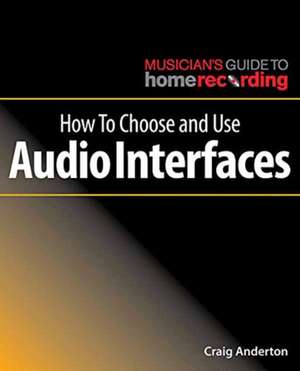
How to Choose and Use Audio Interfaces
Autor Craig Andertonen Limba Engleză Paperback – iul 2018
. The significance of different types of analog and digital connections and how you would use them
. Interconnection protocols (USB, FireWire, Thunderbolt, PCIe) for Windows and Mac computers
. Product options from portable, mobile units up to sophisticated mixers that can also serve as audio interfaces
. The special requirements involved in recording guitar
. The function of drivers and accessory programs (like software mixers for signal routing)
. Ways to minimize delays that occur when using audio interfaces with computers
. How and why to choose particular sample rates and resolutions
. The "high-resolution audio" controversy
. Microphone preamps
. Using multiple interfaces
. Expanding existing interfaces for more inputs
. Understanding specifications
. Various special features unique to particular interfaces, and more
Loaded with illustrations and featuring the judicious use of sidebars to give details on selected topics for those who want to know "why" as well as "how," How to Choose and Use Audio Interfaces is essential reading about one of the most important elements needed for a high-quality, computer-based home or project studio.
Preț: 137.00 lei
Preț vechi: 167.01 lei
-18%
Puncte Express: 206
Preț estimativ în valută:
24.22€ • 28.57$ • 21.15£
24.22€ • 28.57$ • 21.15£
Carte indisponibilă temporar
Doresc să fiu notificat când acest titlu va fi disponibil:
Se trimite...
Specificații
ISBN-13: 9781540024916
ISBN-10: 1540024911
Pagini: 80
Dimensiuni: 185 x 231 x 8 mm
Greutate: 0.26 kg
Editura: BLOOMSBURY ACADEMIC
Locul publicării:New York, United States
ISBN-10: 1540024911
Pagini: 80
Dimensiuni: 185 x 231 x 8 mm
Greutate: 0.26 kg
Editura: BLOOMSBURY ACADEMIC
Locul publicării:New York, United States
Cuprins
Acknowledgments
Introduction. About this Book
The Purpose of an Audio Interface
Tips and References
Chapter 1. Jacks and Connectors
Balanced and Unbalanced Lines .
Signal Level Categories
Connector Types .
Key Takeaways
Chapter 2. Audio Interface Types and Computer Connections
External Box
External Mixer with Audio Interface
External Gear with Built-In Audio Interface
DJ Controller with Built-In Audio Interface
Internal PCIe Card
Digital Connections for External Boxes
Interface Drivers
The Future
How to Choose Driver Settings
Key Takeaways
Chapter 3. Choosing Settings for Sample Rates and Bit Resolution
Sample Rates
The "High-Resolution" Sample Rate Controversy
Bit Resolution
Audio Interface Resolution vs. Recording Software Resolution .
Key Takeaways
Chapter 4. Choosing Settings for Latency (Computer-Based Audio Delays)
Latency Basics
Latency Specifications
How to Obtain the Lowest Possible Latency
Key Takeaways
Chapter 5. Digital Audio Connections
S/PDIF (Sony/Philips Digital Interface)
AES/EBU (Audio Engineering Society/European Broadcast Union)
ADAT (Alesis Digital Audio Tape) Optical Interface
MADI (Multichannel Audio Digital Interface)
MIDI (Musical Instrument Digital Interface)
Basic Clocking .
Word Clock
Networked Audio
Key Takeaways
Chapter 6. Microphone Preamps
Preamp Gain
Preamp Design Classes
Understanding Mic Preamp and Audio Interface Specifications
Key Takeaways
Chapter 7. Other Audio Interface Features
Input Level Metering
Onboard Effects
Universal Audio's Apollo Interfaces
Mic Preamp Low Cut and Phase Switches
Digital Mixer Capabilities
Software Applications
Remote Control Programs
Auto-Level
Digitally Controlled Mic Preamps
Portability
Bundled Software
IEC Cable vs. "Wall Wart"
Ground Post .
Ergonomics and Build Quality
Front Panel vs. Rear Panel Jacks
Key Takeaways
Chapter 8. Cascading/Aggregating Interfaces
Windows
Apple Mac
Expanding Interfaces via the ADAT Port
Interconnecting an Audio Interface and Expansion Unit
Key Takeaways
Appendix. Obtaining the Benefits of High Sample Rates in Lower Sample Rate Projects
Introduction. About this Book
The Purpose of an Audio Interface
Tips and References
Chapter 1. Jacks and Connectors
Balanced and Unbalanced Lines .
Signal Level Categories
Connector Types .
Key Takeaways
Chapter 2. Audio Interface Types and Computer Connections
External Box
External Mixer with Audio Interface
External Gear with Built-In Audio Interface
DJ Controller with Built-In Audio Interface
Internal PCIe Card
Digital Connections for External Boxes
Interface Drivers
The Future
How to Choose Driver Settings
Key Takeaways
Chapter 3. Choosing Settings for Sample Rates and Bit Resolution
Sample Rates
The "High-Resolution" Sample Rate Controversy
Bit Resolution
Audio Interface Resolution vs. Recording Software Resolution .
Key Takeaways
Chapter 4. Choosing Settings for Latency (Computer-Based Audio Delays)
Latency Basics
Latency Specifications
How to Obtain the Lowest Possible Latency
Key Takeaways
Chapter 5. Digital Audio Connections
S/PDIF (Sony/Philips Digital Interface)
AES/EBU (Audio Engineering Society/European Broadcast Union)
ADAT (Alesis Digital Audio Tape) Optical Interface
MADI (Multichannel Audio Digital Interface)
MIDI (Musical Instrument Digital Interface)
Basic Clocking .
Word Clock
Networked Audio
Key Takeaways
Chapter 6. Microphone Preamps
Preamp Gain
Preamp Design Classes
Understanding Mic Preamp and Audio Interface Specifications
Key Takeaways
Chapter 7. Other Audio Interface Features
Input Level Metering
Onboard Effects
Universal Audio's Apollo Interfaces
Mic Preamp Low Cut and Phase Switches
Digital Mixer Capabilities
Software Applications
Remote Control Programs
Auto-Level
Digitally Controlled Mic Preamps
Portability
Bundled Software
IEC Cable vs. "Wall Wart"
Ground Post .
Ergonomics and Build Quality
Front Panel vs. Rear Panel Jacks
Key Takeaways
Chapter 8. Cascading/Aggregating Interfaces
Windows
Apple Mac
Expanding Interfaces via the ADAT Port
Interconnecting an Audio Interface and Expansion Unit
Key Takeaways
Appendix. Obtaining the Benefits of High Sample Rates in Lower Sample Rate Projects