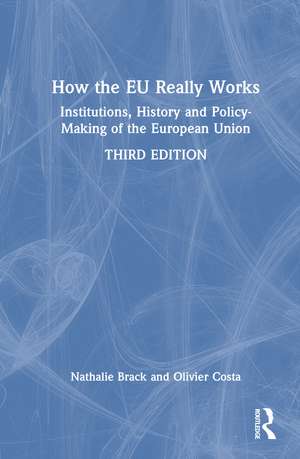
How the EU Really Works: Institutions, History, and Policy-Making of the European Union
Autor Nathalie Brack, Olivier Costaen Limba Engleză Hardback – 24 noi 2026
It helps students and scholars understand the EU’s evolution and organization, as well as its interactions with various global actors, presenting a highly readable analysis of how the EU works while recognizing the complexity of the European project.
Key features:
- Explores core questions of European integration such as democratic deficit, politicization, the role of member states, institutional crisis, and citizen involvement.
- Engages with fundamental and pressing issues in EU policy-making such as its evolutions, the EU’s legitimization, Brexit, Covid-19, the challenges of democratic backsliding, populism, and Euroscepticism, as well as the EU’s role in the world.
- Presents new in-text boxes focusing on major debates or evolutions such as the European Semester, and reflective end-of-chapter questions for further study.
Preț: 1356.93 lei
Preț vechi: 1654.79 lei
-18% Precomandă
Puncte Express: 2035
Carte nepublicată încă
Livrare prin curier în România Precomanda se expediază când titlul devine disponibil.
Transport gratuit pentru acest produs Plată online sau ramburs, în funcție de opțiunile comenzii.
Retur gratuit în 14 zile Comandă securizată și suport în română.
Doresc să fiu notificat când acest titlu va fi disponibil:
Se trimite...
Specificații
ISBN-13: 9781032517841
ISBN-10: 1032517840
Pagini: 486
Ilustrații: 24
Dimensiuni: 156 x 234 mm
Greutate: 0.85 kg
Ediția:3
Editura: Taylor & Francis
Colecția Routledge
Locul publicării:Oxford, United Kingdom
ISBN-10: 1032517840
Pagini: 486
Ilustrații: 24
Dimensiuni: 156 x 234 mm
Greutate: 0.85 kg
Ediția:3
Editura: Taylor & Francis
Colecția Routledge
Locul publicării:Oxford, United Kingdom
V-ar putea interesa
-
 Foundations of Natural Resources Policy and ManagementSusan Gail ClarkPreț: 386.00 lei
 -
 -15%Preț: 668.13 lei786.04 lei
 -
 -36%Preț: 61.93 lei97.38 lei
 -
 Audacious ReformsGrindlePreț: 225.06 lei
 -
 Preț: 247.56 lei
 -
 Rural Roots of Reform Before China's Conservative ChangeLynn T. White III-15%Preț: 428.10 lei503.65 lei
 -
 -18%Preț: 1115.51 lei1360.37 lei
 -
 Presidents, the Presidency, and the Political EnvironmentJohn H. Kessel-23%Preț: 447.82 lei581.58 lei
 -
 Preț: 121.78 lei
 -
 Canada DecentralizedMichael B DaviePreț: 96.81 lei
 -
 Preț: 407.29 lei
 -
 Introduction To The Law Of TreatiesPaul ReuterPreț: 463.28 lei
 -
 European Economic & Political Issues, Volume 2Frank Columbus-26%Preț: 543.76 lei733.21 lei
 -
 Congress & US China PolicyJian Yang-25%Preț: 495.90 lei658.65 lei
 -
 Politics & Economics of Africa, Volume 1Frank H Columbus-25%Preț: 491.64 lei655.88 lei
 -
 China's Regional Disparities: Issues & PoliciesVictor F S Sit-26%Preț: 680.99 lei920.11 lei
 -
 -26%Preț: 539.33 lei730.29 lei
 -
 -26%Preț: 543.15 lei732.80 lei
 -
 The Third HouseAlan Rosenthal-23%Preț: 617.89 lei802.45 lei
 -
 CQ's Desk Reference on American Criminal JusticePatricia G. Barnes-8%Preț: 487.35 lei529.73 lei
 -
 CQ's Desk Reference on the PresidencyBruce Wetterau-23%Preț: 457.59 lei594.27 lei
 -
 American Congressional Dictionary, 3D EditionWalter KravitzPreț: 353.14 lei
 -
 The Burden Of Confederate DiplomacyCHARLES M. HUBBARDPreț: 223.85 lei
 -
 Genocide in NigeriaKen Saro-WiwaPreț: 250.96 lei
Public țintă
Postgraduate and UndergraduateCuprins
Introduction 1. A political system forged by history 2. The main theoretical approaches in EU integration studies 3. Executive power 4. The legislative power 5. Oversight bodies 6. Other institutions, organs and actors in EU policy-making 7. Decision-making in the European Union 8. The foreign policy of the European Union 9. EU decision-making models 10. The EU decision-making process from a public policy network perspective. Conclusion
Notă biografică
Nathalie Brack is Professor of Political Science at CEVIPOL, Université libre de Bruxelles, Belgium.
Olivier Costa is Research Professor at the CNRS, CEVIPOF, Sciences Po, France.
Olivier Costa is Research Professor at the CNRS, CEVIPOF, Sciences Po, France.
Recenzii
“The new edition of this excellent textbook is timely and valuable. Against the background of a quickly shifting context, Brack and Costa manage to communicate the complexities of the European Union in an accessible, succinct yet encompassing manner. Highly recommended as the go-to textbook on all aspects of EU governance!”
Thomas Christiansen, Professor, Luiss University, Rome, Italy
“This impressive book tells it like is, with all the EU’s paradoxes eloquently described, along with the accomplishments and shortcomings of European integration, the challenges for democracy and legitimacy, and the many crises, not the least of which is the rise of populist Euroskepticism. A must read for anyone who wants to know how the EU really works.”
Vivien A. Schmidt, Jean Monnet Professor of European Integration, Boston University, USA
Thomas Christiansen, Professor, Luiss University, Rome, Italy
“This impressive book tells it like is, with all the EU’s paradoxes eloquently described, along with the accomplishments and shortcomings of European integration, the challenges for democracy and legitimacy, and the many crises, not the least of which is the rise of populist Euroskepticism. A must read for anyone who wants to know how the EU really works.”
Vivien A. Schmidt, Jean Monnet Professor of European Integration, Boston University, USA
Descriere
This fully updated textbook provides a concise yet comprehensive textbook on the EU’s polity and politics, offering an ideal balance between its history, institutions and decision-making processes, while drawing connections between these dimensions throughout.