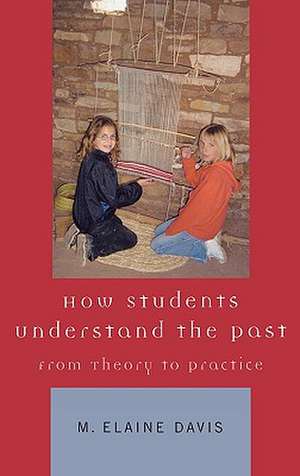
How Students Understand the Past: From Theory to Practice
Autor M. Elaine Davisen Limba Engleză Hardback – 7 mar 2005
Preț: 676.37 lei
Preț vechi: 1003.60 lei
-33%
Puncte Express: 1015
Carte tipărită la comandă
Livrare economică 23 noiembrie-07 decembrie
Livrare prin curier în România Termenul estimat este afișat lângă disponibilitate.
Transport gratuit pentru acest produs Plată online sau ramburs, în funcție de opțiunile comenzii.
Retur gratuit în 14 zile Comandă securizată și suport în română.
Specificații
ISBN-13: 9780759100428
ISBN-10: 075910042X
Pagini: 200
Dimensiuni: 154 x 235 x 18 mm
Greutate: 0.44 kg
Ediția:New.
Editura: Bloomsbury Publishing
Colecția AltaMira Press
Locul publicării:New York, United States
ISBN-10: 075910042X
Pagini: 200
Dimensiuni: 154 x 235 x 18 mm
Greutate: 0.44 kg
Ediția:New.
Editura: Bloomsbury Publishing
Colecția AltaMira Press
Locul publicării:New York, United States
V-ar putea interesa
-
 AQA A Level Sociology Student Book 1Dave AikenPreț: 262.20 lei
 -
 Leading for LiteracyRuth SchoenbachPreț: 218.33 lei
 -
 Loris Malaguzzi and the Reggio Emilia ExperienceProfessor Kathy Hall-16%Preț: 270.09 lei320.69 lei
 -
 A Creative Approach to Teaching GrammarPeter Burrows-42%Preț: 72.84 lei125.67 lei
 -
 -42%Preț: 75.08 lei129.13 lei
 -
 Jedes Kind ein KönnerHenning Kullak-UblickPreț: 139.14 lei
 -
 Communicating Science to the PublicLeo Tan Wee Hin-8%Preț: 592.33 lei643.83 lei
Cuprins
Part 1 Introduction
Part 2 Part I: Teaching and Learning History
Chapter 3 Chapter One: History Matters
Chapter 4 Chapter Two: Thinking Our Way into the Past
Part 5 Part II Constructing the Past: A Case Study from Southwestern Colorado
Chapter 6 Chapter Three: A Sense of Place
Chapter 7 Chapter Four: The Research Design and Project Parameters: Teachers, Students, and Curriculum
Chapter 8 Chapter Five: Pieces of the Past
Chapter 9 Chapter Six: Making Meaning of the Past
Part 10 Part III: Teaching A History That Matters
Chapter 11 Chapter Seven: Constructing Pedagogy: Applying Research to Practice
Chapter 12 Chapter Eight: History as a Dialogic Practice: Sharing Authority for Constructing the Past
Chapter 13 Chapter Nine: Understanding Understanding: Some Tools for Qualitative Inquiry
Part 14 Appendices
Chapter 15 Data List
Chapter 16 Interview Guide
Chapter 17 Student Questionnaire
Part 18 References
Part 19 Index
Part 20 About the Author
Part 2 Part I: Teaching and Learning History
Chapter 3 Chapter One: History Matters
Chapter 4 Chapter Two: Thinking Our Way into the Past
Part 5 Part II Constructing the Past: A Case Study from Southwestern Colorado
Chapter 6 Chapter Three: A Sense of Place
Chapter 7 Chapter Four: The Research Design and Project Parameters: Teachers, Students, and Curriculum
Chapter 8 Chapter Five: Pieces of the Past
Chapter 9 Chapter Six: Making Meaning of the Past
Part 10 Part III: Teaching A History That Matters
Chapter 11 Chapter Seven: Constructing Pedagogy: Applying Research to Practice
Chapter 12 Chapter Eight: History as a Dialogic Practice: Sharing Authority for Constructing the Past
Chapter 13 Chapter Nine: Understanding Understanding: Some Tools for Qualitative Inquiry
Part 14 Appendices
Chapter 15 Data List
Chapter 16 Interview Guide
Chapter 17 Student Questionnaire
Part 18 References
Part 19 Index
Part 20 About the Author
Recenzii
The creation and re-creation of history is fundamental to human beings-both individually and collectively. Elaine Davis reveals to us just how profound is the process of constructing history by bringing together contemporary theory and practice from the fields of history, archaeology, and education. More importantly, this significant book portrays a new and more enlightened way for us to teach 'history' in a variety of settings-a way that honors the student as the agent of his or her own historical reality.
Dr. Elaine Davis's book provides evidence of the need for a paradigm shift in the study of history and archaeology education. It should be read by anyone who is involved in the business of history-archaeologists, teachers, interpreters, museum educators, historians-as well as anyone else who considers him or herself a student of history.
Elaine Davis is a highly respected archaeology educator who understands both the worlds of educators and archaeologists. How Students Understand the Past: From Theory to Practice offers fascinating case studies of both research about learning and educational in-school and out-of school programs, all informed by contemporary learning theory, instructional methodology, and Dr. Davis' personal experiences. For Davis, history encompasses the entire human past that should be studied through oral traditions, archaeology, and written records, a perspective essential for integrating the teaching of archaeology and history. A 'must read' for teachers and teacher educators, for museum and heritage specialists, for archaeologists and historians, or anyone developing an educational program whose goal is the teaching and understanding of the past.
History is created by the people who interpret the past. How and why could it possibly be boring? To investigate, Dr. Davis examined how history is taught, how it is perceived by students, and how students learn. For those wishing to go beyond presenting history toward the goal of helping students discover the past, this volume is a must read.
Dr. Elaine Davis's book provides evidence of the need for a paradigm shift in the study of history and archaeology education. It should be read by anyone who is involved in the business of history-archaeologists, teachers, interpreters, museum educators, historians-as well as anyone else who considers him or herself a student of history.
Elaine Davis is a highly respected archaeology educator who understands both the worlds of educators and archaeologists. How Students Understand the Past: From Theory to Practice offers fascinating case studies of both research about learning and educational in-school and out-of school programs, all informed by contemporary learning theory, instructional methodology, and Dr. Davis' personal experiences. For Davis, history encompasses the entire human past that should be studied through oral traditions, archaeology, and written records, a perspective essential for integrating the teaching of archaeology and history. A 'must read' for teachers and teacher educators, for museum and heritage specialists, for archaeologists and historians, or anyone developing an educational program whose goal is the teaching and understanding of the past.
History is created by the people who interpret the past. How and why could it possibly be boring? To investigate, Dr. Davis examined how history is taught, how it is perceived by students, and how students learn. For those wishing to go beyond presenting history toward the goal of helping students discover the past, this volume is a must read.