
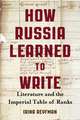
How Russia Learned to Write: Literature and the Imperial Table of Ranks: Publications of the Wisconsin Center for Pushkin Studies
Autor Irina Reyfmanen Limba Engleză Hardback – 23 aug 2016
In the eighteenth century, as modern forms of literature began to emerge in Russia, most of the writers producing it were members of the nobility. But their literary pursuits competed with strictly enforced obligations to imperial state service. Unique to Russia was the Table of Ranks, introduced by Emperor Peter the Great in 1722. Noblesse oblige was not just a lofty principle; aristocrats were expected to serve in the military, civil service, or the court, and their status among peers depended on advancement in ranks.
Irina Reyfman illuminates the surprisingly diverse effects of the Table of Ranks on writers, their work, and literary culture in Russia. From Sumarokov and Derzhavin in the eighteenth century through Pushkin, Gogol, Dostoevsky, and poets serving in the military in the nineteenth, state service affected the self-images of writers and the themes of their creative output. Reyfman also notes its effects on Russia’s atypical course in the professionalization and social status of literary work.
Irina Reyfman illuminates the surprisingly diverse effects of the Table of Ranks on writers, their work, and literary culture in Russia. From Sumarokov and Derzhavin in the eighteenth century through Pushkin, Gogol, Dostoevsky, and poets serving in the military in the nineteenth, state service affected the self-images of writers and the themes of their creative output. Reyfman also notes its effects on Russia’s atypical course in the professionalization and social status of literary work.
| Toate formatele și edițiile | Preț | Express |
|---|---|---|
| Paperback (1) | 169.46 lei 6-8 săpt. | |
| University of Wisconsin Press – 19 ian 2021 | 169.46 lei 6-8 săpt. | |
| Hardback (1) | 485.96 lei 6-8 săpt. | |
| University of Wisconsin Press – 23 aug 2016 | 485.96 lei 6-8 săpt. |




Preț: 485.96 lei
Puncte Express: 729
Preț estimativ în valută:
86.03€ • 100.09$ • 74.60£
86.03€ • 100.09$ • 74.60£
Carte tipărită la comandă
Livrare economică 28 februarie-14 martie
Preluare comenzi: 021 569.72.76
Specificații
ISBN-13: 9780299308308
ISBN-10: 0299308308
Pagini: 256
Dimensiuni: 152 x 229 x 20 mm
Greutate: 0.48 kg
Ediția:1
Editura: University of Wisconsin Press
Colecția University of Wisconsin Press
Seria Publications of the Wisconsin Center for Pushkin Studies
ISBN-10: 0299308308
Pagini: 256
Dimensiuni: 152 x 229 x 20 mm
Greutate: 0.48 kg
Ediția:1
Editura: University of Wisconsin Press
Colecția University of Wisconsin Press
Seria Publications of the Wisconsin Center for Pushkin Studies
V-ar putea interesa
-
 Samuel Johnson and Eighteenth-Century ThoughtNicholas Hudson-19%Preț: 144.82 lei179.30 lei
 -
 Popular Fiction before Richardson: Narrative Patterns 1700-1739John J. Richetti-19%Preț: 300.41 lei369.17 lei
 -
 -27%Preț: 391.09 lei538.98 lei
 -
 -14%Preț: 338.29 lei395.17 lei
 -
 -22%Preț: 344.37 lei441.67 lei
 -
 Samuel Johnson: The Arc of the PendulumFreya Johnston-34%Preț: 499.50 lei753.16 lei
 -
 Andrew Marvell, Orphan of the HurricaneDerek Hirst-28%Preț: 748.60 lei1039.80 lei
 -
 Young Milton: The Emerging Author, 1620-1642Edward Jones-34%Preț: 859.18 lei1297.30 lei
 -
 Subversion and Sympathy: Gender, Law, and the British NovelMartha C. Nussbaum-7%Preț: 632.79 lei678.84 lei
 -
 -7%Preț: 232.76 lei251.19 lei
 -
 The Rise of the NovelNicholas SeagerPreț: 183.36 lei
 -
 Preț: 287.53 lei
 -
 Preț: 215.47 lei
 -
 Shakespeare as Literary DramatistLukas ErnePreț: 368.43 lei
 -
 Acting Companies and their Plays in Shakespeare’s LondonDr. Siobhan Keenan-18%Preț: 198.00 lei241.52 lei
 -
 Macbeth: York Notes AS & A2 - for 2026, 2027 examsAlisdair MacraePreț: 60.93 lei
 -
 Preț: 60.41 lei
Recenzii
“Compelling, clever, and persuasive. Examining many Russian writers’ self-fashioning as members of the nobility and their careers in public service, Reyfman admirably shows that the understanding of rank should inflect all our arguments and histories of the writing profession in Russia.”—Luba Golburt, University of California, Berkeley
“Indispensable reading for all who study Russian literature of the Imperial period. Reyfman adds nuance and necessary reevaluation to our understanding of how literary careers and literary biography evolved in Russia in the eighteenth and nineteenth centuries.”—Andrew Kahn, University of Oxford
“Focuses on the neglected topic of how expectations about state service influenced the lives and works of eighteenth- and nineteenth-century writers. . . . Well worth reading for its numerous valuable insights and its fresh perspective on the creative process in Russia.”—Australian Slavonic and East European Studies
Notă biografică
Irina Reyfman is a professor of Russian literature at Columbia University. She is the author and editor of several books, including Rank and Style: Russians in State Service, Life, and Literature and Ritualized Violence Russian Style.
Cuprins
Acknowledgments
Note on Transliteration and Translation
Introduction: Russian Writers and State Service, 1750s–1850s
1 To Serve or to Write? Noble Writers in the Eighteenth and Early Nineteenth Centuries
2 Pushkin as Bureaucrat, Courtier, and Writer
3 Hierarchy of Ranks according to Gogol
4 Poets in the Military: Denis Davydov, Aleksandr Polezhaev, and Mikhail Lermontov
5 Service Ranks in Dostoevsky’s Life and Fiction
Conclusion: Beyond Rank
Appendix: The Table of Ranks
Notes
Index
Note on Transliteration and Translation
Introduction: Russian Writers and State Service, 1750s–1850s
1 To Serve or to Write? Noble Writers in the Eighteenth and Early Nineteenth Centuries
2 Pushkin as Bureaucrat, Courtier, and Writer
3 Hierarchy of Ranks according to Gogol
4 Poets in the Military: Denis Davydov, Aleksandr Polezhaev, and Mikhail Lermontov
5 Service Ranks in Dostoevsky’s Life and Fiction
Conclusion: Beyond Rank
Appendix: The Table of Ranks
Notes
Index
Descriere
How the status of Russian writers as members of the nobility, and their careers in service to the imperial state, shaped the course of Russian literature from Sumarokov and Derzhavin through Pushkin, Gogol, and Dostoevsky.