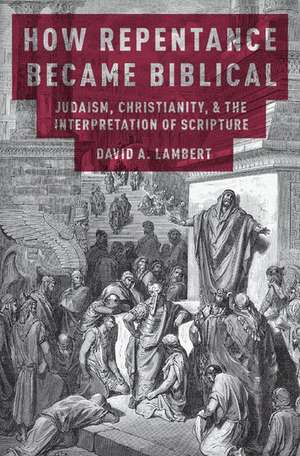
How Repentance Became Biblical: Judaism, Christianity, and the Interpretation of Scripture
Autor David A. Lamberten Limba Engleză Hardback – 7 ian 2016
Analiza lui David A. Lambert pornește de la o problemă fundamentală de exegeză: modul în care proiectăm concepte moderne de interioritate asupra unor texte antice care operau cu alte cadre de referință. Remarcăm modul în care autorul deconstruiește practicile interpretative prin care noțiunea de pocăință a fost „citită înapoi” în Biblia Ebraică, transformând ritualuri externe, precum postul sau rugăciunea, în simple manifestări ale unui zbucium sufletesc interior. Această perspectivă pune sub semnul întrebării continuitatea directă dintre etosul Israelului antic și formele de disciplină penitențială apărute ulterior în iudaism și creștinism.
Ceea ce distinge acest volum, publicat de Oxford University Press, este rigoarea cu care identifică perioada elenistică drept momentul de geneză al pocăinței ca mecanism de control subiectiv. Cititorii familiarizați cu Repentance in Late Antiquity de Alexis C. Torrance vor aprecia modul în care Lambert completează tabloul istoric, concentrându-se pe tranziția de la textele profetice la literatura celui de-al Doilea Templu. În timp ce alte studii analizează pocăința ca pe o doctrină deja stabilită, How Repentance Became Biblical investighează procesul de formare a acestei „lentile” interpretative care ne domină și astăzi cultura occidentală.
Structura narativă a studiului urmărește evoluția termenilor ebraici, cum este îndemnul profetic de a „te întoarce la YHWH”, demonstrând că sensul original viza mai degrabă o reorientare națională și pedagogică decât o transformare psihologică individuală. Este o lucrare esențială pentru înțelegerea modului în care autonomia și virtutea au devenit pilonii centrali ai religiozității moderne, oferind în schimb modele alternative de interpretare ancorate în contextul autentic al antichității.
Preț: 709.53 lei
Preț vechi: 1031.15 lei
-31%
Carte tipărită la comandă
Livrare economică 20-25 noiembrie
Specificații
ISBN-10: 0190212241
Pagini: 280
Dimensiuni: 155 x 239 x 23 mm
Greutate: 0.52 kg
Editura: Oxford University Press
Colecția OUP USA
Locul publicării:New York, United States
V-ar putea interesa
-
 -12%Preț: 253.11 lei288.96 lei
 -
 -28%Preț: 400.72 lei557.85 lei
 -
 -29%Preț: 500.08 lei702.96 lei
 -
 Variety and Unity in New Testament ThoughtJohn Reumann-19%Preț: 330.28 lei408.39 lei
 -
 Pauline ChristianityJ. A. Ziesler-29%Preț: 349.99 lei490.12 lei
 -
 Introducing the Old TestamentRichard Coggins-29%Preț: 389.44 lei545.82 lei
 -
 God, Justice, and Society: Aspects of Law and Legality in the BibleJonathan Burnside-31%Preț: 1113.01 lei1620.39 lei
 -
 The Bible CodeMichael Drosnin-28%Preț: 66.37 lei91.63 lei
 -
 Dictionary of the Old Testament: Historical BooksBill T Arnold-8%Preț: 459.57 lei499.53 lei
 -
 The Vision of His GloryAnne Graham LotzPreț: 122.02 lei
 -
 Finding of the Third EyeVera Stanley AlderPreț: 103.47 lei
 -
 PrayerHans Urs Von BalthasarPreț: 109.79 lei
 -
 The TorahRodney Mariner-27%Preț: 195.40 lei265.91 lei
De ce să citești această carte
Recomandăm această carte cercetătorilor și studenților la teologie sau istoria religiilor care doresc să înțeleagă rădăcinile reale ale conceptului de pocăință. Cititorul câștigă o perspectivă critică asupra modului în care tradițiile occidentale au reinterpretat Biblia Ebraică. Este un instrument valoros pentru cei care vor să depășească clișeele interpretative moderne și să descopere mecanismele de putere și control care au modelat spiritualitatea timpurie.
Despre autor
David A. Lambert este un cercetător respectat în domeniul studiilor biblice, recunoscut pentru abordările sale inovatoare care combină filologia cu analiza istorică și sociologică a religiei. Prin volumul de față, publicat la Oxford University Press, Lambert a obținut recunoașterea internațională, fiind laureat al prestigiosului premiu oferit de American Academy of Religion în 2016. Activitatea sa academică se concentrează pe reconstrucția contextelor antice de gândire, provocând adesea consensul tradițional prin demonstrații riguroase despre modul în care s-au format conceptele fundamentale ale iudaismului și creștinismului.
Descriere
Recenzii
He aptly charts the development of the concept of repentance as it came to prominence in Judaism and Christianity and explains how the penitential lens developed. This volume represents a significant contribution.
Notă biografică
Cuprins
- Preface
- Introduction: The Penitential Lens
- Part I - Rites
- 1. Fasting and the Artistry of Distress
- 2. The Logic of Appeal
- 3. Articulating Sin
- Part II - Language and Pedagogy
- 4. A Material (Re)turn to YHWH
- 5. Power and the Prophetic Utterance
- Part III - Religion
- 6. Agency and Redemption
- 7. The Genealogy of Repentance
- Postscript