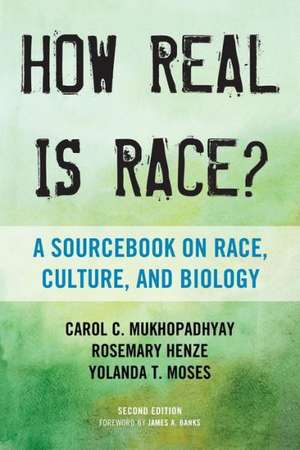
How Real Is Race?: A Sourcebook on Race, Culture, and Biology
Autor Carol C. Mukhopadhyay, Rosemary Henze, Yolanda T. Mosesen Limba Engleză Paperback – 11 dec 2013
The authors systematically cover the myth of race as biology and the reality of race as a cultural invention, drawing on biocultural and cross-cultural perspectives. They then extend the discussion to hot-button issues that arise in tandem with the concept of race, such as educational inequalities; slurs and racialized labels; and interracial relationships. In so doing, they shed light on the intricate, dynamic interplay among race, culture, and biology.
For an online supplement to How Real Is Race? Second Edition, click here.
Preț: 365.72 lei
Preț vechi: 492.48 lei
-26%
Puncte Express: 549
Carte tipărită la comandă
Livrare economică 23 noiembrie-07 decembrie
Livrare prin curier în România Termenul estimat este afișat lângă disponibilitate.
Transport gratuit de la 400.00 lei Plată online sau ramburs, în funcție de opțiunile comenzii.
Retur gratuit în 14 zile Comandă securizată și suport în română.
Specificații
ISBN-13: 9780759122734
ISBN-10: 0759122733
Pagini: 336
Ilustrații: 1 b/w illustration; 7 tables
Dimensiuni: 151 x 225 x 22 mm
Greutate: 0.49 kg
Ediția:2 Rev ed.
Editura: Bloomsbury Publishing
Colecția Rowman & Littlefield
Locul publicării:New York, United States
ISBN-10: 0759122733
Pagini: 336
Ilustrații: 1 b/w illustration; 7 tables
Dimensiuni: 151 x 225 x 22 mm
Greutate: 0.49 kg
Ediția:2 Rev ed.
Editura: Bloomsbury Publishing
Colecția Rowman & Littlefield
Locul publicării:New York, United States
V-ar putea interesa
-
 The Devil That Danced on the WaterAminatta FornaPreț: 92.49 lei
 -
 Country Of My SkullAntjie Krog-19%Preț: 76.61 lei94.05 lei
 -
 -21%Preț: 282.06 lei355.70 lei
 -
 -28%Preț: 346.93 lei482.89 lei
 -
 -31%Preț: 710.53 lei1030.88 lei
 -
 Understanding Social ExclusionJohn Hills-28%Preț: 392.55 lei547.65 lei
 -
 Language Rights and Political TheoryWill Kymlicka-28%Preț: 415.04 lei577.10 lei
 -
 Migration and Social Cohesion in the UKM. HickmanPreț: 401.84 lei
 -
 -15%Preț: 648.96 lei763.48 lei
 -
 Asian American DreamsHelen ZiaPreț: 101.11 lei
 -
 The Other Side of the RiverAlex KotlowitzPreț: 109.71 lei
 -
 Preț: 101.55 lei
 -
 Polite LiesKyoko MoriPreț: 111.85 lei
 -
 The Fire Next TimeJames BaldwinPreț: 83.49 lei
 -
 Democracy and Human Rights in Multicultural SocietiesPaul de Guchteneire-15%Preț: 522.67 lei614.90 lei
 -
 -44%Preț: 257.92 lei457.66 lei
Cuprins
Foreword by James A. Banks
Acknowledgments
Introduction
Part 1: The Fallacy of Race as Biology
Introduction to Part 1
1 Why Contemporary Races Are Not Scientifically Valid
2 Human Biological Variation: What We Don't See
3 If Not Race, How Do We Explain Biological Differences?
4 More Alike Than Different, More Different Than Alike
Part 2: Culture Creates Race
Introduction to Part 2
5 Culture Shapes How We Experience Reality
6 Culture and Classification: Race Is Culturally Real
7 Race and Inequality: Race as a Social Invention to Achieve Certain Goals
8 Cross-Cultural Overview of Race
9 If Race Doesn't Exist, What Are We Seeing? Sex, Mating, and Race
Part 3: Race and Hot-Button Issues in Schools
Introduction to Part 3
10 When is it racism? Who is a racist?
11 The Academic Achievement Gap and Equity
12 Assemblies, Clubs, Slurs, and Racial Labels
13 Interracial Flirting and Dating in Schools
Part 4: Resources
References
Key Websites (Annotated)
List of Activities
Index
About the Authors
Endorsements
Acknowledgments
Introduction
Part 1: The Fallacy of Race as Biology
Introduction to Part 1
1 Why Contemporary Races Are Not Scientifically Valid
2 Human Biological Variation: What We Don't See
3 If Not Race, How Do We Explain Biological Differences?
4 More Alike Than Different, More Different Than Alike
Part 2: Culture Creates Race
Introduction to Part 2
5 Culture Shapes How We Experience Reality
6 Culture and Classification: Race Is Culturally Real
7 Race and Inequality: Race as a Social Invention to Achieve Certain Goals
8 Cross-Cultural Overview of Race
9 If Race Doesn't Exist, What Are We Seeing? Sex, Mating, and Race
Part 3: Race and Hot-Button Issues in Schools
Introduction to Part 3
10 When is it racism? Who is a racist?
11 The Academic Achievement Gap and Equity
12 Assemblies, Clubs, Slurs, and Racial Labels
13 Interracial Flirting and Dating in Schools
Part 4: Resources
References
Key Websites (Annotated)
List of Activities
Index
About the Authors
Endorsements
Recenzii
This book offers educators at all levels a valuable biocultural perspective on race and diversity, and can serve as a resource to enhance curriculum and pedagogy. Distinguished by its biocultural approach integrating race-related research and scholarship from biological, cultural, linguistic, and archaeological perspectives, it is intended for educators at precollege and college levels, especially for teacher education courses, and can serve as a general sourcebook for cultural diversity workshops. It is also appropriate for any reader seeking a better understanding of the concept of race and human variation. New to this edition (1st ed., 2007) is a greater emphasis on how racial identities are dynamic, negotiated, and culturally defined. The book is organized in four sections. The first questions whether racial classification is biologically valid. The second explores the concept of race as a social construct, and the third uses everyday realities of school and college to explore the way racial ideologies operate in educational settings from both student and educator perspectives. The final section presents practical applications for educators, providing a list of references, website resources, and examples of suggested activities relating to topics covered in the book. Summing Up: Highly recommended. All levels/libraries.
Mukhopadhyay, Henze, and Moses' How Real is Race? A Sourcebook on Race, Culture, and Biology is a refreshing read on the significance of understanding race not as biology, but as a sociocultural construct that operates as power. The word 'refreshing' is apropos because it achieves what has been challenging for many of us educators: the writers painstakingly explain and show how race has been and continues to be constructed through culture. And they do it in clear language-a true feat considering the complexity of the topic and the fact that this is the first book to take up the project of a 'biocultural approach' to explaining the racial construct. . . .Best assigned to students beginning on their paths of social and cultural analysis, the text offers abundant opportunities for thought, reflection, and learning. . . . [The authors] provide educators with a clear, accessible, and essential resource for thinking about and instructing on race at the undergraduate and secondary school levels. No other book offers what How Real is Race does: a 'user-friendly' handbook for educators; a detailed and thorough examination of the relationships among race, culture, and biology, and an important contribution to the literature on race theory. Purposed as a 'sourcebook,' it is wise to consider it a practical text to guide instruction on the sociocultural construction of race, wherein race is theorized as a cultural creation that has emerged from biological explanations, but is not statically cultural or inherently biological.
Already in its second edition, How Real is Race?...is an important resource for the non-specialists interested in understanding the persistence and resilience of race within both science and daily encounters. At the same time, it is of value to specialists...who wish to compellingly engage broader audiences, while maintaining an appropriate level of scholarly sophistication. . . .[T]his book communicates an important message and an integrative approach to human life using sophisticated arguments and accessible language. It is a most appropriate book for its intended audiences and a significant contribution to contemporary discussions on race, racism, and social inequality.
This new edition of How Real Is Race appears at an important conjuncture in U.S. history. In 2008, Barack Obama was elected as the first black president and reelected for a second term in 2012, suggesting to some that racism has been eliminated. Yet the Southern Poverty Law Center reports that the incidence of racist violence is at an all-time high. Mukhopadhyay, Henze and Moses provide an in-depth discussion of race that allows the reader to understand this paradox. As they build their finely grained argument that race is not biologically real, but has been culturally constructed, they gently lead the reader through an analysis of human history and biology, kinship, social groups, language, stratification, classification and many other interesting topics. Their summary of key conceptual points and presentation of activities make this a most valuable teaching tool. No teacher should be without it!
How Real Is Race? explains race in a very accessible and commonsense way, and also draws on advanced knowledge from the social and biological sciences. Combining strong anti-racist commitments with deep respect for racial identity and difference, this book addresses such issues of 'colorblindness' and affirmative action with grace and clarity. It will be a valuable teaching tool across the disciplines. Highly recommended for college and high school classrooms, How Real Is Race is the real thing!
The second edition of How Real Is Race? is a godsend for people struggling to talk about race inside and outside of schools. It engages 'big ideas' about race and presents crucial facts clarifying classic confusions about biology andculture. The authors do a great service by summarizing the findings of countless studies into pithy and clear take-away points. When one's brain tires from endless engagements with racial 'worldviews' that are not based in facts, the sentences in this book are mental and verbal life preservers.
This much-welcome second edition will continue to be an essential resource on race and racism for educators and learners at secondary and postsecondary levels. Everyone, from novices to specialists, will find that key questions about what race is and what it means are addressed accurately, thoroughly, and sensitively in a readable style. The text combines exceptional clarity in explaining complex issues with an abundance of ideas and resources for learning activities. The book complements the AAA RACE exhibit and PBS productions such as 'Race: The Power of an Illusion.' I look forward to using-and assigning-this improved second edition in my courses.
An invaluable resource for educators who seek to make sense of the complex issues surrounding race and ethnicity in America today. For those who are afraid to touch the subject but understand that the issue is too important to ignore, this book provides useful insights on how to understand and respond to racial issues as they arise in the classroom and beyond.
Race is not a biological reality but it is a cultural reality, resulting in disparities in residence patterns, wealth distribution, health care, employment, the justice system, education, and many other aspects of our everyday lives. The authors of How Real Is Race? explain how this is possible, and how it makes a difference in the way we deal with racism in the United States. They offer readers an exceptional way to understand and deal with race-related issues, including racism, not from a reactive stance but rather in a proactive fashion.
Mukhopadhyay, Henze, and Moses' How Real is Race? A Sourcebook on Race, Culture, and Biology is a refreshing read on the significance of understanding race not as biology, but as a sociocultural construct that operates as power. The word 'refreshing' is apropos because it achieves what has been challenging for many of us educators: the writers painstakingly explain and show how race has been and continues to be constructed through culture. And they do it in clear language-a true feat considering the complexity of the topic and the fact that this is the first book to take up the project of a 'biocultural approach' to explaining the racial construct. . . .Best assigned to students beginning on their paths of social and cultural analysis, the text offers abundant opportunities for thought, reflection, and learning. . . . [The authors] provide educators with a clear, accessible, and essential resource for thinking about and instructing on race at the undergraduate and secondary school levels. No other book offers what How Real is Race does: a 'user-friendly' handbook for educators; a detailed and thorough examination of the relationships among race, culture, and biology, and an important contribution to the literature on race theory. Purposed as a 'sourcebook,' it is wise to consider it a practical text to guide instruction on the sociocultural construction of race, wherein race is theorized as a cultural creation that has emerged from biological explanations, but is not statically cultural or inherently biological.
Already in its second edition, How Real is Race?...is an important resource for the non-specialists interested in understanding the persistence and resilience of race within both science and daily encounters. At the same time, it is of value to specialists...who wish to compellingly engage broader audiences, while maintaining an appropriate level of scholarly sophistication. . . .[T]his book communicates an important message and an integrative approach to human life using sophisticated arguments and accessible language. It is a most appropriate book for its intended audiences and a significant contribution to contemporary discussions on race, racism, and social inequality.
This new edition of How Real Is Race appears at an important conjuncture in U.S. history. In 2008, Barack Obama was elected as the first black president and reelected for a second term in 2012, suggesting to some that racism has been eliminated. Yet the Southern Poverty Law Center reports that the incidence of racist violence is at an all-time high. Mukhopadhyay, Henze and Moses provide an in-depth discussion of race that allows the reader to understand this paradox. As they build their finely grained argument that race is not biologically real, but has been culturally constructed, they gently lead the reader through an analysis of human history and biology, kinship, social groups, language, stratification, classification and many other interesting topics. Their summary of key conceptual points and presentation of activities make this a most valuable teaching tool. No teacher should be without it!
How Real Is Race? explains race in a very accessible and commonsense way, and also draws on advanced knowledge from the social and biological sciences. Combining strong anti-racist commitments with deep respect for racial identity and difference, this book addresses such issues of 'colorblindness' and affirmative action with grace and clarity. It will be a valuable teaching tool across the disciplines. Highly recommended for college and high school classrooms, How Real Is Race is the real thing!
The second edition of How Real Is Race? is a godsend for people struggling to talk about race inside and outside of schools. It engages 'big ideas' about race and presents crucial facts clarifying classic confusions about biology andculture. The authors do a great service by summarizing the findings of countless studies into pithy and clear take-away points. When one's brain tires from endless engagements with racial 'worldviews' that are not based in facts, the sentences in this book are mental and verbal life preservers.
This much-welcome second edition will continue to be an essential resource on race and racism for educators and learners at secondary and postsecondary levels. Everyone, from novices to specialists, will find that key questions about what race is and what it means are addressed accurately, thoroughly, and sensitively in a readable style. The text combines exceptional clarity in explaining complex issues with an abundance of ideas and resources for learning activities. The book complements the AAA RACE exhibit and PBS productions such as 'Race: The Power of an Illusion.' I look forward to using-and assigning-this improved second edition in my courses.
An invaluable resource for educators who seek to make sense of the complex issues surrounding race and ethnicity in America today. For those who are afraid to touch the subject but understand that the issue is too important to ignore, this book provides useful insights on how to understand and respond to racial issues as they arise in the classroom and beyond.
Race is not a biological reality but it is a cultural reality, resulting in disparities in residence patterns, wealth distribution, health care, employment, the justice system, education, and many other aspects of our everyday lives. The authors of How Real Is Race? explain how this is possible, and how it makes a difference in the way we deal with racism in the United States. They offer readers an exceptional way to understand and deal with race-related issues, including racism, not from a reactive stance but rather in a proactive fashion.
Notă biografică
Carol C. Mukhopadhyay is professor emerita of anthropology at San José State University.