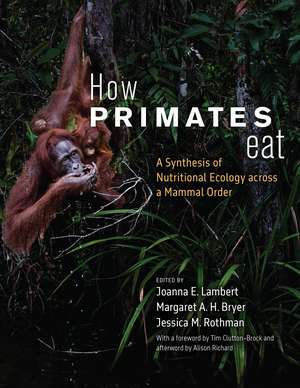
How Primates Eat: A Synthesis of Nutritional Ecology across a Mammal Order
Editat de Joanna E. Lambert, Margaret A. H. Bryer, Jessica M. Rothman Cuvânt înainte de T. H. Clutton-Brock Cuvânt după de Alison Richarden Limba Engleză Paperback – 30 iul 2024
Remarcăm în How Primates Eat o rigoare metodologică de excepție, volumul fiind conceput ca o sinteză exhaustivă ce depășește simpla observație comportamentală pentru a integra date complexe de fiziologie și biochimie. Structura materialului este organizată progresiv: începe cu bazele nutriționale (macro și micronutrienți), explorează „prima dietă” prin studiul laptelui matern și al energeticii reproducerii, și culminează cu analize despre modul în care primatele își folosesc simțurile pentru a naviga disponibilitatea sezonieră a hranei. Această abordare pe mai multe paliere — de la nivel molecular la cel ecosistemic — transformă lucrarea într-un instrument esențial pentru cercetarea contemporană.
Apreciem în mod deosebit modul în care editorii Joanna E. Lambert, Margaret A. H. Bryer și Jessica M. Rothman au reușit să coreleze datele de teren cu analizele de laborator. Cititorii familiarizați cu Feeding Ecology in Apes and Other Primates de Gottfried Hohmann vor aprecia modul în care acest volum nou extinde perspectiva evolutivă, adăugând straturi informaționale despre microbiom, hormoni și cerințele energetice specifice creierului și creșterii puilor. Dacă lucrările anterioare se concentrau adesea pe interacțiunile mediu-comportament, How Primates Eat aduce în prim-plan instrumente științifice de ultimă generație pentru a explica de ce anumite specii, precum gorilele de munte, au strategii alimentare radical diferite de cele ale cimpanzeilor, în ciuda proximității filogenetice.
Merită menționat că cele 29 de tabele și 128 de ilustrații nu sunt simple anexe, ci piloni ai argumentației, oferind date comparative între specii de pe tot globul. Este o resursă fundamentală pentru curriculumul de antropologie biologică și zoologie, oferind o bază solidă pentru discuțiile despre conservare într-o lume în continuă schimbare.
Preț: 467.05 lei
Preț vechi: 606.57 lei
-23%
Carte disponibilă
Livrare economică 09-23 noiembrie
Livrare express 24-30 octombrie pentru 86.40 lei
Specificații
ISBN-10: 0226829758
Pagini: 656
Ilustrații: 128 halftones, 29 tables
Dimensiuni: 216 x 279 x 46 mm
Greutate: 1.7 kg
Ediția:First Edition
Editura: University of Chicago Press
Colecția University of Chicago Press
De ce să citești această carte
Această lucrare este recomandată cercetătorilor și studenților la nivel postuniversitar care doresc o înțelegere holistică a ecologiei nutriționale. Dincolo de descrierea dietei, volumul explică mecanismele fiziologice și evolutive ale hrănirii. Cititorul câștigă acces la o bază de date vastă despre energetica primatelor, esențială pentru strategiile de conservare și pentru înțelegerea adaptărilor mamiferelor la medii fluctuante.
Despre autor
Volumul este coordonat de un colectiv de editori de elită în domeniul primatologiei. Joanna E. Lambert este profesor la University of Colorado Boulder, specializată în evoluția primatelor și ecologia nutrițională. Margaret A. H. Bryer și Jessica M. Rothman aduc expertiză suplimentară în ecologia hrănirii și antropologie biologică. Contribuția lor este girată de prefața semnată de T. H. Clutton-Brock, un nume de referință în biologia evoluționistă, și de un cuvânt de încheiere semnat de Alison Richard, subliniind autoritatea academică a acestui tratat publicat de University of Chicago Press.
Descriere scurtă
What do we mean when we say that a diet is nutritious? Why can some animals get all the energy they need from eating leaves while others would perish on such a diet? Why don’t mountain gorillas eat fruit all day as chimpanzees do? Answers to these questions about food and feeding are among the many tasty morsels that emerge from this authoritative book. Informed by the latest scientific tools and millions of hours of field and laboratory work on species across the primate order and around the globe, this volume is an exhaustive synthesis of our understanding of what, why, and how primates eat. State-of-the-art information presented at physiological, behavioral, ecological, and evolutionary scales will serve as a road map for graduate students, researchers, and practitioners as they work toward a holistic understanding of life as a primate and the urgent conservation consequences of diet and food availability in a changing world.
Notă biografică
Cuprins
T. H. Clutton-Brock
Preface
Joanna E. Lambert, Margaret A. H. Bryer, and Jessica M. Rothman
Introduction: From Diets to Disturbance: The Evolution of Primate Feeding Studies
David J. Chivers and Kim R. McConkey
Part I. Finding, Building, and Using a Diet
Chapter 1: The Role of Macro- and Micronutrients in Primate Food Choice
Annika Felton and Joanna E. Lambert
Chapter 2: What Extant Primates Eat: A Global Survey
Joseph E. Hawes, Carlos A. Peres, and Andrew C. Smith
Chapter 3: The First Diet: Mother’s Milk
Katie Hinde, Lauren A. Milligan, and Gregory E. Blomquist
Chapter 4: Diet and the Energetics of Reproduction
Melissa Emery Thompson
Chapter 5: Primate Energy Requirements: Brains, Babies, or Behavior?
Alexandra R. DeCasien, Mary H. Brown, Stephen R. Ross, and Herman Pontzer
Chapter 6: Primate Senses: Finding and Evaluating Food
Amanda D. Melin and Carrie C. Veilleux
Chapter 7: Seasonality in Food Availability and Energy Intake
Cheryl D. Knott and Andrea L. DiGiorgio
Part II. Nutrients, Nutrition, and Food Processing
Chapter 8: Enzymes and Microbes of the Mammalian Gut: Toward an Integrated Understanding of Digestion
Joanna E. Lambert, Richard Mutegeki, and Katherine R. Amato
Chapter 9: Secondary Compounds in Primate Foods: Time for New Approaches
Eleanor M. Stalenberg, Jörg U. Ganzhorn, and William J. Foley
Chapter 10: Hormonally Active Phytochemicals in Primate Diets: Prevalence across the Order
Michael Wasserman, Marie-Lyne Després-Einspenner, Richard Mutegeki, and Tessa Steiniche
Chapter 11: Nutrition and Immune Function in Primates
Erin R. Vogel, Astri Zulfa, Sri Suci Utami Atmoko, and Lyle L. Moldawer
Chapter 12: Nutrition and Primate Life History
Carola Borries and Andreas Koenig
Part III. Food Acquisition and Nutrition in Social Environments
Chapter 13: Social Food Competition, Then and Now
Charles H. Janson
Chapter 14: Applying a Framework of Social Nutrition to Primate Behavioral Ecology
Margaret A. H. Bryer and Moreen Uwimbabazi
Chapter 15: Primate Cognitive Ecology: Challenges and Solutions to Locating and Acquiring Resources in Social Foragers
Paul A. Garber
Chapter 16: Feeding-Related Tool Use in Primates: S Systematic Overview
Jill D. Pruetz, Landing Badji, Stephanie L. Bogart, Stacy M. Lindshield, Papa Ibnou Ndiaye, and Kristina R. Walkup
Chapter 17: Hunting by Primates
David Watts
Chapter 18: Movement Ecology and Feeding Neighborhoods
Margaret C. Crofoot and Shauhin E. Alavi
Chapter 19: Foraging in a Landscape of Fear
Russell Hill
Chapter 20: Behavioral Flexibility and Diet
A. J. Hardie and Karen B. Strier
Part IV. Methods, Practice, and Application
Chapter 21: Measuring Food in the Field
Eckhard W. Heymann
Chapter 22: Wild Plant Food Chemistry
Nancy Lou Conklin-Brittain
Chapter 23: Evaluating Primate Diets with Stable Isotopes
Matt Sponheimer and Brooke Crowley
Chapter 24: Mechanical Properties of Primate Foods
Adam van Casteren and Peter Lucas
Chapter 25: Modeling Primate Nutrition
David Raubenheimer
Chapter 26: Reconstructing Fossil Primate Diets: Dental-Dietary Adaptations and Foodprints for Thought
Peter S. Ungar
Chapter 27: Food and Primate Carrying Capacity
Andrew J. Marshall
Chapter 28: Climate Change and Primate Nutritional Ecology
Jessica M. Rothman, John B. Makombo, and Mitchell T. Irwin
Chapter 29: Primate Foraging Strategies Modulate Responses to Anthropogenic Change and Thus Primate Conservation
Colin A. Chapman, Kim Valenta, Fabiola Espinosa-Gómez, Amélie Corriveau, and Sarah Bortolamiol
Afterword
Alison Richard
Acknowledgments
Literature Cited
List of Contributors
Index