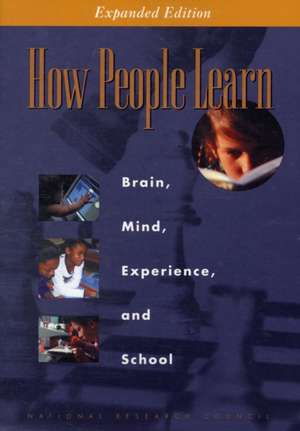
How People Learn: Informal Learning
Autor Cognitive Board on Behavioral, Committee on Developments in the Science of Learning with additional material from the Committee on, Division of Behavioral and Social Sciences and Education, National Research Councilen Limba Engleză Paperback – 11 aug 2000
Suntem de părere că How People Learn reprezintă un reper fundamental în psihologia educațională, fiind rezultatul unei colaborări extinse între comitetele de experți din cadrul National Research Council. Această lucrare nu este doar un volum teoretic, ci o sinteză riguroasă a cercetărilor din neuroștiințe, psihologie cognitivă și pedagogie, menită să fundamenteze practicile de predare pe baze științifice solide. Autoritatea instituțională a National Academies Press garantează o abordare imparțială și actualizată a mecanismelor prin care mintea umană procesează informația. Remarcăm faptul că această „Expanded edition” reușește să traducă perspectivele teoretice în acțiuni concrete pentru sala de clasă. Textul analizează fenomene fascinante, precum capacitatea creierului de a-și modifica structura fizică în urma învățării sau modul în care cunoștințele preexistente filtrează percepția noilor concepte. Un aspect distinctiv este analiza contrastantă între procesele de gândire ale experților și cele ale începătorilor, oferind profesorilor indicii vitale pentru structurarea curriculumului. În contextul operei autorului colectiv, volumul se aliniază rigurozității metodologice observate în A Framework for K-12 Science Education, unde accentul cade pe structurarea coerentă a cunoașterii. Totuși, spre deosebire de lucrările tehnice precum Nutrient Requirements of Swine, acest titlu are o aplicabilitate socială mult mai largă, vizând direct reforma sistemului educațional. Acoperă aceeași arie ca How Learning Happens, dar cu o abordare mai interdisciplinară, integrând date despre dezvoltarea timpurie a sugarilor și impactul mediului cultural, depășind simpla trecere în revistă a cercetătorilor clasici din educație. Este o resursă esențială pentru a înțelege nu doar ce învățăm, ci și cum evaluăm corect competențele dobândite.
Preț: 308.78 lei
Carte disponibilă
Livrare economică 16-30 noiembrie
Livrare express 30 octombrie-05 noiembrie pentru 66.62 lei
Specificații
ISBN-10: 0309070368
Pagini: 384
Ilustrații: index
Dimensiuni: 177 x 254 x 27 mm
Greutate: 0.82 kg
Ediția:Expanded Edition
Editura: National Academies Press
Colecția Informal Learning
Seria Informal Learning
V-ar putea interesa
-
 Preț: 194.92 lei
 -
 Angelo Mosso's Circulation of Blood in the Human BrainMarcus E. Raichle-30%Preț: 525.25 lei753.19 lei
 -
 An Introduction to NeuroendocrinologyMichael Wilkinson-11%Preț: 566.94 lei637.02 lei
 -
 The Neural Code of Pitch and HarmonyGerald D LangnerPreț: 443.67 lei
 -
 Looking Inside the Disordered BrainAhmad R. Hariri-27%Preț: 869.41 lei1190.97 lei
 -
 Melatonin: Therapeutic Value and NeuroprotectionVenkatramanujan Srinivasan-18%Preț: 1712.94 lei2088.95 lei
 -
 -27%Preț: 1388.11 lei1890.35 lei
 -
 A Student's Guide to Developmental PsychologyMargaret HarrisPreț: 418.27 lei
 -
 Neurodevelopmental Disorders: Research challenges and solutionsJo Van Herwegen-18%Preț: 1116.43 lei1361.49 lei
 -
 Neurodevelopmental Disorders: Research challenges and solutionsJo Van Herwegen-15%Preț: 440.74 lei518.51 lei
 -
 Atoms of MindW. R. Klemm-18%Preț: 923.41 lei1126.11 lei
De ce să citești această carte
Recomandăm această carte educatorilor și cercetătorilor care doresc să depășească metodele tradiționale de predare. Cititorul câștigă o înțelegere profundă a proceselor neuronale din spatele învățării și strategii practice pentru a crește eficiența la clasă. Este un instrument indispensabil pentru oricine dorește să fundamenteze actul pedagogic pe dovezi științifice, explorând de la neuroplasticitate până la rolul tehnologiei în școli.
Descriere
Descriere scurtă
Like the original edition, this book offers exciting new research about the mind and the brain that provides answers to a number of compelling questions. When do infants begin to learn? How do experts learn and how is this different from non-experts? What can teachers and schools do-with curricula, classroom settings, and teaching methods--to help children learn most effectively? New evidence from many branches of science has significantly added to our understanding of what it means to know, from the neural processes that occur during learning to the influence of culture on what people see and absorb.
How People Learn examines these findings and their implications for what we teach, how we teach it, and how we assess what our children learn. The book uses exemplary teaching to illustrate how approaches based on what we now know result in in-depth learning. This new knowledge calls into question concepts and practices firmly entrenched in our current education system.
Topics include: How learning actually changes the physical structure of the brain. How existing knowledge affects what people notice and how they learn. What the thought processes of experts tell us about how to teach. The amazing learning potential of infants. The relationship of classroom learning and everyday settings of community and workplace. Learning needs and opportunities for teachers. A realistic look at the role of technology in education.